Loading...
Prajadhipok vs Prince Albert II
Prajadhipok leads by 7.6 pts · 2 figures compared
…
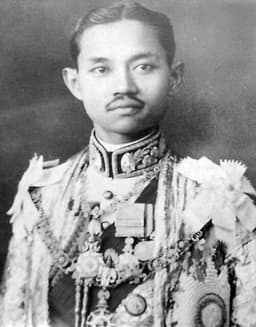
Prajadhipok
Emperor · Modern
50.0Total

Prince Albert II
Emperor · Modern
42.4Total
Basic Information
Born
1893
1958
Died
1941
—
Era
Modern
Modern
Nationality
Thailand
Monaco
Occupation
Emperor
Emperor
Civilization
Eastern
Western
Score Comparison
Military (10%)
53.8
45.8
Political (20%)
48.0
30.8
Influence (20%)
49.4
48.6
Legacy (20%)
40.0
35.0
Leadership (15%)
62.2
47.7
Strategy (15%)
57.2
51.0
TOTAL
50.0
42.4
Prajadhipok — Complete Timeline
1925 AD
Became the last absolute monarch of SiamPolitical Action◆ Major
Prajadhipok ascended the throne as King Rama VII, becoming the last absolute monarch of Siam. His reign began during economic difficulties and growing demands for constitutional reform.
CoronationAbsolute MonarchyEnd of Era
Impact: national
1932 AD
Granted a constitution after the 1932 revolutionPolitical Action◆ Major
Following a bloodless coup by the People's Party, Prajadhipok agreed to end absolute monarchy and granted a constitution. He became a constitutional monarch, retaining the throne but with limited powers.
Constitutional Monarchy1932 RevolutionReform
Impact: national
1935 AD
Abdicated the thronePolitical Action◆ Major
Prajadhipok abdicated the throne due to disagreements with the government over his powers and the treatment of royalists. He went into exile in England, where he died in 1941.
AbdicationExileEnd of Reign
Impact: nationaltragic
Prince Albert II — Complete Timeline
2002 AD
Constitutional reforms of 2002Reform◆ Major
Albert II, as regent for his ailing father, oversaw constitutional reforms in 2002 that strengthened the role of the National Council and limited the prince's powers. These reforms modernized Monaco's governance.
Constitutional ReformDemocratizationGovernance
Impact: nationalconstructive
2005 AD
Accession to the thronePolitical Action◆ Major
Prince Albert II became the Sovereign Prince of Monaco on April 6, 2005, following the death of his father, Prince Rainier III. His accession marked the continuation of the Grimaldi dynasty's rule over the principality.
AccessionSuccession
Impact: national
Recognition of two illegitimate childrenPolitical Action
Albert II formally recognized two illegitimate children, Jazmin Grace Grimaldi (born 1992) and Alexandre Grimaldi-Coste (born 2003), in 2005. This was a significant personal and legal step, though they are excluded from the line of succession.
PaternitySuccessionFamily
Impact: national
2006 AD
Environmental activism and polar expeditionsCultural◆ Major
Albert II has been a prominent environmental activist, leading expeditions to the North Pole (2006) and Antarctica (2009) to raise awareness about climate change. He founded the Prince Albert II of Monaco Foundation to support environmental projects.
EnvironmentalismClimate ChangeExpedition
Impact: globalconstructive
2011 AD
Marriage to Charlene WittstockCultural◆ Major
Albert II married South African Olympic swimmer Charlene Wittstock on July 1, 2011. The wedding was a major media event, but the marriage has been subject to persistent rumors of unhappiness and attempts to leave.
MarriageRoyal WeddingMedia Scrutiny
Impact: national
Expert Analysis
Origins
Prajadhipok (Rama VII) was born on November 8, 1893, in Bangkok, Siam, as the 32nd child of King Chulalongkorn (Rama V). He was educated at Eton College and the Royal Military Academy, Woolwich, and served in the British Army during World War I. His upbringing was steeped in absolute monarchy, but he was exposed to Western ideas. Prince Albert II was born on March 14, 1958, in Monaco, to Prince Rainier III and Princess Grace (Kelly). He studied at Amherst College and the University of Southampton, focusing on political science. His formative years were marked by Monaco's transformation from a gambling haven to a financial hub.
Rise to Power
Prajadhipok became king in 1925 after his brother King Vajiravudh died without a male heir. His reign began during economic strain from global depression and demands for reform. On June 24, 1932, the People's Party staged a bloodless coup, forcing him to grant a constitution on December 10, 1932. He became a constitutional monarch but struggled with reduced powers. Prince Albert II served as regent for his ailing father from 2005 and assumed the throne on April 6, 2005. His accession was smooth, but he faced challenges of modernizing Monaco while preserving its sovereignty.
Leadership & Governance
Prajadhipok governed as an absolute monarch for seven years, then as a constitutional monarch. He attempted fiscal reforms but was slow to address popular demands. His decision to accept the constitution avoided bloodshed but weakened his authority. He scored 48.0 in political leadership, reflecting his inability to navigate the transition. Prince Albert II governs as a constitutional prince with executive powers. He oversaw the 2002 constitutional reforms that strengthened the National Council and limited princely powers, scoring 30.8 in politics. His environmental initiatives, like the Polar expeditions (2006, 2009), scored 51.0 in strategy, but his leadership score is 47.7.
Triumph & Tragedy
Prajadhipok's greatest triumph was peacefully transitioning Siam to a constitutional monarchy, preventing civil war. His tragedy was his abdication in 1935 after disagreements with the government over royal powers and treatment of royalists. He died in exile in England in 1941, with a legacy score of 40.0. Prince Albert II's triumphs include modernizing Monaco's economy and championing climate change awareness. However, his marriage to Charlene Wittstock has been marred by rumors, and his recognition of two illegitimate children (Jazmin, born 1992; Alexandre, born 2003) caused scandal. His influence score is 48.6.
Character & Destiny
Prajadhipok was cautious and diplomatic, seeking compromise. His character led him to accept constitutional change but also to abdicate when he felt powerless. Historians view him as a tragic figure who lost his throne. Prince Albert II is pragmatic and environmentally conscious. His decisions to recognize paternity and pursue green initiatives reflect a desire to modernize. However, his personal controversies have dented his image. His total score is 42.4, lower than Prajadhipok's 50.0.
Legacy
Prajadhipok's legacy is as the last absolute monarch of Siam who paved the way for constitutional rule. His abdication set a precedent for royal restraint. Thailand's monarchy remains influential but constrained. Prince Albert II's legacy is still forming; he is known for environmental advocacy and stabilizing Monaco's economy. His score of 35.0 in legacy reflects ongoing assessment. Both men navigated modernity, but Prajadhipok's impact on Thai history is deeper.
Conclusion
Prajadhipok had greater historical impact. His transition from absolute to constitutional monarch shaped Thailand's political development, even as he lost power. Prince Albert II maintains a stable principality but has not faced existential threats. Prajadhipok's total score of 50.0 versus Albert's 42.4 underscores his greater significance. While Albert's environmental work is notable, Prajadhipok's role in a pivotal historical moment gives him a more profound legacy.
Rankings
🥇
PrajadhipokLeader
Mil: 53.8Pol: 48.0Inf: 49.4
50.0
🥈
Prince Albert II
Mil: 45.8Pol: 30.8Inf: 48.6
42.4
+7.6 behind
How This Comparison Works
Algorithm
Each figure is scored on 6 dimensions (0—100 scale) based on structured historical data: Military (10%), Political (20%), Influence (20%), Legacy (20%), Leadership (15%), Strategy (15%). The weighted total produces the final ranking.
Data Sources
Scores are computed from structured sub-indicators in the database. Scale factors adjust for era (Ancient ×0.85, Modern ×1.0) and civilization size (Eastern ×1.05, Other ×0.80) to account for differences in population and military scale.
Maximum 3 Figures
Comparisons are limited to 2—3 figures to ensure readability and statistical meaningfulness.
Error Margins
±5 points per dimension — Sub-scores are derived from historical records with inherent uncertainty. Two figures within 5 points on a dimension should be considered roughly equivalent in that area.
Total Score Accuracy
±3 points overall — The weighted combination of 6 dimensions produces a total score with approximately ±3 points of uncertainty. Differences of less than 3 points are not statistically significant— the figures are effectively tied.
Known Limitations
- Historical records are incomplete and uneven across civilizations
- Figures from oral-tradition societies may be underrepresented
- Occupation labels can misclassify multi-role figures
- Scores measure capability and impact, not moral character
- Quantitative scoring is a comparison tool, not absolute truth
Capability Radar
Military (10%) — Battles & Warfare
Battles
53
24
Win Rate
56
29
Expansion
59
31
Political (20%) — Governance & Reform
Reform
40
15
Diplomacy
30
25
Economy
20
20
Influence (20%) — Cultural & Global Reach
Cultural
20
15
Global
15
15
Legacy (20%) — Historical Impact
Historical
30
10
Longevity
20
10
Leadership (15%) — Power & Stability
Tenure
25
19
Stability
15
20
Strategy (15%) — Tactics & Innovation
Strategy
63
33
Tactics
65
37
Reform
69
37
Similar Comparisons
Comments & Discussion
No comments yet. Be the first to share your thoughts!