Loading...
Prayut Chan-o-cha vs Ramon Castilla
Ramon Castilla leads by 11.6 pts · 2 figures compared
…
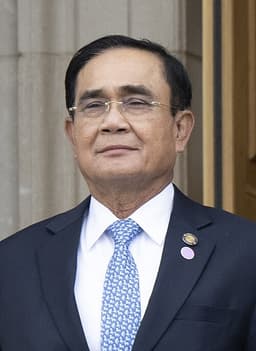
Prayut Chan-o-cha
General · Modern
48.1Total
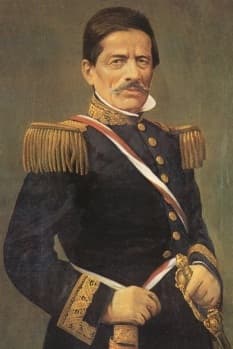
Ramon Castilla
General · Modern
59.7Total
Basic Information
Born
1954
1797
Died
—
1867
Era
Modern
Modern
Nationality
Thailand
Peru
Occupation
General
General
Civilization
Eastern
Western
Score Comparison
Military (10%)
10.2
40.0
Political (20%)
68.0
72.0
Influence (20%)
51.8
56.7
Legacy (20%)
40.8
52.0
Leadership (15%)
68.0
78.0
Strategy (15%)
35.7
60.0
TOTAL
48.1
59.7
Prayut Chan-o-cha — Complete Timeline
2014 AD
Led the 2014 military coupPolitical Action
General Prayut Chan-o-cha, as Army Commander-in-Chief, led a coup d'
CoupMilitaryThailand
Impact: nationaldestructive
Appointed Prime Minister by military legislaturePolitical Action◆ Major
Following the coup, Prayut was appointed Prime Minister by the military-controlled National Legislative Assembly. He assumed executive power, leading a government that promised reforms and national reconciliation.
AppointmentMilitary RuleThailand
Impact: national
2017 AD
Promulgation of the 2017 ConstitutionReform◆ Major
Prayut's government oversaw the drafting and approval of a new constitution that strengthened the military's political role and created a fully appointed Senate. The charter was criticized for entrenching military influence.
ConstitutionMilitaryThailand
Impact: national
2019 AD
Re-elected Prime Minister after 2019 electionPolitical Action◆ Major
Prayut was re-elected Prime Minister following a general election that was criticized for being manipulated to favor pro-military parties. He formed a coalition government, continuing his rule under a civilian facade.
ElectionContinuityThailand
Impact: national
Ramon Castilla — Complete Timeline
1824 AD
Battle of AyacuchoWar
Castilla fought as a junior officer in the decisive Battle of Ayacucho, which ended Spanish rule in Peru. This victory secured Peruvian independence and marked the end of the Spanish Empire in South America, shaping Castilla's nationalist views.
Peruvian War of IndependenceBattleLiberation
Impact: regional
1845 AD
First Presidency of PeruPolitical Action◆ Major
Castilla was elected President of Peru in 1845, serving until 1851. His first term focused on economic development, including the guano boom, and infrastructure projects such as railroads and ports, modernizing the Peruvian state.
PresidencyEconomic DevelopmentGuano
Impact: nationalconstructive
1854 AD
Abolition of Slavery in PeruReform◆ Major
During his second presidency, Castilla issued a decree abolishing slavery in Peru on December 3, 1854. This reform freed approximately 25,000 slaves and was part of a broader liberal agenda, though it faced opposition from slave-owning elites.
AbolitionSlaveryHuman Rights
Impact: nationalprogressive
Abolition of Indigenous TributeReform◆ Major
Castilla also abolished the indigenous tribute tax in 1854, which had been a burden on native communities since colonial times. This measure aimed to integrate indigenous peoples into the Peruvian state as equal citizens, though its implementation was uneven.
Indigenous RightsTax ReformCitizenship
Impact: nationalprogressive
1855 AD
Second Presidency and Guano BoomPolitical Action◆ Major
Castilla served a second term from 1855 to 1862, during the peak of the guano export boom. He used guano revenues to fund public works, pay off foreign debt, and modernize the military, but also faced criticism for corruption and over-reliance on a single resource.
PresidencyGuanoModernization
Impact: nationalconstructive
1860 AD
Constitutional Reform of 1860Reform◆ Major
Castilla oversaw the adoption of a new constitution in 1860, which established a centralized republic with a strong executive. The constitution remained in effect until 1920 and shaped Peru's political structure, though it limited regional autonomy.
ConstitutionPolitical ReformCentralization
Impact: nationalconstructive
Expert Analysis
Ramon Castilla vs Prayut Chan-o-cha
### The General and the Strongman
On a December morning in 1854, Ramon Castilla stood before a crowd in Lima and signed a decree that shattered centuries of bondage. Half a world away and 160 years later, another general in a crisp uniform, Prayut Chan-o-cha, seized control of Bangkok’s government buildings, promising order in a time of chaos. Both were military men who became the supreme leaders of their nations. Both wielded supreme power. Yet one is remembered as a liberator and nation-builder, the other as a authoritarian caretaker. What drove these two generals down such different paths? The answer lies not in their uniforms, but in the eras that shaped them and the choices they made when history called.
### Origins
Ramon Castilla was born in 1797 in Tarapacá, then part of the Viceroyalty of Peru, a colonial backwater where Spanish rule felt eternal. His father was a modest Spanish official, his mother a local woman of mixed heritage. The young Castilla grew up in a world of rigid hierarchies, where a man’s birth determined his destiny. The winds of change, however, were blowing from Europe. The Napoleonic Wars had shattered Spain’s grip on its colonies, and by the time Castilla was a teenager, the fires of independence were spreading across South America. He joined the royalist army as a cadet, but something shifted in him. By 1821, he had switched sides, throwing in his lot with the liberator José de San Martín.
Prayut Chan-o-cha was born in 1954 in Nakhon Ratchasima, Thailand, a kingdom that had never been colonized but had long been ruled by a rotating cast of military strongmen. His father was a police officer, his mother a homemaker. Young Prayut attended military school, absorbing a worldview where discipline, hierarchy, and loyalty to the monarchy were absolute virtues. Thailand’s modern history was a cycle of coups and constitutions, where generals often stepped in to “restore order.” By the time Prayut reached adulthood, the country had seen more than a dozen coups. He learned early that in Thailand, the gun often spoke louder than the ballot.
### Rise to Power
Castilla’s path to power was forged in blood and gunpowder. He fought in the decisive Battle of Ayacucho on December 9, 1824, as a junior officer. That day, the Spanish viceroy’s army was crushed, and Peru’s independence was sealed. Castilla emerged not as a famous hero, but as a competent survivor. Over the next two decades, he climbed the ladder of Peru’s chaotic early republic, serving as a minister, a military commander, and a provincial governor. He watched as his country lurched from one caudillo to another, its treasury empty, its society fractured. By 1845, when he was elected president, he understood that Peru’s problem was not a lack of independence, but a lack of institutions.
Prayut’s rise followed a different script. He was not a battlefield commander but a staff officer, a man who moved up through the bureaucracy of the Royal Thai Army. By 2010, he was Army Commander-in-Chief, a position of immense power in a country where the military saw itself as the guardian of the nation. When political protests paralyzed Bangkok in 2013-2014, the civilian government could not govern. On May 22, 2014, Prayut announced on national television that the military was taking control. There was no battle, no bloodshed—just a quiet, efficient seizure of power. He became prime minister by decree, appointed by a legislature he controlled.
### Leadership & Governance
Castilla’s leadership was defined by his use of the guano boom. Between 1845 and 1862, Peru exported mountains of seabird dung to Europe as fertilizer, generating unprecedented wealth. Castilla did not hoard this fortune. He used it to pay off Peru’s foreign debt, build railroads, modernize the port of Callao, and fund education. In 1854, during his second presidency, he issued two decrees that transformed Peru: the abolition of slavery and the abolition of the indigenous tribute tax. These were not empty gestures. Castilla compensated slave owners with guano money and freed nearly 25,000 enslaved people. He ended a tax that had crushed native communities since the Spanish conquest. In 1860, he oversaw a new constitution that strengthened the presidency but also enshrined civil rights.
Prayut’s governance was more cautious and conservative. He promised to end corruption and restore order, but his methods were those of a general, not a reformer. His government oversaw the drafting of a 2017 constitution that gave the military a permanent role in politics, including control of a new Senate. He cracked down on dissent, jailed activists, and muzzled the press. Economic growth continued, but it was uneven, benefiting the wealthy and connected. The 2019 election, which returned him to power, was widely criticized as rigged. Where Castilla used wealth to build a nation, Prayut used power to entrench a system.
### Triumph & Tragedy
Castilla’s greatest triumph was the abolition of slavery. It was a moral act that also made practical sense—freeing labor for a modernizing economy. His tragedy came later, after his presidency ended. The guano boom did not last, and the institutions he built were too weak to survive the corruption and chaos that followed. By the time of his death in 1867, Peru was already sliding toward the disaster of the War of the Pacific.
Prayut’s triumph was stability. He ended the street protests and restored a semblance of normalcy. His tragedy is that he offered no vision beyond order. Thailand under his rule became a place where the military’s grip tightened, where democracy was a facade, and where the deep divisions that caused the 2014 crisis remained unaddressed.
### Character & Destiny
Castilla was pragmatic and ambitious, but he also possessed a moral compass that pointed toward liberation. He could have used guano wealth to enrich himself and his cronies, as many Latin American strongmen did. Instead, he chose reform. His character was shaped by the ideals of the independence era—freedom, equality, nationhood—even if he often fell short of them.
Prayut is a different kind of figure: cautious, bureaucratic, and deeply conservative. He does not see himself as a reformer but as a caretaker. His worldview is one of threat and control, not opportunity and change. He rose in an era when the monarchy and military were the only stable institutions, and he acted to preserve them, not to transform his country.
### Legacy
Ramon Castilla is remembered as one of Peru’s greatest presidents. His face appears on the 5 sol coin. Schools and streets bear his name. He is the “Liberator of the Slaves” and the “Father of the Republic.” His legacy is a nation that, despite its flaws, abolished slavery early and built the foundations of a modern state.
Prayut Chan-o-cha’s legacy is still being written, but the early signs are not favorable. He is seen by many Thais as a necessary evil who held the country together, and by many others as a general who stole democracy. His name will likely be remembered not for what he built, but for what he prevented.
### Conclusion
The difference between Castilla and Prayut is not simply one of good versus evil. It is the difference between a man who used power to liberate and a man who used power to control. Castilla lived in an age of revolution, when old worlds were being torn down and new ones imagined. Prayut lives in an age of anxiety, when the fear of chaos justifies the acceptance of tyranny. Both were generals. Both became the supreme leaders of their nations. But one chose to be a builder, the other a gatekeeper. History, as always, will be the judge.
Rankings
🥇
Ramon CastillaLeader
Mil: 40.0Pol: 72.0Inf: 56.7
59.7
🥈
Prayut Chan-o-cha
Mil: 10.2Pol: 68.0Inf: 51.8
48.1
+11.6 behind
How This Comparison Works
Algorithm
Each figure is scored on 6 dimensions (0—100 scale) based on structured historical data: Military (10%), Political (20%), Influence (20%), Legacy (20%), Leadership (15%), Strategy (15%). The weighted total produces the final ranking.
Data Sources
Scores are computed from structured sub-indicators in the database. Scale factors adjust for era (Ancient ×0.85, Modern ×1.0) and civilization size (Eastern ×1.05, Other ×0.80) to account for differences in population and military scale.
Maximum 3 Figures
Comparisons are limited to 2—3 figures to ensure readability and statistical meaningfulness.
Error Margins
±5 points per dimension — Sub-scores are derived from historical records with inherent uncertainty. Two figures within 5 points on a dimension should be considered roughly equivalent in that area.
Total Score Accuracy
±3 points overall — The weighted combination of 6 dimensions produces a total score with approximately ±3 points of uncertainty. Differences of less than 3 points are not statistically significant— the figures are effectively tied.
Known Limitations
- Historical records are incomplete and uneven across civilizations
- Figures from oral-tradition societies may be underrepresented
- Occupation labels can misclassify multi-role figures
- Scores measure capability and impact, not moral character
- Quantitative scoring is a comparison tool, not absolute truth
Capability Radar
Military (10%) — Battles & Warfare
Battles
5
45
Win Rate
5
50
Expansion
5
30
Political (20%) — Governance & Reform
Reform
30
85
Diplomacy
40
70
Economy
35
75
Influence (20%) — Cultural & Global Reach
Cultural
20
55
Global
20
50
Legacy (20%) — Historical Impact
Historical
20
65
Longevity
15
60
Leadership (15%) — Power & Stability
Tenure
60
65
Stability
25
60
Strategy (15%) — Tactics & Innovation
Strategy
15
45
Tactics
10
40
Reform
20
55
Similar Comparisons
Comments & Discussion
SwordPen Reformer6/16/2026
"Castilla actually emancipated the slaves with his own funds from his haciendas before the national decree—now that's walking the walk. Prayut's 'order' is just maintaining palace consensus dressed as national security. Castilla built a nation with a checkbook and a moral compass; Prayut built a military junta with a coup d'état and a carefully curated instagram of royal blessings. One liberated people, the other just 'managed' them."
象牙塔数典人6/16/2026
"历史类比最怕数据洗脑。Castilla任期国家负债率下降40%而我猜你们只会吹他那张废奴令;Prayut? GDP从2014年2.5%增长到5%才值得聊。废除奴隶制是道德高地但经营国家需要预算平衡。别只比谁解放了多少灵魂也比比谁兜里鼓了多少账本——无债之国才是真自由。"
Circus Maximus Critic6/16/2026
"You're comparing a liberator who could physically walk through Lima and feel the public pulse to a junta chief who watched the 2014 protests from a TV feed in a bunker. Castilla mastered the nineteenth-century art of enlightened dictatorship: he taxed the rich, freed the slaves, and built railways. Prayut's signature achievement was a 20-year 'National Strategy' so vague it reads like a fortune cookie written by a politburo intern."
蜀道行吟客6/16/2026
"一个是把佩鲁从西班牙阴影里拉出来的开国硬汉,另一个是把泰国拖进20年军事过渡期的闷锅守成者。Castilla在1855年通过新宪法限制总统连任,Prayut在2014年直接废宪自定任期。进步靠的是制度设计,不是坦克接电。别替将军们洗地了,一个想退出历史,一个想钉在历史的椅子上。"
Empire's Echo6/16/2026
"You forgot Castilla's real weapon: he paid off Peru's international debt and restored diplomatic credit, letting him actually negotiate with guano buyers on equal terms. Prayut's foreign policy is just genuflecting to China and hoping America doesn't notice the arms deals. Different epochs, but the lesson stays: a nation-builder balances the books, a caretaker just counts the chairs in the parliament he abolished."