Loading...
This comparison has not been analyzed yet.
One-time AI generation (~1 minute). Scores and timeline are already available below.
Qin Er Shi vs Sun Liang
Sun Liang leads by 2.8 pts · 2 figures compared
…
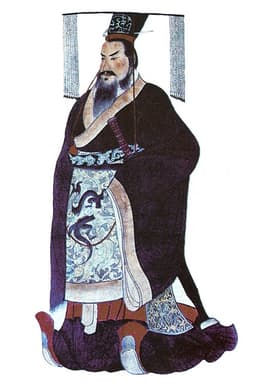
Qin Er Shi
Emperor · Ancient
44.1Total

Sun Liang
Emperor · Ancient
46.9Total
Basic Information
Born
-229
244
Died
-207
260
Era
Ancient
Ancient
Nationality
China
China
Occupation
Emperor
Emperor
Civilization
Eastern
Eastern
Score Comparison
Military (10%)
20.2
33.7
Political (20%)
68.0
68.0
Influence (20%)
42.4
47.9
Legacy (20%)
35.0
31.7
Leadership (15%)
43.6
49.9
Strategy (15%)
60.0
59.9
TOTAL
44.1
46.9
Qin Er Shi — Complete Timeline
210 BC
Accession as Second EmperorPolitical Action◆ Major
After Qin Shi Huang's death, Zhao Gao and Li Si forged a decree to force the crown prince Fusu to commit suicide and installed Huhai as Qin Er Shi. This illegitimate succession undermined the dynasty's legitimacy and placed an incompetent ruler on the throne.
SuccessionPalace IntrigueZhao Gao
Impact: nationaldestructive
209 BC
Outbreak of Dazexiang UprisingWar
Chen Sheng and Wu Guang led a rebellion of conscripted farmers at Dazexiang, sparking widespread revolts across the Qin empire. Qin Er Shi's harsh policies and heavy taxation had created widespread discontent, and the uprising quickly spread, leading to the dynasty's collapse.
RebellionQin CollapseChen Sheng
Impact: nationaldestructive
208 BC
Execution of Li SiPolitical Action◆ Major
Zhao Gao falsely accused Chancellor Li Si of treason. Qin Er Shi ordered Li Si's execution by the Five Pains method, along with his entire family. This removed the last capable administrator from the Qin court, accelerating the dynasty's decline.
ExecutionPolitical PurgeZhao Gao
Impact: nationaldestructive
207 BC
Death at the Hands of Zhao GaoPolitical Action◆ Major
Zhao Gao, fearing Qin Er Shi's anger over military defeats, staged a coup and forced the emperor to commit suicide. Zhao Gao then installed Ziying as the new king. This event marked the effective end of Qin rule, as Ziying surrendered to Liu Bang shortly after.
CoupDeathZhao Gao
Impact: nationaltragic
Sun Liang — Complete Timeline
252 AD
Ascended the Throne as Emperor of WuPolitical Action◆ Major
Sun Liang became emperor of Eastern Wu at age 8 after the death of his father Sun Quan. His reign was dominated by regents including Zhuge Ke and later Sun Chen.
Eastern WuSuccessionSun Quan
Impact: national
258 AD
Deposed by Sun ChenPolitical Action◆ Major
Sun Liang, emperor of Eastern Wu, was deposed by the regent Sun Chen after attempting to assert his authority. He was demoted to the rank of Prince of Kuaiji and placed under house arrest.
Eastern WuDepositionSun Chen
Impact: nationaltragic
260 AD
Death in ExilePolitical Action
Sun Liang died in exile at age 16, possibly murdered on the orders of Sun Xiu, who had succeeded him as emperor. His death ended any chance of restoration.
Eastern WuExileDeath
Impact: nationaltragic
This comparison has not been analyzed yet.
One-time AI generation (~1 minute). Scores and timeline are already available below.
Rankings
🥇
Sun LiangLeader
Mil: 33.7Pol: 68.0Inf: 47.9
46.9
🥈
Qin Er Shi
Mil: 20.2Pol: 68.0Inf: 42.4
44.1
+2.8 behind
How This Comparison Works
Algorithm
Each figure is scored on 6 dimensions (0—100 scale) based on structured historical data: Military (10%), Political (20%), Influence (20%), Legacy (20%), Leadership (15%), Strategy (15%). The weighted total produces the final ranking.
Data Sources
Scores are computed from structured sub-indicators in the database. Scale factors adjust for era (Ancient ×0.85, Modern ×1.0) and civilization size (Eastern ×1.05, Other ×0.80) to account for differences in population and military scale.
Maximum 3 Figures
Comparisons are limited to 2—3 figures to ensure readability and statistical meaningfulness.
Error Margins
±5 points per dimension — Sub-scores are derived from historical records with inherent uncertainty. Two figures within 5 points on a dimension should be considered roughly equivalent in that area.
Total Score Accuracy
±3 points overall — The weighted combination of 6 dimensions produces a total score with approximately ±3 points of uncertainty. Differences of less than 3 points are not statistically significant— the figures are effectively tied.
Known Limitations
- Historical records are incomplete and uneven across civilizations
- Figures from oral-tradition societies may be underrepresented
- Occupation labels can misclassify multi-role figures
- Scores measure capability and impact, not moral character
- Quantitative scoring is a comparison tool, not absolute truth
Capability Radar
Military (10%) — Battles & Warfare
Battles
33
33
Win Rate
37
34
Expansion
37
36
Political (20%) — Governance & Reform
Reform
0
0
Diplomacy
0
0
Economy
0
0
Influence (20%) — Cultural & Global Reach
Cultural
5
5
Global
5
0
Legacy (20%) — Historical Impact
Historical
15
5
Longevity
5
5
Leadership (15%) — Power & Stability
Tenure
3
10
Stability
0
5
Strategy (15%) — Tactics & Innovation
Strategy
41
44
Tactics
48
46
Reform
48
51
Similar Comparisons
Comments & Discussion
No comments yet. Be the first to share your thoughts!