Loading...
This comparison has not been analyzed yet.
One-time AI generation (~1 minute). Scores and timeline are already available below.
Queen Min vs Rene Saguisag
Rene Saguisag leads by 0.5 pts · 2 figures compared
…
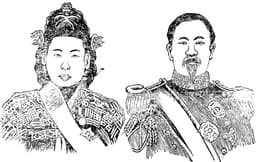
Queen Min
Politician · Modern
42.0Total

Rene Saguisag
Politician · Modern
42.5Total
Basic Information
Born
1851
1939
Died
1895
—
Era
Modern
Modern
Nationality
Korea
Philippines
Occupation
Politician
Politician
Civilization
Eastern
Eastern
Score Comparison
Military (10%)
12.1
17.0
Political (20%)
39.4
45.1
Influence (20%)
54.9
51.8
Legacy (20%)
47.5
44.2
Leadership (15%)
45.0
45.0
Strategy (15%)
25.4
33.1
TOTAL
42.0
42.5
Queen Min — Complete Timeline
1882 AD
Queen Min's role in the Imo IncidentPolitical Action◆ Major
During the Imo Incident, a mutiny by Korean soldiers against modernization efforts, Queen Min and King Gojong fled the palace. She later supported the suppression of the rebellion with Chinese military assistance, which reinforced Chinese influence in Korea and weakened the reformist faction.
Imo IncidentChinese InterventionReform
Impact: national
1895 AD
Assassination of Queen MinPolitical Action
Japanese agents, along with Korean collaborators, entered the Gyeongbokgung Palace and murdered Queen Min. The assassination was ordered by Miura Goro, the Japanese minister to Korea, due to her efforts to counter Japanese influence and seek Russian support. This event intensified Korean resistance to Japanese imperialism.
AssassinationJapanese ImperialismKorean Resistance
Impact: nationaltragic
Queen Min's diplomatic overtures to RussiaPolitical Action◆ Major
Queen Min sought to strengthen ties with the Russian Empire to counterbalance Japan's growing influence in Korea. She encouraged King Gojong to adopt a pro-Russian policy, which led to increased tensions with Japan and ultimately contributed to the decision to assassinate her.
DiplomacyRussian InfluenceKorean Independence
Impact: regional
Rene Saguisag — Complete Timeline
1986 AD
Appointed Presidential Assistant on Human RightsPolitical Action
President Corazon Aquino appointed Saguisag as Presidential Assistant on Human Rights. He investigated human rights abuses committed during the Marcos dictatorship, documenting cases of torture, disappearances, and extrajudicial killings.
Human RightsAquinoTransition
Impact: nationalconstructive
1987 AD
Elected to the Philippine SenatePolitical Action◆ Major
Saguisag was elected as a senator under the Aquino administration's coalition. He served until 1992, focusing on human rights, civil liberties, and anti-corruption legislation. He authored the Philippine Human Rights Act.
SenateLegislationHuman Rights
Impact: nationalconstructive
1991 AD
Voted against the US Military Bases Extension TreatyPolitical Action◆ Major
Saguisag was one of 12 senators who voted against extending the US Military Bases Agreement. The vote led to the closure of Clark Air Base and Subic Naval Base. He argued that the bases compromised Philippine sovereignty.
US BasesSovereigntySenate Vote
Impact: nationalconstructive
This comparison has not been analyzed yet.
One-time AI generation (~1 minute). Scores and timeline are already available below.
Rankings
🥇
Rene SaguisagLeader
Mil: 17.0Pol: 45.1Inf: 51.8
42.5
🥈
Queen Min
Mil: 12.1Pol: 39.4Inf: 54.9
42.0
+0.5 behind
How This Comparison Works
Algorithm
Each figure is scored on 6 dimensions (0—100 scale) based on structured historical data: Military (10%), Political (20%), Influence (20%), Legacy (20%), Leadership (15%), Strategy (15%). The weighted total produces the final ranking.
Data Sources
Scores are computed from structured sub-indicators in the database. Scale factors adjust for era (Ancient ×0.85, Modern ×1.0) and civilization size (Eastern ×1.05, Other ×0.80) to account for differences in population and military scale.
Maximum 3 Figures
Comparisons are limited to 2—3 figures to ensure readability and statistical meaningfulness.
Error Margins
±5 points per dimension — Sub-scores are derived from historical records with inherent uncertainty. Two figures within 5 points on a dimension should be considered roughly equivalent in that area.
Total Score Accuracy
±3 points overall — The weighted combination of 6 dimensions produces a total score with approximately ±3 points of uncertainty. Differences of less than 3 points are not statistically significant— the figures are effectively tied.
Known Limitations
- Historical records are incomplete and uneven across civilizations
- Figures from oral-tradition societies may be underrepresented
- Occupation labels can misclassify multi-role figures
- Scores measure capability and impact, not moral character
- Quantitative scoring is a comparison tool, not absolute truth
Capability Radar
Military (10%) — Battles & Warfare
Battles
15
13
Win Rate
15
15
Expansion
23
21
Political (20%) — Governance & Reform
Reform
30
60
Diplomacy
40
40
Economy
20
10
Influence (20%) — Cultural & Global Reach
Cultural
35
30
Global
25
20
Legacy (20%) — Historical Impact
Historical
45
40
Longevity
30
25
Leadership (15%) — Power & Stability
Tenure
20
20
Stability
15
15
Strategy (15%) — Tactics & Innovation
Strategy
23
24
Tactics
28
26
Reform
30
28
Similar Comparisons
Comments & Discussion
No comments yet. Be the first to share your thoughts!