Loading...
Ramon Castilla vs Soe Win
Ramon Castilla leads by 18.0 pts · 2 figures compared
…
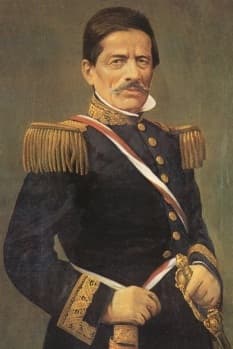
Ramon Castilla
General · Modern
59.7Total
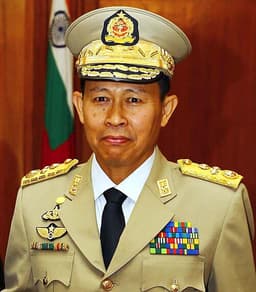
Soe Win
General · Modern
41.7Total
Basic Information
Born
1797
1947
Died
1867
—
Era
Modern
Modern
Nationality
Peru
Myanmar
Occupation
General
General
Civilization
Western
Eastern
Score Comparison
Military (10%)
40.0
25.9
Political (20%)
72.0
30.8
Influence (20%)
56.7
48.6
Legacy (20%)
52.0
40.0
Leadership (15%)
78.0
57.6
Strategy (15%)
60.0
36.8
TOTAL
59.7
41.7
Ramon Castilla — Complete Timeline
1824 AD
Battle of AyacuchoWar
Castilla fought as a junior officer in the decisive Battle of Ayacucho, which ended Spanish rule in Peru. This victory secured Peruvian independence and marked the end of the Spanish Empire in South America, shaping Castilla's nationalist views.
Peruvian War of IndependenceBattleLiberation
Impact: regional
1845 AD
First Presidency of PeruPolitical Action◆ Major
Castilla was elected President of Peru in 1845, serving until 1851. His first term focused on economic development, including the guano boom, and infrastructure projects such as railroads and ports, modernizing the Peruvian state.
PresidencyEconomic DevelopmentGuano
Impact: nationalconstructive
1854 AD
Abolition of Slavery in PeruReform◆ Major
During his second presidency, Castilla issued a decree abolishing slavery in Peru on December 3, 1854. This reform freed approximately 25,000 slaves and was part of a broader liberal agenda, though it faced opposition from slave-owning elites.
AbolitionSlaveryHuman Rights
Impact: nationalprogressive
Abolition of Indigenous TributeReform◆ Major
Castilla also abolished the indigenous tribute tax in 1854, which had been a burden on native communities since colonial times. This measure aimed to integrate indigenous peoples into the Peruvian state as equal citizens, though its implementation was uneven.
Indigenous RightsTax ReformCitizenship
Impact: nationalprogressive
1855 AD
Second Presidency and Guano BoomPolitical Action◆ Major
Castilla served a second term from 1855 to 1862, during the peak of the guano export boom. He used guano revenues to fund public works, pay off foreign debt, and modernize the military, but also faced criticism for corruption and over-reliance on a single resource.
PresidencyGuanoModernization
Impact: nationalconstructive
1860 AD
Constitutional Reform of 1860Reform◆ Major
Castilla oversaw the adoption of a new constitution in 1860, which established a centralized republic with a strong executive. The constitution remained in effect until 1920 and shaped Peru's political structure, though it limited regional autonomy.
ConstitutionPolitical ReformCentralization
Impact: nationalconstructive
Soe Win — Complete Timeline
2004 AD
Appointed Prime Minister of MyanmarPolitical Action◆ Major
Soe Win was appointed Prime Minister of Myanmar by the State Peace and Development Council, succeeding Khin Nyunt. He served as a key figure in the military junta's government.
Military JuntaGovernment Appointment
Impact: national
2007 AD
Saffron Revolution CrackdownPolitical Action
As Prime Minister, Soe Win oversaw the military's violent suppression of the Saffron Revolution, a series of anti-government protests led by Buddhist monks. The crackdown resulted in numerous deaths, arrests, and international condemnation.
Saffron RevolutionHuman RightsRepression
Impact: nationaldestructive
Death in OfficeOther
Soe Win died in office on October 12, 2007, from leukemia. His death occurred shortly after the Saffron Revolution crackdown, and he was succeeded by Thein Sein.
DeathSuccession
Impact: national
Expert Analysis
Ramon Castilla vs Soe Win
### The General and the Junta: Two Paths of Power in Peru and Myanmar
On a December day in 1854, a Peruvian general named Ramon Castilla signed a decree that would forever change his nation. Thousands of miles away and a century and a half later, another general, Soe Win of Myanmar, faced a different kind of historical judgment. One man ended slavery with a stroke of a pen; the other crushed a peaceful revolution with the barrel of a gun. Both were generals. Both ruled their countries. But the chasm between their legacies is not merely a matter of time—it is a testament to how character, opportunity, and a sense of national destiny can turn the same uniform into radically different instruments of history.
### Origins
Ramon Castilla was born in 1797 in Tarapacá, then a remote province of the Spanish Viceroyalty of Peru. His father was a Spanish colonial official; his mother was of indigenous descent. This mixed heritage placed him at the crossroads of Peru’s colonial caste system, a world where the conquerors and the conquered lived in uneasy proximity. The winds of revolution were already stirring across the Americas, and young Castilla joined the Spanish army before switching sides to fight for independence. His was a world being forged in fire, where a man could reinvent himself through war.
Soe Win was born in 1947 in British Burma, a country emerging from colonial rule into a landscape of ethnic strife and military ambition. His formative years were shaped not by the ideals of liberation but by the reality of a nation that had seen its democratic experiment crushed by its own army in 1962. Soe Win grew up in a Burma where the military was not a liberating force but a permanent, paranoid institution. He was a product of the Defense Services Academy, a system designed to produce loyal soldiers, not visionary statesmen.
### Rise to Power
Castilla’s rise was forged on the battlefield. At the Battle of Ayacucho in 1824, he was a junior officer fighting alongside Simón Bolívar’s forces in the final, decisive blow against Spanish rule. That day, he witnessed the birth of a nation. For the next two decades, he navigated Peru’s chaotic early republic—a period of caudillos, coups, and civil wars—emerging as a moderate, pragmatic leader. When he was elected president in 1845, it was not because he was the strongest general, but because he was seen as a steady hand.
Soe Win’s ascent was quieter, more bureaucratic. He rose through the ranks of the State Peace and Development Council (SPDC), the military junta that had ruled Myanmar since 1988. He was a loyalist, a man who had proven his reliability in a regime that valued obedience above all. In 2004, he was appointed Prime Minister after a purge of his rival, Khin Nyunt. He did not seize power; he inherited it, like a trust fund of repression.
### Leadership & Governance
Castilla’s leadership was defined by a rare combination of vision and pragmatism. During his first presidency (1845–1851), he focused on economic development, using the fledgling state’s resources to build railways, telegraph lines, and ports. But his true moment came in his second term (1855–1862), during the guano boom. Peru was suddenly rich, sitting on mountains of bird dung that the world craved as fertilizer. Castilla could have enriched himself and his cronies. Instead, he used the guano revenues to fund public works, modernize the army, and—most importantly—buy the freedom of enslaved people.
On December 3, 1854, he issued a decree abolishing slavery, compensating slave owners with state funds. A year later, he abolished the indigenous tribute tax, a colonial relic that had crushed native communities. He then oversaw the adoption of a new constitution in 1860, creating a centralized republic with a strong executive. Castilla was not a democrat in the modern sense, but he was a modernizer who understood that a stable nation required a free citizenry.
Soe Win’s governance was the opposite. He inherited a country already isolated by international sanctions and ruled by a paranoid military elite. His primary achievement was maintaining the junta’s grip on power. When the Saffron Revolution erupted in 2007—led by Buddhist monks protesting fuel price hikes—Soe Win did not negotiate. He ordered the crackdown. Monks were beaten, arrested, and shot. Monasteries were raided. The world watched in horror as the “Land of Golden Pagodas” became a prison. Soe Win’s leadership was not about building a nation; it was about crushing dissent.
### Triumph & Tragedy
Castilla’s greatest triumph was the abolition of slavery, a moral victory that also strengthened the state by creating a class of free laborers. His tragedy was that the guano boom he managed so wisely would later become a curse. After his death, Peru squandered its wealth, falling into debt and war. But Castilla himself died in 1867, respected and remembered as the “Liberator of the Slaves.”
Soe Win’s triumph was never his own. He was a cog in a machine. His tragedy was the Saffron Revolution—a moment when history called on him to be a statesman, and he chose to be a thug. He died of leukemia in October 2007, just months after the crackdown, leaving behind a nation more isolated and a people more bitter than before.
### Character & Destiny
Castilla was a man of his time—a caudillo with a conscience. He understood that power required legitimacy, and legitimacy required reform. He was not a saint; he was a pragmatist who saw that freeing slaves and ending tribute taxes would create a more stable, prosperous Peru. His mixed heritage may have given him a deeper empathy for the oppressed, but it was his political cunning that turned empathy into law.
Soe Win was also a man of his time—a product of a military culture that saw politics as a zero-sum game. He had no vision beyond survival. His character was shaped by fear: fear of democracy, fear of the outside world, fear of his own people. Where Castilla saw opportunity in change, Soe Win saw only threat.
### Legacy
Castilla is remembered in Peru as one of the great founding fathers. Streets, schools, and a currency note bear his name. His abolition decree is a national landmark. He is a symbol of what a military leader can achieve when he serves the nation, not himself.
Soe Win is barely remembered at all. In Myanmar, his name is a footnote in a dark chapter. The Saffron Revolution failed in the short term, but it planted the seeds for the democratic opening that would come years later. Soe Win’s legacy is a warning: that power without purpose, leadership without vision, leaves only a trail of sorrow.
### Conclusion
Two generals. Two centuries. Two nations. One chose to free a people; the other chose to imprison them. The difference was not in their uniforms but in their hearts. Castilla saw a nation waiting to be born; Soe Win saw a prison waiting to be guarded. History does not judge by rank alone, but by the choices made when the pen is mightier than the sword—or when it is simply a weapon in a different hand.
Rankings
🥇
Ramon CastillaLeader
Mil: 40.0Pol: 72.0Inf: 56.7
59.7
🥈
Soe Win
Mil: 25.9Pol: 30.8Inf: 48.6
41.7
+18.0 behind
How This Comparison Works
Algorithm
Each figure is scored on 6 dimensions (0—100 scale) based on structured historical data: Military (10%), Political (20%), Influence (20%), Legacy (20%), Leadership (15%), Strategy (15%). The weighted total produces the final ranking.
Data Sources
Scores are computed from structured sub-indicators in the database. Scale factors adjust for era (Ancient ×0.85, Modern ×1.0) and civilization size (Eastern ×1.05, Other ×0.80) to account for differences in population and military scale.
Maximum 3 Figures
Comparisons are limited to 2—3 figures to ensure readability and statistical meaningfulness.
Error Margins
±5 points per dimension — Sub-scores are derived from historical records with inherent uncertainty. Two figures within 5 points on a dimension should be considered roughly equivalent in that area.
Total Score Accuracy
±3 points overall — The weighted combination of 6 dimensions produces a total score with approximately ±3 points of uncertainty. Differences of less than 3 points are not statistically significant— the figures are effectively tied.
Known Limitations
- Historical records are incomplete and uneven across civilizations
- Figures from oral-tradition societies may be underrepresented
- Occupation labels can misclassify multi-role figures
- Scores measure capability and impact, not moral character
- Quantitative scoring is a comparison tool, not absolute truth
Capability Radar
Military (10%) — Battles & Warfare
Battles
45
10
Win Rate
50
10
Expansion
30
10
Political (20%) — Governance & Reform
Reform
85
10
Diplomacy
70
10
Economy
75
10
Influence (20%) — Cultural & Global Reach
Cultural
55
10
Global
50
10
Legacy (20%) — Historical Impact
Historical
65
20
Longevity
60
10
Leadership (15%) — Power & Stability
Tenure
65
30
Stability
60
10
Strategy (15%) — Tactics & Innovation
Strategy
45
10
Tactics
40
10
Reform
55
10
Similar Comparisons
Comments & Discussion
The Liberator Lawyer6/16/2026
Castilla didn’t just free slaves with rhetoric—he actually paid the slave owners compensation from state funds and created labor contracts for freedmen. That’s administrative genius, not just moral theater. Soe Win’s “Saffron Revolution” crackdown is the opposite: pure coercion without a policy follow-up. One general built institutions; the other just broke people. Give me Castilla’s pragmatic emancipation over Soe Win’s paranoid brutality any day.
历史账单员6/16/2026
数据不会说谎:Castilla执政期间秘鲁奴隶人口从1854年近25000人降至1856年基本归零,而Soe Win治下缅甸2007年抗议后被判刑学生超过200人。但别忘了,Castilla靠硝石出口富国,Soe Win靠天然气合作养军——两人都是资源型政权。别美化一个、妖魔化另一个,本质都是强人利用时代风口。我站在中间打脸两边。
The Classicist Judge6/16/2026
Castilla’s 1854 decree echoes the Roman manumission ceremonies where slaves were freed before a magistrate—a legal act cementing social reinvention. Soe Win’s 2007 crackdown, by contrast, feels like a late-imperial Roman proscription list, targeting citizens for political elimination. One general restored citizenship; the other criminalized peaceful speech. I’d rather live under a modern Augustus than a mini-Caligula in green fatigues.
市井历史观察家6/16/2026
别扯什么解放者光环——Castilla废除奴隶制是为了拉拢自由派对抗保守派军队,本质是政治赌博。Soe Win镇压僧侣则是军政府本能反应,两人都是把国家当棋盘。只是Castilla赌赢了,留下好名声;Soe Win赌输了,钉在耻辱柱上。历史评定有时就靠运气,别吹得跟道德史诗似的。我更信“成王败寇”四个字。
The Military Realist6/16/2026
Both men commanded armies, but Castilla led from the front in the War of the Confederation and later signed laws that outlasted his uniform. Soe Win stayed inside the junta’s shadow, ordering troops to fire on unarmed monks—a commander who never risked his own skin. For a soldier, that’s the ultimate disgrace: using soldiers to kill citizens instead of enemies. Castilla fought for a nation; Soe Win fought for a desk. I know which one I’d follow.