Loading...
This comparison has not been analyzed yet.
One-time AI generation (~1 minute). Scores and timeline are already available below.
Recep Tayyip Erdogan vs V. K. Krishna Menon
Recep Tayyip Erdogan leads by 6.2 pts · 2 figures compared
…
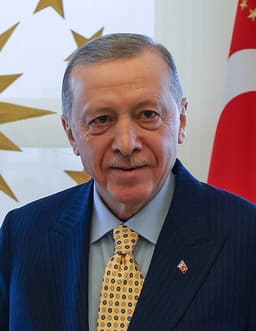
Recep Tayyip Erdogan
Politician · Modern
56.7Total

V. K. Krishna Menon
Politician · Modern
50.5Total
Basic Information
Born
1954
1896
Died
—
1974
Era
Modern
Modern
Nationality
Turkey
India
Occupation
Politician
Politician
Civilization
Middle Eastern
Indian
Score Comparison
Military (10%)
50.0
51.7
Political (20%)
59.3
42.3
Influence (20%)
55.0
58.0
Legacy (20%)
56.0
45.0
Leadership (15%)
72.0
48.4
Strategy (15%)
42.5
60.0
TOTAL
56.7
50.5
Recep Tayyip Erdogan — Complete Timeline
1994 AD
Elected Mayor of IstanbulPolitical Action◆ Major
Erdogan was elected mayor of Istanbul as a candidate of the Welfare Party. His tenure focused on infrastructure projects and improving municipal services, raising his national profile.
MayorIstanbul
Impact: nationalconstructive
1998 AD
Imprisonment for inciting religious hatredPolitical Action
Erdogan was sentenced to 10 months in prison after reciting a poem that a court deemed incited religious hatred. He served four months, which fueled his image as a victim of secularist repression.
ImprisonmentSecularism
Impact: nationaltragic
2001 AD
Founding of AK PartyPolitical Action◆ Major
Erdogan co-founded the Justice and Development Party (AKP) as a conservative democratic party. The AKP won a landslide victory in 2002, ending decades of coalition governments.
Party FoundingAKP
Impact: nationalconstructive
2003 AD
Prime Minister of TurkeyPolitical Action◆ Major
Erdogan became Prime Minister after a constitutional amendment allowed him to hold office. His early years saw economic growth, EU accession talks, and reforms to reduce military influence.
Prime MinisterReforms
Impact: nationalconstructive
2013 AD
Gezi Park protestsPolitical Action◆ Major
A small protest against the redevelopment of Gezi Park in Istanbul escalated into nationwide demonstrations against Erdogan's authoritarian governance. The government's heavy-handed response drew international condemnation.
ProtestsAuthoritarianism
Impact: nationaldestructive
2016 AD
Failed coup attemptWar◆ Major
A faction of the Turkish military attempted a coup against Erdogan's government. The coup was suppressed after Erdogan rallied supporters via social media. Thousands were subsequently purged from state institutions.
Coup AttemptPurge
Impact: nationaldestructive
2017 AD
Presidential system referendumPolitical Action◆ Major
Erdogan narrowly won a referendum that replaced Turkey's parliamentary system with a powerful executive presidency. Critics argued it concentrated power in his hands and weakened democratic checks.
Constitutional ChangePresidential System
Impact: nationaldestructive
V. K. Krishna Menon — Complete Timeline
1953 AD
Led India's Delegation to the United NationsPolitical Action◆ Major
Krishna Menon led the Indian delegation to the UN, where he became a prominent voice for decolonization and non-alignment. He played a key role in the Korean War armistice negotiations and advocated for the admission of China to the UN.
United NationsDiplomacyNon-Alignment
Impact: globalconstructive
1954 AD
Instrumental in the Panchsheel AgreementPolitical Action◆ Major
Krishna Menon helped draft the Panchsheel, or Five Principles of Peaceful Coexistence, which were incorporated into the Sino-Indian Agreement on Tibet. The principles became a cornerstone of India's foreign policy and influenced the Non-Aligned Movement.
PanchsheelForeign PolicyChina
Impact: globalconstructive
1962 AD
Served as India's Defense Minister during the 1962 Sino-Indian WarWar◆ Major
As Defense Minister, Krishna Menon oversaw India's military response to the Chinese invasion. India suffered a decisive defeat, leading to widespread criticism of Menon's leadership and his eventual resignation from the post.
Sino-Indian WarDefense MinisterDefeat
Impact: nationaltragic
Resigned as Defense MinisterPolitical Action◆ Major
Following India's defeat in the Sino-Indian War, Krishna Menon resigned as Defense Minister under pressure from the Congress party and public opinion. His resignation marked the end of his tenure in high office.
ResignationSino-Indian WarAccountability
Impact: nationaltragic
This comparison has not been analyzed yet.
One-time AI generation (~1 minute). Scores and timeline are already available below.
Rankings
🥇
Recep Tayyip ErdoganLeader
Mil: 50.0Pol: 59.3Inf: 55.0
56.7
🥈
V. K. Krishna Menon
Mil: 51.7Pol: 42.3Inf: 58.0
50.5
+6.2 behind
How This Comparison Works
Algorithm
Each figure is scored on 6 dimensions (0—100 scale) based on structured historical data: Military (10%), Political (20%), Influence (20%), Legacy (20%), Leadership (15%), Strategy (15%). The weighted total produces the final ranking.
Data Sources
Scores are computed from structured sub-indicators in the database. Scale factors adjust for era (Ancient ×0.85, Modern ×1.0) and civilization size (Eastern ×1.05, Other ×0.80) to account for differences in population and military scale.
Maximum 3 Figures
Comparisons are limited to 2—3 figures to ensure readability and statistical meaningfulness.
Error Margins
±5 points per dimension — Sub-scores are derived from historical records with inherent uncertainty. Two figures within 5 points on a dimension should be considered roughly equivalent in that area.
Total Score Accuracy
±3 points overall — The weighted combination of 6 dimensions produces a total score with approximately ±3 points of uncertainty. Differences of less than 3 points are not statistically significant— the figures are effectively tied.
Known Limitations
- Historical records are incomplete and uneven across civilizations
- Figures from oral-tradition societies may be underrepresented
- Occupation labels can misclassify multi-role figures
- Scores measure capability and impact, not moral character
- Quantitative scoring is a comparison tool, not absolute truth
Capability Radar
Military (10%) — Battles & Warfare
Battles
24
43
Win Rate
25
45
Expansion
27
47
Political (20%) — Governance & Reform
Reform
65
20
Diplomacy
70
70
Economy
60
10
Influence (20%) — Cultural & Global Reach
Cultural
55
30
Global
65
50
Legacy (20%) — Historical Impact
Historical
60
40
Longevity
50
20
Leadership (15%) — Power & Stability
Tenure
85
30
Stability
40
10
Strategy (15%) — Tactics & Innovation
Strategy
28
54
Tactics
34
54
Reform
34
57
Similar Comparisons
Comments & Discussion
No comments yet. Be the first to share your thoughts!