Loading...
This comparison has not been analyzed yet.
One-time AI generation (~1 minute). Scores and timeline are already available below.
Roy Geiger vs Soe Win
Roy Geiger leads by 15.5 pts · 2 figures compared
…

Roy Geiger
General · Modern
57.2Total
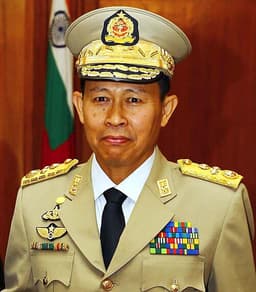
Soe Win
General · Modern
41.7Total
Basic Information
Born
1885
1947
Died
1947
—
Era
Modern
Modern
Nationality
United States
Myanmar
Occupation
General
General
Civilization
Western
Eastern
Score Comparison
Military (10%)
61.7
25.9
Political (20%)
46.6
30.8
Influence (20%)
60.0
48.6
Legacy (20%)
52.0
40.0
Leadership (15%)
68.0
57.6
Strategy (15%)
58.0
36.8
TOTAL
57.2
41.7
Roy Geiger — Complete Timeline
1942 AD
Battle of GuadalcanalWar◆ Major
Geiger commanded the 1st Marine Aircraft Wing during the Battle of Guadalcanal. His air units provided close air support and defended against Japanese air attacks, playing a key role in the Allied victory.
World War IIPacificGuadalcanal
Impact: regional
1943 AD
Battle of BougainvilleWar◆ Major
Geiger commanded the I Marine Amphibious Corps during the landing and subsequent operations on Bougainville. His forces established a beachhead and defended against Japanese counterattacks, securing the island for Allied use.
World War IIPacificBougainville
Impact: regional
1945 AD
Battle of OkinawaWar◆ Major
Geiger commanded the III Amphibious Corps during the Battle of Okinawa. His corps conducted amphibious landings and sustained ground combat against Japanese forces, contributing to the capture of the island.
World War IIPacificOkinawa
Impact: regional
Command of Tenth ArmyWar◆ Major
Geiger assumed command of the US Tenth Army after the death of General Simon Buckner during the Battle of Okinawa. He became the first Marine Corps officer to command a field army, leading it until the end of the battle.
World War IIPacificCommand
Impact: regional
Soe Win — Complete Timeline
2004 AD
Appointed Prime Minister of MyanmarPolitical Action◆ Major
Soe Win was appointed Prime Minister of Myanmar by the State Peace and Development Council, succeeding Khin Nyunt. He served as a key figure in the military junta's government.
Military JuntaGovernment Appointment
Impact: national
2007 AD
Saffron Revolution CrackdownPolitical Action
As Prime Minister, Soe Win oversaw the military's violent suppression of the Saffron Revolution, a series of anti-government protests led by Buddhist monks. The crackdown resulted in numerous deaths, arrests, and international condemnation.
Saffron RevolutionHuman RightsRepression
Impact: nationaldestructive
Death in OfficeOther
Soe Win died in office on October 12, 2007, from leukemia. His death occurred shortly after the Saffron Revolution crackdown, and he was succeeded by Thein Sein.
DeathSuccession
Impact: national
This comparison has not been analyzed yet.
One-time AI generation (~1 minute). Scores and timeline are already available below.
Rankings
🥇
Roy GeigerLeader
Mil: 61.7Pol: 46.6Inf: 60.0
57.2
🥈
Soe Win
Mil: 25.9Pol: 30.8Inf: 48.6
41.7
+15.5 behind
How This Comparison Works
Algorithm
Each figure is scored on 6 dimensions (0—100 scale) based on structured historical data: Military (10%), Political (20%), Influence (20%), Legacy (20%), Leadership (15%), Strategy (15%). The weighted total produces the final ranking.
Data Sources
Scores are computed from structured sub-indicators in the database. Scale factors adjust for era (Ancient ×0.85, Modern ×1.0) and civilization size (Eastern ×1.05, Other ×0.80) to account for differences in population and military scale.
Maximum 3 Figures
Comparisons are limited to 2—3 figures to ensure readability and statistical meaningfulness.
Error Margins
±5 points per dimension — Sub-scores are derived from historical records with inherent uncertainty. Two figures within 5 points on a dimension should be considered roughly equivalent in that area.
Total Score Accuracy
±3 points overall — The weighted combination of 6 dimensions produces a total score with approximately ±3 points of uncertainty. Differences of less than 3 points are not statistically significant— the figures are effectively tied.
Known Limitations
- Historical records are incomplete and uneven across civilizations
- Figures from oral-tradition societies may be underrepresented
- Occupation labels can misclassify multi-role figures
- Scores measure capability and impact, not moral character
- Quantitative scoring is a comparison tool, not absolute truth
Capability Radar
Military (10%) — Battles & Warfare
Battles
65
10
Win Rate
70
10
Expansion
60
10
Political (20%) — Governance & Reform
Reform
30
10
Diplomacy
45
10
Economy
25
10
Influence (20%) — Cultural & Global Reach
Cultural
40
10
Global
50
10
Legacy (20%) — Historical Impact
Historical
55
20
Longevity
45
10
Leadership (15%) — Power & Stability
Tenure
40
30
Stability
35
10
Strategy (15%) — Tactics & Innovation
Strategy
68
10
Tactics
72
10
Reform
55
10
Similar Comparisons
Comments & Discussion
No comments yet. Be the first to share your thoughts!