Loading...
This comparison has not been analyzed yet.
One-time AI generation (~1 minute). Scores and timeline are already available below.
Shi Siming vs Su Dingfang
Su Dingfang leads by 13.4 pts · 2 figures compared
…

Shi Siming
General · Medieval
44.7Total
Su Dingfang
General · Medieval
58.1Total
Basic Information
Born
703
591
Died
761
667
Era
Medieval
Medieval
Nationality
China
China
Occupation
General
General
Civilization
Eastern
Eastern
Score Comparison
Military (10%)
60.0
80.0
Political (20%)
27.9
48.0
Influence (20%)
47.9
57.2
Legacy (20%)
40.8
47.5
Leadership (15%)
43.8
62.0
Strategy (15%)
58.0
74.4
TOTAL
44.7
58.1
Shi Siming — Complete Timeline
755 AD
Joined An Lushan's RebellionWar◆ Major
Shi Siming, a fellow general and friend of An Lushan, joined the rebellion from the outset. He commanded forces in the northern theater, securing key territories in Hebei and Shanxi for the Yan dynasty.
Tang DynastyAn Lushan RebellionHebei
Impact: regionaldestructive
757 AD
Defected to the Tang DynastyPolitical Action◆ Major
After An Lushan's assassination, Shi Siming briefly submitted to the Tang court. He was pardoned and given a military command, but he remained suspicious of Tang intentions and soon rebelled again.
Tang DynastyDefectionAn Lushan Rebellion
Impact: national
758 AD
Rebelled Again and Killed An QingxuPolitical Action◆ Major
Shi Siming rebelled again, killing An Qingxu and seizing control of the Yan dynasty. He declared himself emperor and continued the war against Tang, proving to be a more capable commander than An Qingxu.
Tang DynastyYan DynastyCoup
Impact: nationaldestructive
759 AD
Defeated at the Battle of YanchengWar◆ Major
Shi Siming defeated Tang forces at Yancheng (modern Anyang), killing the Tang general Li Guangbi's ally. This victory allowed him to consolidate control over the Yellow River valley and threaten Luoyang.
Tang DynastyBattleYan Dynasty
Impact: regionaldestructive
761 AD
Assassinated by His SonPolitical Action◆ Major
Shi Siming was assassinated by his son Shi Chaoyi, who feared being replaced as heir. The patricide weakened the Yan dynasty, leading to internal strife and eventual defeat by Tang forces in 763.
Tang DynastyAssassinationYan Dynasty
Impact: nationaltragic
Su Dingfang — Complete Timeline
635 AD
Defeated the Tuyuhun kingdomWar
Su Dingfang participated in the Tang campaign against the Tuyuhun kingdom. The Tuyuhun were defeated and became a Tang vassal, securing the Tang's western frontier.
Tang expansionTuyuhunMilitary campaign
Impact: regional
657 AD
Conquered the Western Turkic KhaganateWar
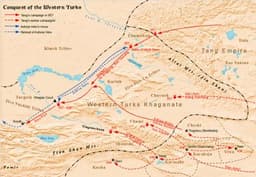
Su Dingfang led a Tang army to defeat the Western Turkic Khaganate at the Battle of Irtysh River. The khagan was captured, and the Western Turkic state was destroyed, extending Tang control over Central Asia.
Tang expansionCentral AsiaMilitary campaign
Impact: regional
Suppressed the rebellion of Ashina HeluWar◆ Major
After the conquest of the Western Turks, Su Dingfang suppressed a rebellion led by Ashina Helu, a former Turkic vassal. The rebellion was crushed, and Helu was captured, solidifying Tang control.
RebellionCentral AsiaTang dynasty
Impact: regional
This comparison has not been analyzed yet.
One-time AI generation (~1 minute). Scores and timeline are already available below.
Rankings
🥇
Su DingfangLeader
Mil: 80.0Pol: 48.0Inf: 57.2
58.1
🥈
Shi Siming
Mil: 60.0Pol: 27.9Inf: 47.9
44.7
+13.4 behind
How This Comparison Works
Algorithm
Each figure is scored on 6 dimensions (0—100 scale) based on structured historical data: Military (10%), Political (20%), Influence (20%), Legacy (20%), Leadership (15%), Strategy (15%). The weighted total produces the final ranking.
Data Sources
Scores are computed from structured sub-indicators in the database. Scale factors adjust for era (Ancient ×0.85, Modern ×1.0) and civilization size (Eastern ×1.05, Other ×0.80) to account for differences in population and military scale.
Maximum 3 Figures
Comparisons are limited to 2—3 figures to ensure readability and statistical meaningfulness.
Error Margins
±5 points per dimension — Sub-scores are derived from historical records with inherent uncertainty. Two figures within 5 points on a dimension should be considered roughly equivalent in that area.
Total Score Accuracy
±3 points overall — The weighted combination of 6 dimensions produces a total score with approximately ±3 points of uncertainty. Differences of less than 3 points are not statistically significant— the figures are effectively tied.
Known Limitations
- Historical records are incomplete and uneven across civilizations
- Figures from oral-tradition societies may be underrepresented
- Occupation labels can misclassify multi-role figures
- Scores measure capability and impact, not moral character
- Quantitative scoring is a comparison tool, not absolute truth
Capability Radar
Military (10%) — Battles & Warfare
Battles
65
85
Win Rate
60
90
Expansion
55
80
Political (20%) — Governance & Reform
Reform
20
40
Diplomacy
35
65
Economy
25
45
Influence (20%) — Cultural & Global Reach
Cultural
30
55
Global
25
60
Legacy (20%) — Historical Impact
Historical
45
65
Longevity
30
50
Leadership (15%) — Power & Stability
Tenure
40
50
Stability
20
55
Strategy (15%) — Tactics & Innovation
Strategy
65
85
Tactics
70
88
Reform
30
60
Similar Comparisons
Comments & Discussion
No comments yet. Be the first to share your thoughts!