Loading...
This comparison has not been analyzed yet.
One-time AI generation (~1 minute). Scores and timeline are already available below.
Thomas Cranmer vs Yang Bo
Thomas Cranmer leads by 4.2 pts · 2 figures compared
…
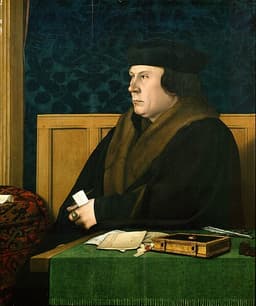
Thomas Cranmer
Politician · Medieval
61.5Total

Yang Bo
Politician · Medieval
57.3Total
Basic Information
Born
1489
1509
Died
1556
1574
Era
Medieval
Medieval
Nationality
England
China
Occupation
Politician
Politician
Civilization
Western
Eastern
Score Comparison
Military (10%)
44.8
50.0
Political (20%)
68.0
72.0
Influence (20%)
65.0
57.2
Legacy (20%)
55.0
48.3
Leadership (15%)
74.0
72.0
Strategy (15%)
56.8
43.3
TOTAL
61.5
57.3
Thomas Cranmer — Complete Timeline
1533 AD
Appointed Archbishop of CanterburyPolitical Action◆ Major
Cranmer was appointed Archbishop of Canterbury by Henry VIII. He annulled Henry's marriage to Catherine of Aragon, enabling the king's marriage to Anne Boleyn and solidifying the English Reformation.
English ReformationChurch Leadership
Impact: national
1549 AD
Authored the Book of Common PrayerCultural
Cranmer compiled and wrote the first Book of Common Prayer, establishing a standardized English liturgy for the Church of England. It replaced Latin services and shaped Anglican worship for centuries.
LiturgyAnglicanism
Impact: globalconstructive
1552 AD
Revised the Book of Common PrayerCultural◆ Major
Cranmer issued a more Protestant revision of the Book of Common Prayer, removing Catholic elements and emphasizing justification by faith. This version further defined Anglican doctrine.
LiturgyProtestantism
Impact: nationalconstructive
1556 AD
Tried for Heresy and Burned at the StakePolitical Action◆ Major
Under Mary I, Cranmer was tried for heresy and recanted his Protestant beliefs, but later retracted his recantation. He was burned at the stake in Oxford, becoming a martyr for the English Reformation.
MartyrdomReligious Persecution
Impact: nationaltragic
Yang Bo — Complete Timeline
1567 AD
Appointed Minister of WarPolitical Action◆ Major
Yang Bo was appointed Minister of War during the Longqing reign. He was responsible for managing the Ming military and addressing the threat from Mongol tribes along the northern border.
Ming DynastyMinister of WarLongqing Reign
Impact: nationalconstructive
1568 AD
Strengthened border defensesReform◆ Major
Yang Bo oversaw the construction of fortifications and the reorganization of garrisons along the Great Wall. These measures improved the Ming military's ability to defend against Mongol incursions.
Ming DynastyBorder DefenseGreat Wall
Impact: regionalconstructive
1571 AD
Negotiated peace with Altan KhanPolitical Action
Yang Bo played a key role in negotiating a peace treaty with Altan Khan, the Mongol leader. The treaty established a tributary relationship and reduced border raids, bringing stability to the northern frontier.
Ming DynastyMongol PeaceAltan Khan
Impact: regionalconstructive
This comparison has not been analyzed yet.
One-time AI generation (~1 minute). Scores and timeline are already available below.
Rankings
🥇
Thomas CranmerLeader
Mil: 44.8Pol: 68.0Inf: 65.0
61.5
🥈
Yang Bo
Mil: 50.0Pol: 72.0Inf: 57.2
57.3
+4.2 behind
How This Comparison Works
Algorithm
Each figure is scored on 6 dimensions (0—100 scale) based on structured historical data: Military (10%), Political (20%), Influence (20%), Legacy (20%), Leadership (15%), Strategy (15%). The weighted total produces the final ranking.
Data Sources
Scores are computed from structured sub-indicators in the database. Scale factors adjust for era (Ancient ×0.85, Modern ×1.0) and civilization size (Eastern ×1.05, Other ×0.80) to account for differences in population and military scale.
Maximum 3 Figures
Comparisons are limited to 2—3 figures to ensure readability and statistical meaningfulness.
Error Margins
±5 points per dimension — Sub-scores are derived from historical records with inherent uncertainty. Two figures within 5 points on a dimension should be considered roughly equivalent in that area.
Total Score Accuracy
±3 points overall — The weighted combination of 6 dimensions produces a total score with approximately ±3 points of uncertainty. Differences of less than 3 points are not statistically significant— the figures are effectively tied.
Known Limitations
- Historical records are incomplete and uneven across civilizations
- Figures from oral-tradition societies may be underrepresented
- Occupation labels can misclassify multi-role figures
- Scores measure capability and impact, not moral character
- Quantitative scoring is a comparison tool, not absolute truth
Capability Radar
Military (10%) — Battles & Warfare
Battles
52
55
Win Rate
56
60
Expansion
59
30
Political (20%) — Governance & Reform
Reform
75
55
Diplomacy
55
70
Economy
30
50
Influence (20%) — Cultural & Global Reach
Cultural
80
40
Global
60
35
Legacy (20%) — Historical Impact
Historical
75
50
Longevity
70
40
Leadership (15%) — Power & Stability
Tenure
60
65
Stability
25
60
Strategy (15%) — Tactics & Innovation
Strategy
60
70
Tactics
64
65
Reform
68
60
Similar Comparisons
Comments & Discussion
No comments yet. Be the first to share your thoughts!