Loading...
Traian Basescu vs Ukhnaagiin Khurelsukh
Traian Basescu leads by 10.8 pts · 2 figures compared
…
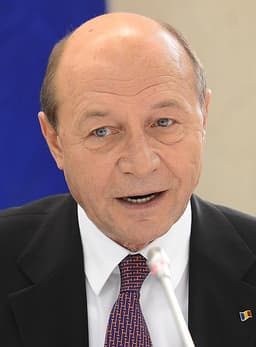
Traian Basescu
Politician · Modern
54.1Total

Ukhnaagiin Khurelsukh
Politician · Modern
43.3Total
Basic Information
Born
1951
1968
Died
—
—
Era
Modern
Modern
Nationality
Romania
Mongolia
Occupation
Politician
Politician
Civilization
Western
Eastern
Score Comparison
Military (10%)
50.0
17.3
Political (20%)
68.0
48.0
Influence (20%)
53.3
49.4
Legacy (20%)
42.5
37.5
Leadership (15%)
72.0
67.0
Strategy (15%)
42.0
25.5
TOTAL
54.1
43.3
Traian Basescu — Complete Timeline
2004 AD
Election as President of RomaniaPolitical Action◆ Major
Traian Băsescu was elected President of Romania on December 12, 2004, defeating Adrian Năstase. He ran on an anti-corruption platform and served two terms until 2014, focusing on judicial reform, EU integration, and combating high-level corruption.
ElectionAnti-CorruptionRomania
Impact: nationalconstructive
2007 AD
Romanian EU AccessionPolitical Action◆ Major
Under Băsescu's presidency, Romania joined the European Union on January 1, 2007. He played a key role in pushing through necessary reforms, though the EU continued to monitor Romania's progress on judicial reform and corruption.
EU AccessionIntegrationRomania
Impact: nationalconstructive
Suspension from OfficePolitical Action◆ Major
Băsescu was suspended from office by parliament on April 19, 2007, on charges of unconstitutional conduct. A referendum on his impeachment was held on May 19, 2007, but he survived with 74% of voters opposing removal, allowing him to return to office.
ImpeachmentPolitical CrisisRomania
Impact: national
2012 AD
Second Suspension and ReferendumPolitical Action◆ Major
Băsescu was suspended again by parliament on July 6, 2012, amid a political power struggle with Prime Minister Victor Ponta. A referendum on July 29, 2012, saw 88% vote for removal, but turnout was below the required threshold, so he remained in office.
ImpeachmentPolitical CrisisRomania
Impact: national
Ukhnaagiin Khurelsukh — Complete Timeline
2017 AD
Appointed Prime Minister of MongoliaPolitical Action◆ Major
Khurelsukh was appointed Prime Minister after the resignation of Jargaltulgyn Erdenebat. He led a coalition government focused on economic recovery and anti-corruption measures.
Prime MinisterGovernment
Impact: nationalconstructive
2020 AD
Resigned as Prime Minister After 2020 ProtestsPolitical Action◆ Major
Khurelsukh resigned as Prime Minister in January 2020 following widespread protests over the government's handling of the COVID-19 pandemic and economic issues. The resignation was seen as a concession to public pressure.
ResignationProtestsCOVID-19
Impact: national
2021 AD
Initiated the 'New Revival Policy'Reform◆ Major
As President, Khurelsukh launched the 'New Revival Policy', a comprehensive economic strategy focusing on infrastructure development, energy independence, and digital transformation. The policy aimed to reduce Mongolia's reliance on mining.
Economic PolicyDevelopment
Impact: nationalconstructive
Elected President of MongoliaPolitical Action◆ Major
Khurelsukh won the 2021 presidential election as the Mongolian People's Party candidate, defeating Dangaasuren Enkhbat. His victory marked the return of the MPP to the presidency after a decade.
ElectionPresidency
Impact: nationalconstructive
2022 AD
Signed the 'Mongolia-Russia Strategic Partnership' AgreementPolitical Action◆ Major
During a state visit to Russia, Khurelsukh signed a strategic partnership agreement with President Vladimir Putin, strengthening bilateral cooperation in energy, trade, and infrastructure.
DiplomacyRussiaStrategic Partnership
Impact: regionalconstructive
Expert Analysis
Origins
Traian Băsescu was born on November 4, 1951, in Basarabi, Romania, into a working-class family. His father was a soldier and his mother a housewife. He graduated from the Mircea cel Bătrân Naval Institute in 1976, becoming a merchant navy officer. His early career at sea shaped his pragmatic, direct leadership style. Ukhnaagiin Khurelsukh was born on June 14, 1968, in Ulaanbaatar, Mongolia, to a herder family. He studied at the Mongolian State University of Agriculture and later at the National University of Mongolia, earning a degree in law. His background in agriculture and law influenced his focus on rural development and legal reforms.
Rise to Power
Băsescu entered politics after the Romanian Revolution, joining the Democratic Party. He served as Minister of Transport (1996–2000) and Mayor of Bucharest (2000–2004). His anti-corruption stance and charismatic populism propelled him to the presidency in December 2004, defeating Adrian Năstase. Khurelsukh rose through the Mongolian People's Party (MPP). He served as Minister of Agriculture (2008–2012) and Deputy Prime Minister (2012–2014). In 2017, he became Prime Minister after the resignation of Jargaltulgyn Erdenebat. He won the 2021 presidential election with 72% of the vote, marking the MPP's return to power.
Leadership & Governance
Băsescu's leadership was confrontational and reformist. He pushed for NATO and EU integration, overseeing Romania's EU accession in 2007. His governance was marked by frequent conflicts with parliament, leading to two suspensions (2007 and 2012) and impeachment referendums. He scored 72.0 in leadership but only 42.0 in strategy. Khurelsukh's leadership style is more conciliatory. As Prime Minister, he focused on economic recovery and anti-corruption. His 'New Revival Policy' aims to boost infrastructure and energy independence. However, his resignation in 2020 after protests highlighted strategic weaknesses, scoring 67.0 in leadership and 25.5 in strategy.
Triumph & Tragedy
Băsescu's greatest triumph was guiding Romania into the EU in 2007, a historic achievement. His tragedies were the two suspensions and a legacy tarnished by corruption allegations against his associates. Khurelsukh's triumph includes signing the strategic partnership with Russia in 2021 and launching the New Revival Policy. His tragedy was the 2020 protests over COVID-19 mismanagement, forcing his resignation. He also faced criticism for authoritarian tendencies, such as curbing press freedom.
Character & Destiny
Băsescu was blunt, often polarizing. His naval background gave him a command-and-control style, but his strategic miscalculations led to political crises. He scored 68.0 in political acumen but only 42.0 in strategy. Khurelsukh is methodical and cautious, with a focus on economic stability. However, his low strategy score (25.5) reflects reactive decision-making during crises. Both leaders were shaped by post-communist transitions, but Băsescu's destiny was more turbulent.
Legacy
Băsescu's legacy is tied to Romania's EU membership and anti-corruption efforts, though his personal reputation remains mixed. His total score is 54.1. Khurelsukh's legacy is still forming, but his New Revival Policy and Russia ties may define his tenure. He scored 43.3. Băsescu's influence on Romania's European trajectory is substantial, while Khurelsukh's impact on Mongolia's global positioning is growing but less profound.
Conclusion
Traian Băsescu had a greater impact than Ukhnaagiin Khurelsukh. His leadership during Romania's EU accession (score 72.0) and his role in anchoring Romania to the West outweigh Khurelsukh's achievements. Băsescu's total score of 54.1 versus 43.3 reflects his higher influence and legacy. While Khurelsukh's policies are important, they lack the transformative scale of EU integration. Băsescu's confrontational style, though flawed, drove historic change.
Rankings
🥇
Traian BasescuLeader
Mil: 50.0Pol: 68.0Inf: 53.3
54.1
🥈
Ukhnaagiin Khurelsukh
Mil: 17.3Pol: 48.0Inf: 49.4
43.3
+10.8 behind
How This Comparison Works
Algorithm
Each figure is scored on 6 dimensions (0—100 scale) based on structured historical data: Military (10%), Political (20%), Influence (20%), Legacy (20%), Leadership (15%), Strategy (15%). The weighted total produces the final ranking.
Data Sources
Scores are computed from structured sub-indicators in the database. Scale factors adjust for era (Ancient ×0.85, Modern ×1.0) and civilization size (Eastern ×1.05, Other ×0.80) to account for differences in population and military scale.
Maximum 3 Figures
Comparisons are limited to 2—3 figures to ensure readability and statistical meaningfulness.
Error Margins
±5 points per dimension — Sub-scores are derived from historical records with inherent uncertainty. Two figures within 5 points on a dimension should be considered roughly equivalent in that area.
Total Score Accuracy
±3 points overall — The weighted combination of 6 dimensions produces a total score with approximately ±3 points of uncertainty. Differences of less than 3 points are not statistically significant— the figures are effectively tied.
Known Limitations
- Historical records are incomplete and uneven across civilizations
- Figures from oral-tradition societies may be underrepresented
- Occupation labels can misclassify multi-role figures
- Scores measure capability and impact, not moral character
- Quantitative scoring is a comparison tool, not absolute truth
Capability Radar
Military (10%) — Battles & Warfare
Battles
31
13
Win Rate
32
17
Expansion
33
18
Political (20%) — Governance & Reform
Reform
55
40
Diplomacy
60
45
Economy
50
35
Influence (20%) — Cultural & Global Reach
Cultural
30
20
Global
30
15
Legacy (20%) — Historical Impact
Historical
35
15
Longevity
20
10
Leadership (15%) — Power & Stability
Tenure
65
30
Stability
45
40
Strategy (15%) — Tactics & Innovation
Strategy
40
21
Tactics
40
28
Reform
41
32
Similar Comparisons
Comments & Discussion
No comments yet. Be the first to share your thoughts!