Loading...
Abdal Bucaram vs Istvan Szechenyi
Istvan Szechenyi leads by 14.9 pts · 2 figures compared
…

Abdal Bucaram
Politician · Modern
43.3Total
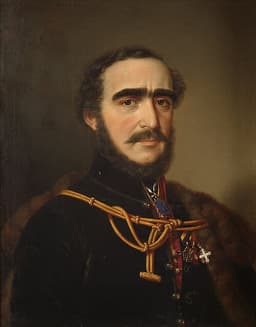
Istvan Szechenyi
Politician · Modern
58.2Total
Basic Information
Born
1952
1791
Died
—
1860
Era
Modern
Modern
Nationality
Ecuador
Hungary
Occupation
Politician
Politician
Civilization
Western
Western
Score Comparison
Military (10%)
49.2
49.7
Political (20%)
32.1
72.0
Influence (20%)
45.5
56.7
Legacy (20%)
35.0
55.0
Leadership (15%)
62.2
68.0
Strategy (15%)
41.5
43.2
TOTAL
43.3
58.2
Abdal Bucaram — Complete Timeline
1996 AD
Elected President of EcuadorPolitical Action◆ Major
Abdal Bucaram was elected President of Ecuador as the candidate of the Ecuadorian Roldosist Party. He campaigned as a populist, promising to help the poor and challenging the political establishment.
ElectionPresidencyEcuador
Impact: national
1997 AD
Ousted by Congress for Mental IncapacityPolitical Action◆ Major
After only six months in office, the Ecuadorian Congress voted to remove Bucaram from office, citing 'mental incapacity' to govern. His erratic behavior and controversial policies had led to widespread protests and loss of support.
ImpeachmentPolitical CrisisEcuador
Impact: nationaltragic
Fled to PanamaPolitical Action◆ Major
Following his ouster, Bucaram fled to Panama to avoid prosecution on corruption charges. He remained in exile for several years, continuing to be a controversial figure in Ecuadorian politics.
ExileCorruptionEcuador
Impact: national
2005 AD
Returned to Ecuador and ArrestedPolitical Action◆ Major
Bucaram returned to Ecuador and was arrested on corruption charges related to his brief presidency. He was imprisoned but later released, continuing to face legal battles.
ArrestCorruptionLegal Proceedings
Impact: national
Istvan Szechenyi — Complete Timeline
1825 AD
Founding of the Hungarian Academy of SciencesCultural◆ Major
Istvan Szechenyi donated a year's income to found the Hungarian Academy of Sciences. The institution promoted scientific and cultural development in Hungary.
AcademyScienceCulture
Impact: nationalconstructive
1830 AD
Publication of 'Credit'Cultural◆ Major
Istvan Szechenyi published 'Credit', a book advocating for economic reforms in Hungary. The work argued for the abolition of serfdom and the modernization of agriculture.
PublicationReformEconomy
Impact: nationalconstructive
1849 AD
Chain Bridge ConstructionOther◆ Major
Istvan Szechenyi oversaw the construction of the Chain Bridge across the Danube in Budapest. The bridge connected Buda and Pest, symbolizing modernization and national unity.
InfrastructureBridgeModernization
Impact: nationalconstructive
1860 AD
SuicideOther◆ Major
Istvan Szechenyi died by suicide at the D
SuicideDeath
Impact: nationaltragic
Expert Analysis
Origins
Abdal Bucaram was born on February 20, 1952, in Guayaquil, Ecuador, into a politically active family of Lebanese descent. His father, Jacobo Bucaram, was a prominent politician and former mayor of Guayaquil. Abdal studied law at the University of Guayaquil but did not complete his degree. He became involved in politics early, joining the Ecuadorian Roldosist Party (PRE) founded by his brother-in-law, President Jaime Roldós. Bucaram's flamboyant style and populist rhetoric earned him the nickname 'El Loco' (The Madman).
Istvan Szechenyi was born on September 21, 1791, in Vienna, into one of Hungary's wealthiest aristocratic families. His father, Ferenc Szechenyi, was a statesman and founder of the Hungarian National Museum. Istvan received a military education and served as an officer in the Napoleonic Wars, but his travels across Europe exposed him to modernization. He became a leading figure in the Hungarian Reform Era, advocating for economic and social progress.
Rise to Power
Bucaram's political career began in 1984 when he was elected mayor of Guayaquil. He gained notoriety for his eccentric behavior and populist policies, such as distributing free food and hosting concerts. In 1996, he won the presidency under the PRE, campaigning against corruption and poverty. His inauguration on August 10, 1996, was marked by promises of sweeping reforms. However, his erratic governance quickly alienated Congress and the public.
Szechenyi rose to prominence through his writings and philanthropic initiatives. In 1825, he donated a year's income to establish the Hungarian Academy of Sciences, a pivotal moment in Hungary's cultural revival. His book 'Credit' (1830) argued for abolishing serfdom and modernizing agriculture. He became a key advisor to the Hungarian Diet and oversaw major infrastructure projects, including the Chain Bridge, which began construction in 1839.
Leadership & Governance
Bucaram's leadership was chaotic and populist. He reduced fuel prices, increased subsidies, and clashed with the legislature. His governance scored 62.2 in leadership but only 32.1 in political effectiveness. He alienated elites and failed to implement sustainable policies. His cabinet was unstable, with frequent resignations. His behavior, including dancing at official events and making bizarre speeches, led to accusations of mental instability.
Szechenyi's leadership was reformist and pragmatic. He scored 68.0 in leadership and 72.0 in political influence. He championed modernization through education, infrastructure, and economic liberalization. His approach was gradualist, seeking to work within the Habsburg monarchy. He promoted the construction of the Chain Bridge, which connected Buda and Pest, and advocated for steamship navigation on the Danube. His governance focused on long-term development rather than immediate popularity.
Triumph & Tragedy
Bucaram's greatest success was winning the presidency with a populist mandate. However, his tenure was a disaster: after six months, Congress voted to remove him on February 6, 1997, citing 'mental incapacity.' He fled to Panama to avoid corruption charges, later returning and being arrested. His legacy is tainted by failure, with a legacy score of 35.0.
Szechenyi's triumphs include founding the Hungarian Academy of Sciences (1825), which promoted science and culture, and constructing the Chain Bridge (completed 1849), a symbol of Hungarian unity. His reform ideas influenced the 1848 revolution. However, his tragedy was his suicide on April 8, 1860, at a mental institution in Döbling, following political setbacks and mental health struggles.
Character & Destiny
Bucaram was charismatic but erratic, with a populist appeal that masked incompetence. His destiny was shaped by his inability to govern effectively, leading to his ouster and exile. His character, scoring 62.2 in leadership but 41.5 in strategy, reflected impulsive decision-making.
Szechenyi was visionary and dedicated, but prone to melancholy. His character drove his reformist agenda, but his mental health deteriorated after the failed 1848 revolution. He scored 68.0 in leadership and 43.2 in strategy, showing strength in vision but weakness in political maneuvering.
Legacy
Bucaram's legacy is largely negative; he is remembered as a failed president who destabilized Ecuador. His influence score of 45.5 and legacy of 35.0 reflect his brief, chaotic rule. No enduring institutions bear his name.
Szechenyi's legacy is profound: he is considered the 'Greatest Hungarian' for his role in modernizing Hungary. The Academy of Sciences remains a leading institution, and the Chain Bridge is a national symbol. His influence score of 56.7 and legacy of 55.0 underscore his lasting impact. His ideas on reform influenced generations.
Conclusion
Istvan Szechenyi clearly had greater impact. With a total score of 58.2 compared to Bucaram's 43.3, Szechenyi's contributions to Hungarian modernization—the Academy, Chain Bridge, and economic reforms—endure. Bucaram's presidency was a failure, leaving no positive legacy. Szechenyi's reforms shaped Hungary's path to modernity, while Bucaram's rule was a cautionary tale of populism. The data supports Szechenyi as the more significant historical figure.
Rankings
🥇
Istvan SzechenyiLeader
Mil: 49.7Pol: 72.0Inf: 56.7
58.2
🥈
Abdal Bucaram
Mil: 49.2Pol: 32.1Inf: 45.5
43.3
+14.9 behind
How This Comparison Works
Algorithm
Each figure is scored on 6 dimensions (0—100 scale) based on structured historical data: Military (10%), Political (20%), Influence (20%), Legacy (20%), Leadership (15%), Strategy (15%). The weighted total produces the final ranking.
Data Sources
Scores are computed from structured sub-indicators in the database. Scale factors adjust for era (Ancient ×0.85, Modern ×1.0) and civilization size (Eastern ×1.05, Other ×0.80) to account for differences in population and military scale.
Maximum 3 Figures
Comparisons are limited to 2—3 figures to ensure readability and statistical meaningfulness.
Error Margins
±5 points per dimension — Sub-scores are derived from historical records with inherent uncertainty. Two figures within 5 points on a dimension should be considered roughly equivalent in that area.
Total Score Accuracy
±3 points overall — The weighted combination of 6 dimensions produces a total score with approximately ±3 points of uncertainty. Differences of less than 3 points are not statistically significant— the figures are effectively tied.
Known Limitations
- Historical records are incomplete and uneven across civilizations
- Figures from oral-tradition societies may be underrepresented
- Occupation labels can misclassify multi-role figures
- Scores measure capability and impact, not moral character
- Quantitative scoring is a comparison tool, not absolute truth
Capability Radar
Military (10%) — Battles & Warfare
Battles
30
31
Win Rate
33
32
Expansion
33
33
Political (20%) — Governance & Reform
Reform
5
85
Diplomacy
5
60
Economy
5
80
Influence (20%) — Cultural & Global Reach
Cultural
5
70
Global
5
55
Legacy (20%) — Historical Impact
Historical
5
75
Longevity
5
65
Leadership (15%) — Power & Stability
Tenure
10
55
Stability
0
50
Strategy (15%) — Tactics & Innovation
Strategy
35
41
Tactics
44
40
Reform
41
45
Similar Comparisons
Comments & Discussion
No comments yet. Be the first to share your thoughts!