Loading...
This comparison has not been analyzed yet.
One-time AI generation (~1 minute). Scores and timeline are already available below.
Abdallahi ibn Muhammad vs George Tupou I
George Tupou I leads by 10.3 pts · 2 figures compared
…
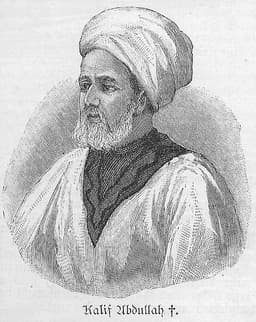
Abdallahi ibn Muhammad
Emperor · Modern
50.5Total
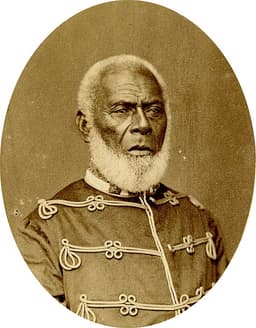
George Tupou I
Emperor · Modern
60.8Total
Basic Information
Born
1846
1797
Died
1899
1893
Era
Modern
Modern
Nationality
Sudan
Tonga
Occupation
Emperor
Emperor
Civilization
Other
Other
Score Comparison
Military (10%)
52.5
55.0
Political (20%)
43.7
75.0
Influence (20%)
52.5
55.0
Legacy (20%)
40.8
52.0
Leadership (15%)
62.2
85.0
Strategy (15%)
60.0
45.0
TOTAL
50.5
60.8
Abdallahi ibn Muhammad — Complete Timeline
1885 AD
Succession as KhalifaPolitical Action
Following Muhammad Ahmad's death, Abdallahi ibn Muhammad succeeded him as Khalifa (successor) of the Mahdist state. He consolidated power by eliminating rivals and establishing a military dictatorship based on his Ta'aisha tribe.
SuccessionMahdist StateConsolidation
Impact: regional
1898 AD
Battle of OmdurmanWar
Anglo-Egyptian forces under General Herbert Kitchener defeated the Mahdist army at Omdurman on September 2, 1898. The battle resulted in over 10,000 Mahdist casualties and effectively ended the Mahdist state's control over Sudan.
Battle of OmdurmanMahdist WarKitchener
Impact: regional
1899 AD
Death at the Battle of Umm DiwaykaratWar◆ Major
Abdallahi ibn Muhammad was killed in action at the Battle of Umm Diwaykarat on November 25, 1899. His death marked the final defeat of the Mahdist movement and the establishment of Anglo-Egyptian condominium rule over Sudan.
Final BattleMahdist DefeatAnglo-Egyptian Sudan
Impact: regionaltragic
George Tupou I — Complete Timeline
1831 AD
Converted to Christianity and made it the state religionCultural◆ Major
George Tupou I converted to Christianity under the influence of Methodist missionaries. He later made Christianity the official religion of Tonga, which shaped the nation's laws and social structure, including the abolition of traditional pagan practices.
TongaReligionChristianity
Impact: regionalconstructive
1845 AD
Unified Tonga under one ruleWar
George Tupou I, then known as Taufa'ahau, completed the unification of Tonga after a series of wars and alliances. He defeated rival chiefs and consolidated the islands under his rule, ending centuries of civil conflict.
TongaUnificationKingdom
Impact: regionalconstructive
1862 AD
Abolished serfdom and established land rightsReform◆ Major
George Tupou I abolished the traditional system of serfdom and granted land rights to commoners. He decreed that every adult male Tongan was entitled to a plot of land for farming, a policy that continues to shape Tongan society.
TongaLand ReformSocial Change
Impact: regionalprogressive
1875 AD
Promulgated the Constitution of 1875Reform
George Tupou I issued Tonga's first written constitution, establishing a constitutional monarchy with a parliament, judiciary, and protection of civil rights. This constitution remains in force today, making Tonga the only Pacific island nation to never lose its indigenous governance.
TongaConstitutionReform
Impact: regionalprogressive
This comparison has not been analyzed yet.
One-time AI generation (~1 minute). Scores and timeline are already available below.
Rankings
🥇
George Tupou ILeader
Mil: 55.0Pol: 75.0Inf: 55.0
60.8
🥈
Abdallahi ibn Muhammad
Mil: 52.5Pol: 43.7Inf: 52.5
50.5
+10.3 behind
How This Comparison Works
Algorithm
Each figure is scored on 6 dimensions (0—100 scale) based on structured historical data: Military (10%), Political (20%), Influence (20%), Legacy (20%), Leadership (15%), Strategy (15%). The weighted total produces the final ranking.
Data Sources
Scores are computed from structured sub-indicators in the database. Scale factors adjust for era (Ancient ×0.85, Modern ×1.0) and civilization size (Eastern ×1.05, Other ×0.80) to account for differences in population and military scale.
Maximum 3 Figures
Comparisons are limited to 2—3 figures to ensure readability and statistical meaningfulness.
Error Margins
±5 points per dimension — Sub-scores are derived from historical records with inherent uncertainty. Two figures within 5 points on a dimension should be considered roughly equivalent in that area.
Total Score Accuracy
±3 points overall — The weighted combination of 6 dimensions produces a total score with approximately ±3 points of uncertainty. Differences of less than 3 points are not statistically significant— the figures are effectively tied.
Known Limitations
- Historical records are incomplete and uneven across civilizations
- Figures from oral-tradition societies may be underrepresented
- Occupation labels can misclassify multi-role figures
- Scores measure capability and impact, not moral character
- Quantitative scoring is a comparison tool, not absolute truth
Capability Radar
Military (10%) — Battles & Warfare
Battles
60
20
Win Rate
55
25
Expansion
50
45
Political (20%) — Governance & Reform
Reform
35
80
Diplomacy
30
75
Economy
25
70
Influence (20%) — Cultural & Global Reach
Cultural
30
60
Global
25
55
Legacy (20%) — Historical Impact
Historical
35
65
Longevity
20
70
Leadership (15%) — Power & Stability
Tenure
40
85
Stability
20
80
Strategy (15%) — Tactics & Innovation
Strategy
45
35
Tactics
50
30
Reform
40
40
Similar Comparisons
Comments & Discussion
No comments yet. Be the first to share your thoughts!