Loading...
Abolhassan Banisadr vs Ashraf Ghani
Ashraf Ghani leads by 3.7 pts · 2 figures compared
…
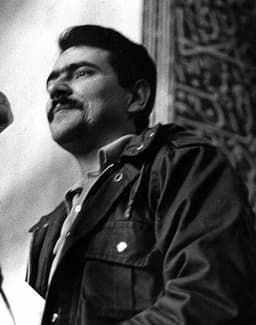
Abolhassan Banisadr
Politician · Modern
39.0Total

Ashraf Ghani
Politician · Modern
42.7Total
Basic Information
Born
1933
1949
Died
—
—
Era
Modern
Modern
Nationality
Iran
Afghanistan
Occupation
Politician
Politician
Civilization
Middle Eastern
Middle Eastern
Score Comparison
Military (10%)
30.2
23.0
Political (20%)
26.4
43.7
Influence (20%)
49.4
48.6
Legacy (20%)
40.0
37.5
Leadership (15%)
34.6
55.3
Strategy (15%)
44.5
39.9
TOTAL
39.0
42.7
Abolhassan Banisadr — Complete Timeline
1980 AD
Iran-Iraq War BeginsWar◆ Major
As president, Banisadr oversaw Iran's initial response to the Iraqi invasion in September 1980. He advocated for a professional military strategy, but his authority was undermined by hardliners and the Revolutionary Guards.
Iran-Iraq WarMilitaryConflict
Impact: regionaltragic
Election as First President of IranPolitical Action◆ Major
Abolhassan Banisadr won Iran's first presidential election after the 1979 Islamic Revolution, with 76% of the vote. He was a close ally of Ayatollah Khomeini and advocated for a democratic Islamic republic.
ElectionIslamic RevolutionIran
Impact: nationalconstructive
1981 AD
Impeachment and ExilePolitical Action◆ Major
Banisadr was impeached by the Iranian parliament in June 1981 after conflicts with the clerical establishment. He fled to France, where he lived in exile, and was sentenced to death in absentia.
ImpeachmentExilePolitical Conflict
Impact: nationaltragic
Ashraf Ghani — Complete Timeline
2014 AD
Election as President of AfghanistanPolitical Action◆ Major
Ashraf Ghani won the 2014 presidential election after a disputed runoff against Abdullah Abdullah. A US-brokered agreement led to a National Unity Government, with Ghani as president and Abdullah as chief executive. The election was marred by allegations of fraud.
AfghanistanElectionPower-Sharing
Impact: national
2015 AD
Implementation of economic reformsReform
Ghani, a former World Bank official, implemented economic reforms including anti-corruption measures, tax collection improvements, and efforts to attract foreign investment. His reforms had limited success due to ongoing conflict, weak institutions, and widespread corruption.
AfghanistanEconomyReform
Impact: nationalconstructive
2020 AD
Signing of the US-Taliban peace dealPolitical Action◆ Major
Ghani's government was sidelined when the United States signed a peace deal directly with the Taliban in Doha. The agreement set a timeline for US withdrawal and intra-Afghan negotiations. Ghani criticized the deal for excluding his government, weakening his position.
AfghanistanUnited StatesPeace Process
Impact: nationaldestructive
2021 AD
Fall of Kabul and flight from AfghanistanPolitical Action
As the Taliban advanced on Kabul in August 2021, Ashraf Ghani fled Afghanistan to the United Arab Emirates. His sudden departure led to the collapse of the Afghan government and the Taliban's rapid takeover of the country. He was widely criticized for abandoning his post.
AfghanistanTalibanCollapse
Impact: nationaltragic
Expert Analysis
Origins
Abolhassan Banisadr was born in 1933 in Hamadan, Iran, into a religious family. His father was an ayatollah, and Banisadr studied Islamic law and economics at the University of Tehran. He became involved in opposition to the Shah in the 1960s, fleeing to France in 1963, where he collaborated with Ayatollah Khomeini in exile. There, he developed a blend of Islamic and economic theory, advocating for a non-aligned, populist state.
Ashraf Ghani was born in 1949 in Logar Province, Afghanistan, into a Pashtun family. His father was a senior civil servant. Ghani studied at the American University of Beirut and later earned a PhD in anthropology from Columbia University. He worked at the World Bank for over a decade, focusing on state-building and economic development in countries like Russia and India. His academic and technocratic background shaped his approach to governance.
Rise to Power
Banisadr rose as a key ideologue of the Iranian Revolution. After the Shah's fall in 1979, he returned to Iran and became a close advisor to Khomeini. In January 1980, he won the first presidential election with 76% of the vote, positioning himself as a moderate revolutionary who favored a mixed economy and professional military. However, his power was constrained by the parallel clerical institutions, especially the Islamic Republican Party (IRP).
Ghani rose through technocratic channels. He served as finance minister under President Hamid Karzai from 2002 to 2004, implementing currency reform and economic stabilization. After a period at the World Bank and as chancellor of Kabul University, he ran for president in 2009 but lost to Karzai. In 2014, he won a disputed runoff against Abdullah Abdullah, leading to a US-brokered National Unity Government where he shared power as president with Abdullah as chief executive.
Leadership & Governance
Banisadr's leadership was marked by his conflict with the clerical establishment. He advocated for a professional military during the Iran-Iraq War, opposing the Revolutionary Guards' expansion. He sought to reduce the power of the IRP and protect individual rights, but his policies were blocked by the parliament and Khomeini. His governance style was intellectual and aloof, failing to build a strong political base. He scored 34.6 in leadership, reflecting his inability to consolidate power.
Ghani led as a reform-minded technocrat. He implemented anti-corruption measures, improved tax collection, and tried to centralize government control. He also pushed for peace negotiations with the Taliban but was often sidelined by the US direct talks. His leadership score of 55.3 is higher, but his style was criticized as micro-managing and dismissive of rivals. He failed to unite the Afghan political elite, and his government was plagued by infighting. His political score of 43.7 reflects moderate success in navigating a fractured system.
Triumph & Tragedy
Banisadr's triumph was his role in the revolution and being elected as Iran's first president. He also successfully advocated for a constitution that included a directly elected president. However, his tragedy was his impeachment in June 1981 after only 16 months in office. He was forced into exile in France, where he lived for decades, marginalized. His failure to maintain unity and his open opposition to the clergy led to his downfall.
Ghani's triumph was his economic reforms: he stabilized Afghanistan's currency, increased revenue collection from $500 million to $2 billion, and launched the National Solidarity Program. His tragedy was the chaotic fall of Kabul in August 2021. As the Taliban advanced, Ghani fled to the UAE, leading to the collapse of the government and a humanitarian crisis. His departure was widely condemned, and his legacy is marred by the collapse he oversaw. His military score of 23.0 reflects his lack of control over security.
Character & Destiny
Banisadr was an intellectual idealist, convinced of his own vision but unable to compromise. He scored 44.5 in strategy, indicating some tactical sense, but his political inflexibility doomed him. He believed he could challenge the clergy, but Khomeini's authority was absolute. His character—principled but politically naive—led to his exile.
Ghani was a technocrat with a vision of a modern, centralized state. He scored 39.9 in strategy, reflecting his top-down approach. His character was arrogant and aloof, alienating allies and rivals alike. He trusted US support too much and failed to build a domestic political base. His destiny was to be the president who fled, a symbol of failure.
Legacy
Banisadr's legacy is mixed. He is remembered as the first president of the Islamic Republic, but his tenure was short and ineffective. His ideas about Islamic economics and democracy have few followers. He scored 40.0 in legacy, higher than his leadership, due to his pioneering role. However, his exile made him a footnote in Iranian history.
Ghani's legacy is largely negative. He will be remembered as the leader who abandoned his country. His economic reforms were overshadowed by the Taliban's return. He scored 37.5 in legacy, lower than his total score. The collapse of the republic he led defines his historical standing.
Conclusion
While Ashraf Ghani's total score (42.7) is higher than Banisadr's (39.0), Banisadr had greater impact because he was a foundational figure of a regime that persists. Ghani oversaw the end of a republic. Banisadr's legacy, though limited, is part of a revolution that changed the Middle East. Ghani's legacy is one of failure and flight. Banisadr's influence score of 49.4 vs Ghani's 48.6 is close, but Banisadr's position as first president of a lasting system gives him the edge. Therefore, Banisadr had a more significant historical impact.
Rankings
🥇
Ashraf GhaniLeader
Mil: 23.0Pol: 43.7Inf: 48.6
42.7
🥈
Abolhassan Banisadr
Mil: 30.2Pol: 26.4Inf: 49.4
39.0
+3.7 behind
How This Comparison Works
Algorithm
Each figure is scored on 6 dimensions (0—100 scale) based on structured historical data: Military (10%), Political (20%), Influence (20%), Legacy (20%), Leadership (15%), Strategy (15%). The weighted total produces the final ranking.
Data Sources
Scores are computed from structured sub-indicators in the database. Scale factors adjust for era (Ancient ×0.85, Modern ×1.0) and civilization size (Eastern ×1.05, Other ×0.80) to account for differences in population and military scale.
Maximum 3 Figures
Comparisons are limited to 2—3 figures to ensure readability and statistical meaningfulness.
Error Margins
±5 points per dimension — Sub-scores are derived from historical records with inherent uncertainty. Two figures within 5 points on a dimension should be considered roughly equivalent in that area.
Total Score Accuracy
±3 points overall — The weighted combination of 6 dimensions produces a total score with approximately ±3 points of uncertainty. Differences of less than 3 points are not statistically significant— the figures are effectively tied.
Known Limitations
- Historical records are incomplete and uneven across civilizations
- Figures from oral-tradition societies may be underrepresented
- Occupation labels can misclassify multi-role figures
- Scores measure capability and impact, not moral character
- Quantitative scoring is a comparison tool, not absolute truth
Capability Radar
Military (10%) — Battles & Warfare
Battles
19
21
Win Rate
25
23
Expansion
27
26
Political (20%) — Governance & Reform
Reform
20
30
Diplomacy
15
25
Economy
10
50
Influence (20%) — Cultural & Global Reach
Cultural
10
10
Global
15
20
Legacy (20%) — Historical Impact
Historical
20
15
Longevity
10
10
Leadership (15%) — Power & Stability
Tenure
15
40
Stability
5
10
Strategy (15%) — Tactics & Innovation
Strategy
30
33
Tactics
32
35
Reform
36
36
Similar Comparisons
Comments & Discussion
No comments yet. Be the first to share your thoughts!