Loading...
Abolhassan Banisadr vs Chan Santokhi
Chan Santokhi leads by 10.0 pts · 2 figures compared
…
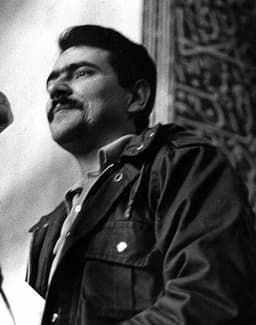
Abolhassan Banisadr
Politician · Modern
39.0Total
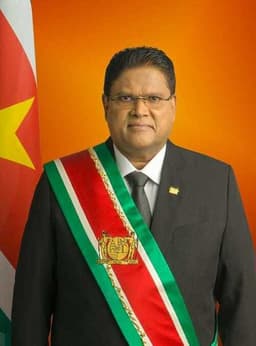
Chan Santokhi
Politician · Modern
49.0Total
Basic Information
Born
1933
1959
Died
—
—
Era
Modern
Modern
Nationality
Iran
Suriname
Occupation
Politician
Politician
Civilization
Middle Eastern
Other
Score Comparison
Military (10%)
30.2
50.0
Political (20%)
26.4
45.0
Influence (20%)
49.4
50.2
Legacy (20%)
40.0
40.8
Leadership (15%)
34.6
68.0
Strategy (15%)
44.5
42.9
TOTAL
39.0
49.0
Abolhassan Banisadr — Complete Timeline
1980 AD
Iran-Iraq War BeginsWar◆ Major
As president, Banisadr oversaw Iran's initial response to the Iraqi invasion in September 1980. He advocated for a professional military strategy, but his authority was undermined by hardliners and the Revolutionary Guards.
Iran-Iraq WarMilitaryConflict
Impact: regionaltragic
Election as First President of IranPolitical Action◆ Major
Abolhassan Banisadr won Iran's first presidential election after the 1979 Islamic Revolution, with 76% of the vote. He was a close ally of Ayatollah Khomeini and advocated for a democratic Islamic republic.
ElectionIslamic RevolutionIran
Impact: nationalconstructive
1981 AD
Impeachment and ExilePolitical Action◆ Major
Banisadr was impeached by the Iranian parliament in June 1981 after conflicts with the clerical establishment. He fled to France, where he lived in exile, and was sentenced to death in absentia.
ImpeachmentExilePolitical Conflict
Impact: nationaltragic
Chan Santokhi — Complete Timeline
1991 AD
Appointed Police CommissionerPolitical Action
Santokhi was appointed Commissioner of the Suriname Police Force, a position he held until 2005. His tenure was noted for efforts to professionalize the force and combat crime, though it also coincided with periods of political tension.
PoliceLaw EnforcementCareer
Impact: national
2000 AD
Led investigation into December MurdersPolitical Action◆ Major
As Police Commissioner, Santokhi oversaw the investigation into the 1982 December Murders, in which 15 political opponents of the military regime were executed. This investigation eventually led to the trial and conviction of former President Desi Bouterse.
Human RightsJusticeDecember Murders
Impact: nationalconstructive
2005 AD
Elected to National AssemblyPolitical Action
Santokhi was elected to the National Assembly of Suriname as a member of the Progressive Reform Party (VHP). This marked his transition from police leadership to formal politics.
ParliamentPolitical CareerVHP
Impact: national
Appointed Minister of Justice and PolicePolitical Action
Santokhi served as Minister of Justice and Police under President Ronald Venetiaan. He continued efforts to reform the justice system and pursue accountability for past human rights abuses.
CabinetJustice ReformVenetiaan
Impact: nationalconstructive
2020 AD
Elected President of SurinamePolitical Action◆ Major
Chan Santokhi was elected President of Suriname by the National Assembly, succeeding Desi Bouterse. His election marked a shift in Suriname's political landscape after a period of economic difficulty and the previous administration's legal troubles.
ElectionPresidencySuriname
Impact: nationalconstructive
Expert Analysis
Origins
Abolhassan Banisadr was born in 1933 in Hamadan, Iran, into a religious family. His father was an ayatollah. He studied at the University of Tehran and later in France, where he became involved in anti-Shah activism alongside Ayatollah Khomeini. His exile in France shaped his political ideology, blending Islamic thought with modernist economics.
Chan Santokhi was born in 1959 in Lelydorp, Suriname, to a family of Indian descent. He studied at the Police Academy in Suriname and later at the Dutch Police Academy. His early career was in law enforcement, rising through the ranks to become Police Commissioner. His background as a police chief, not a revolutionary, defined his approach to governance.
Rise to Power
Banisadr's rise was meteoric. After the 1979 Iranian Revolution, he became a key economic adviser and was elected president in January 1980 with 76% of the vote. His close ties to Khomeini and his role in drafting the constitution positioned him as the first head of state of the Islamic Republic.
Santokhi's path was gradual. He was appointed Police Commissioner in 2000, leading the investigation into the 1982 December Murders. This brought him political capital. He entered politics with the Progressive Reform Party (VHP), served as Minister of Justice and Police (2005-2010), and was elected president in 2020 after defeating Desi Bouterse. His rise was a shift from security to political leadership.
Leadership & Governance
Banisadr's leadership was chaotic. As president during the Iran-Iraq War (starting September 1980), he advocated for a professional military strategy but clashed with clerics and the Revolutionary Guard. He attempted to centralize power but lacked institutional support. His governance score of 34.6 reflects his inability to consolidate authority.
Santokhi's leadership is pragmatic. He focused on rule of law, anti-corruption, and economic recovery. As president, he inherited a crisis-ridden economy and pursued IMF agreements. His police background gave him a security-oriented approach, earning a leadership score of 68.0. He decentralized decision-making but faced criticism for slow reforms.
Triumph & Tragedy
Banisadr's triumph was winning Iran's first presidential election and shaping early revolutionary policy. His tragedy was his impeachment in June 1981 after 16 months in office, fleeing to France where he lived in exile. His failure to balance revolutionary factions led to his downfall. He scored 44.5 in strategy but 30.2 in military, reflecting poor wartime coordination.
Santokhi's triumph was overseeing the December Murders investigation, which held the military regime accountable, and winning the presidency in 2020. His tragedy is the slow pace of economic revival and persistent corruption. His military score of 50.0 is average, but his political score of 45.0 shows moderate effectiveness.
Character & Destiny
Banisadr was idealistic but inflexible. He believed in a hybrid Islamic-democratic system but could not navigate the clerical power structure. His destiny was exile, a pattern common among Iranian dissidents. His total score of 39.0 reflects a promising start undone by political naivete.
Santokhi is methodical and resilient. His police training gave him a step-by-step approach. He survived political shifts and Bouterse's resistance. His total score of 49.0 indicates steady, if unspectacular, progress. His destiny is to lead a small nation toward stability.
Legacy
Banisadr's legacy is as a footnote in Iranian history: the first president who failed. His ideas on Islamic economics are largely forgotten. In Iran, he is remembered as a dissident who opposed theocracy. His influence score of 49.4 is moderate but limited to exile circles.
Santokhi's legacy is still unfolding. He is seen as a reformer who broke the cycle of military rule. His legacy hinges on economic success. His influence score of 50.2 is slightly higher than Banisadr's, but his impact is confined to Suriname.
Conclusion
Chan Santokhi had greater impact. His total score of 49.0 surpasses Banisadr's 39.0 by 10 points. Banisadr's presidency was too brief and chaotic to effect lasting change, while Santokhi's long career in police and politics brought tangible reforms to Suriname. Santokhi's leadership score of 68.0 dwarfs Banisadr's 34.6, and his ability to transition from investigator to head of state demonstrates adaptability. Banisadr's legacy is negative—a warning of revolutionary failure. Santokhi's is positive—a model of incremental progress. The data supports Santokhi as the more effective leader.
Rankings
🥇
Chan SantokhiLeader
Mil: 50.0Pol: 45.0Inf: 50.2
49.0
🥈
Abolhassan Banisadr
Mil: 30.2Pol: 26.4Inf: 49.4
39.0
+10.0 behind
How This Comparison Works
Algorithm
Each figure is scored on 6 dimensions (0—100 scale) based on structured historical data: Military (10%), Political (20%), Influence (20%), Legacy (20%), Leadership (15%), Strategy (15%). The weighted total produces the final ranking.
Data Sources
Scores are computed from structured sub-indicators in the database. Scale factors adjust for era (Ancient ×0.85, Modern ×1.0) and civilization size (Eastern ×1.05, Other ×0.80) to account for differences in population and military scale.
Maximum 3 Figures
Comparisons are limited to 2—3 figures to ensure readability and statistical meaningfulness.
Error Margins
±5 points per dimension — Sub-scores are derived from historical records with inherent uncertainty. Two figures within 5 points on a dimension should be considered roughly equivalent in that area.
Total Score Accuracy
±3 points overall — The weighted combination of 6 dimensions produces a total score with approximately ±3 points of uncertainty. Differences of less than 3 points are not statistically significant— the figures are effectively tied.
Known Limitations
- Historical records are incomplete and uneven across civilizations
- Figures from oral-tradition societies may be underrepresented
- Occupation labels can misclassify multi-role figures
- Scores measure capability and impact, not moral character
- Quantitative scoring is a comparison tool, not absolute truth
Capability Radar
Military (10%) — Battles & Warfare
Battles
19
23
Win Rate
25
27
Expansion
27
27
Political (20%) — Governance & Reform
Reform
20
60
Diplomacy
15
65
Economy
10
55
Influence (20%) — Cultural & Global Reach
Cultural
10
20
Global
15
20
Legacy (20%) — Historical Impact
Historical
20
25
Longevity
10
20
Leadership (15%) — Power & Stability
Tenure
15
55
Stability
5
50
Strategy (15%) — Tactics & Innovation
Strategy
30
28
Tactics
32
35
Reform
36
34
Similar Comparisons
Comments & Discussion
No comments yet. Be the first to share your thoughts!