Loading...
Abubakari I vs Henry VI of England
Henry VI of England leads by 0.5 pts · 2 figures compared
…

Abubakari I
Emperor · Medieval
37.3Total
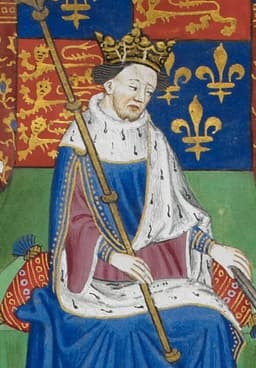
Henry VI of England
Emperor · Medieval
37.8Total
Basic Information
Born
1270
1421
Died
1285
1471
Era
Medieval
Medieval
Nationality
Mali Empire
England
Occupation
Emperor
Emperor
Civilization
Other
Western
Score Comparison
Military (10%)
21.2
20.0
Political (20%)
26.4
30.7
Influence (20%)
47.9
47.9
Legacy (20%)
37.5
40.0
Leadership (15%)
41.5
31.2
Strategy (15%)
36.8
45.0
TOTAL
37.3
37.8
Henry VI of England — Complete Timeline
1444 AD
Treaty of ToursPolitical Action◆ Major
Henry VI agreed to a truce with France through the Treaty of Tours, which included his marriage to Margaret of Anjou. The truce was intended to pause the Hundred Years' War but was criticized for ceding territory and failing to secure lasting peace.
Hundred Years' WarDiplomacyMarriage
Impact: regional
1453 AD
Loss of GasconyWar
The French army defeated English forces at the Battle of Castillon, ending English rule in Gascony and effectively concluding the Hundred Years' War. This loss stripped England of its last major continental possession, marking a decisive defeat for Henry VI's reign.
Hundred Years' WarTerritorial LossDefeat
Impact: regionaldestructive
1455 AD
First Battle of St AlbansWar
Richard, Duke of York, led forces against the king's army at St Albans, capturing Henry VI. This battle marked the start of the Wars of the Roses, a series of civil wars between the Houses of York and Lancaster for control of the English throne.
Wars of the RosesCivil WarCapture
Impact: nationaldestructive
1460 AD
Act of AccordPolitical Action◆ Major
Henry VI agreed to the Act of Accord, which named Richard, Duke of York, as his heir, disinheriting his own son Edward. This agreement aimed to end the conflict but was rejected by Queen Margaret, leading to continued warfare.
Wars of the RosesSuccessionCompromise
Impact: national
1470 AD
Readeption of Henry VIPolitical Action◆ Major
After being deposed and imprisoned, Henry VI was restored to the throne by the Earl of Warwick and Queen Margaret. This brief return to power lasted only six months before Edward IV reclaimed the crown at the Battle of Barnet.
Wars of the RosesRestorationPower Shift
Impact: national
Expert Analysis
Origins
Abubakari I (also known as Mansa Abubakari, likely early 14th century) was a mansa (emperor) of the Mali Empire, hailing from the Keita dynasty. He was the first ruler from the line of Sundiata Keita's daughter, indicating a shift in succession. Details of his early life are scarce, but his reign is recorded in the Tarikh al-Sudan and through oral traditions. He is believed to have been a learned and pious leader, possibly with a scholarly background before ascending the throne.
Henry VI of England (1421–1471) was the only child of Henry V and Catherine of Valois. Born during the Hundred Years' War, he became king at nine months old upon his father's death. His upbringing was dominated by regents and nobles, leaving him ill-prepared for rule. He was known for his devout religiosity, founding Eton College and King's College, Cambridge, but lacked the decisiveness needed for kingship.
Rise to Power
Abubakari I came to power after a period of internal dynastic struggle. The Mali Empire, founded by Sundiata Keita, had seen several rulers from different branches. Abubakari's accession marked a return to Sundiata's direct lineage through his daughter. His rise was likely peaceful, supported by the empire's powerful court and military leaders. Specific dates are unknown, but his reign is placed in the early 1300s.
Henry VI's rise was automatic due to primogeniture, but his effective power was limited until he came of age. He was crowned King of England at Westminster Abbey in 1429 and King of France at Notre-Dame in Paris in 1431, but real control rested with his regents, including his uncles John, Duke of Bedford, and Humphrey, Duke of Gloucester. His personal rule began in 1437, but he remained heavily influenced by advisors.
Leadership & Governance
Abubakari I's governance is poorly documented, but he is remembered as a just and pious ruler who maintained the Mali Empire's stability and prosperity. The empire at its height controlled vast gold mines and trans-Saharan trade routes. His leadership style likely emphasized continuity with Sundiata's traditions, though no major reforms or conquests are recorded. His political score of 26.4 reflects limited known achievements.
Henry VI's leadership was marked by indecision and favoritism. He relied heavily on his wife, Margaret of Anjou, and favorites like William de la Pole, Duke of Suffolk. His inability to control the nobility led to factionalism. The Treaty of Tours (1444) secured a truce with France but ceded Maine, angering many. His governance score of 30.7 is slightly higher than Abubakari's, but his reign was plagued by weak oversight and financial mismanagement.
Triumph & Tragedy
Abubakari I's greatest success was maintaining the Mali Empire's unity and prestige. Under his rule, the empire continued to be a center of wealth and learning. However, his greatest failure may have been his lack of expansion or innovation, as the empire's power gradually waned after his reign. No major military campaigns or cultural achievements are attributed to him, earning a military score of 21.2.
Henry VI's triumphs include the founding of Eton College and King's College, Cambridge, which endure as educational institutions. His piety and patronage of learning are notable. However, his tragedies dominate: the loss of the Hundred Years' War (culminating in the Battle of Castillon in 1453, where English rule in Gascony ended), the outbreak of the Wars of the Roses (first Battle of St Albans in 1455), and his deposition and murder. The Act of Accord (1460) disinherited his son, causing further chaos. His military score of 20.0 reflects these losses.
Character & Destiny
Abubakari I is portrayed in oral traditions as a wise and spiritual leader, possibly more interested in scholarship than conquest. His character aligned with a peaceful reign in a stable empire, but his lack of assertive action may have limited his impact. His legacy score of 37.5 reflects his relatively minor historical footprint.
Henry VI was deeply religious and gentle, but these traits made him a weak king in a turbulent era. He was prone to bouts of mental illness, possibly inherited from his grandfather Charles VI of France. His passivity led to his downfall, as he was unable to control the ambitious nobles who tore England apart. His character, while personally admirable, was disastrous for his kingdom. His influence score of 47.9 ties with Abubakari's, but his legacy is more tangible.
Legacy
Abubakari I's legacy is minimal in the broader historical record. He is remembered primarily as a transitional figure in the Keita dynasty, but his reign did not produce lasting changes. The Mali Empire continued, but his reign is overshadowed by more famous rulers like Mansa Musa. His total score of 37.3 reflects his obscurity.
Henry VI's legacy is more complex. He is remembered as a failed king who lost the Hundred Years' War and triggered the Wars of the Roses. However, his educational foundations survive, and his reign saw the establishment of Eton and King's College. He is also a saint in the Anglican Church, venerated by some. His total score of 37.8 slightly edges out Abubakari's, but his negative impact on England's stability is significant.
Conclusion
While Henry VI scores marginally higher overall (37.8 vs 37.3), the comparison reveals two monarchs who were largely ineffective. Abubakari I maintained the status quo in a prosperous empire, while Henry VI presided over catastrophic losses and civil war. In terms of impact, Henry VI had a more tangible, though largely negative, effect on history. His actions (and inactions) directly shaped England's trajectory, while Abubakari's reign was a quiet continuation. Therefore, Henry VI had greater historical impact, but not for the better. His legacy is a cautionary tale of weak leadership, whereas Abubakari's is a footnote.
Rankings
🥇
Henry VI of EnglandLeader
Mil: 20.0Pol: 30.7Inf: 47.9
37.8
🥈
Abubakari I
Mil: 21.2Pol: 26.4Inf: 47.9
37.3
+0.5 behind
How This Comparison Works
Algorithm
Each figure is scored on 6 dimensions (0—100 scale) based on structured historical data: Military (10%), Political (20%), Influence (20%), Legacy (20%), Leadership (15%), Strategy (15%). The weighted total produces the final ranking.
Data Sources
Scores are computed from structured sub-indicators in the database. Scale factors adjust for era (Ancient ×0.85, Modern ×1.0) and civilization size (Eastern ×1.05, Other ×0.80) to account for differences in population and military scale.
Maximum 3 Figures
Comparisons are limited to 2—3 figures to ensure readability and statistical meaningfulness.
Error Margins
±5 points per dimension — Sub-scores are derived from historical records with inherent uncertainty. Two figures within 5 points on a dimension should be considered roughly equivalent in that area.
Total Score Accuracy
±3 points overall — The weighted combination of 6 dimensions produces a total score with approximately ±3 points of uncertainty. Differences of less than 3 points are not statistically significant— the figures are effectively tied.
Known Limitations
- Historical records are incomplete and uneven across civilizations
- Figures from oral-tradition societies may be underrepresented
- Occupation labels can misclassify multi-role figures
- Scores measure capability and impact, not moral character
- Quantitative scoring is a comparison tool, not absolute truth
Capability Radar
Military (10%) — Battles & Warfare
Battles
10
5
Win Rate
10
5
Expansion
10
5
Political (20%) — Governance & Reform
Reform
20
10
Diplomacy
20
15
Economy
20
10
Influence (20%) — Cultural & Global Reach
Cultural
15
15
Global
10
10
Legacy (20%) — Historical Impact
Historical
15
25
Longevity
10
15
Leadership (15%) — Power & Stability
Tenure
30
30
Stability
20
5
Strategy (15%) — Tactics & Innovation
Strategy
10
5
Tactics
10
5
Reform
10
5
Similar Comparisons
Comments & Discussion
No comments yet. Be the first to share your thoughts!