Loading...
This comparison has not been analyzed yet.
One-time AI generation (~1 minute). Scores and timeline are already available below.
Ahidjo Ahmadou vs Bhimsen Thapa
Bhimsen Thapa leads by 3.3 pts · 2 figures compared
…

Ahidjo Ahmadou
Politician · Modern
54.6Total
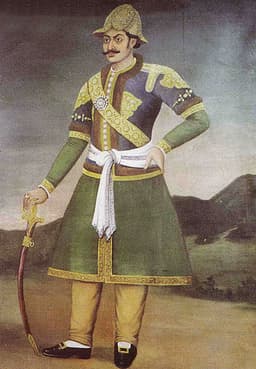
Bhimsen Thapa
Politician · Modern
57.9Total
Basic Information
Born
1924
1775
Died
—
1839
Era
Modern
Modern
Nationality
Cameroon
Nepal
Occupation
Politician
Politician
Civilization
Other
Indian
Score Comparison
Military (10%)
35.0
55.0
Political (20%)
72.0
68.0
Influence (20%)
55.7
54.9
Legacy (20%)
45.8
50.0
Leadership (15%)
72.0
68.0
Strategy (15%)
41.7
57.5
TOTAL
54.6
57.9
Ahidjo Ahmadou — Complete Timeline
1960 AD
Became First President of CameroonPolitical Action◆ Major
Ahmadou Ahidjo became the first president of independent Cameroon, leading the French-speaking part. He later oversaw the unification with the British Southern Cameroons to form the Federal Republic of Cameroon in 1961.
IndependenceUnificationFounding Father
Impact: nationalconstructive
1966 AD
Established One-Party StatePolitical Action◆ Major
Ahidjo merged all political parties into the Cameroon National Union (UNC), establishing a one-party state. This move consolidated his power and suppressed political dissent, but also brought stability to the ethnically diverse nation.
AuthoritarianismPolitical ConsolidationStability
Impact: national
1982 AD
Resigned from PresidencyPolitical Action
Ahmadou Ahidjo unexpectedly resigned as president, citing health reasons. He handed power to his Prime Minister Paul Biya. However, he later attempted to regain influence, leading to a power struggle and his conviction for plotting a coup.
ResignationPower TransferPolitical Crisis
Impact: national
Bhimsen Thapa — Complete Timeline
1806 AD
Appointment as Mukhtiyar of NepalPolitical Action
Bhimsen Thapa became the first Mukhtiyar (equivalent to prime minister) of Nepal after the assassination of Rana Bahadur Shah. He consolidated power and became the de facto ruler, serving under the minor king Girvan Yuddha Bikram Shah.
MukhtiyarPrime MinisterPower Consolidation
Impact: national
1810 AD
Modernization of the Nepalese ArmyReform◆ Major
Bhimsen Thapa modernized the Nepalese army by introducing European-style training, weapons, and organization. He established arsenals, recruited Gurkha soldiers, and expanded the army's size, making it a formidable force in the region.
Military ReformModernizationGurkha Army
Impact: nationalconstructive
1814 AD
Anglo-Nepalese War (1814-1816)War
Bhimsen Thapa led Nepal into the Anglo-Nepalese War against the British East India Company. Despite initial Nepalese victories, the war ended with the Treaty of Sugauli in 1816, which forced Nepal to cede territories including Sikkim and Kumaon.
Anglo-Nepalese WarTreaty of SugauliTerritorial Loss
Impact: regionaldestructive
1816 AD
Treaty of SugauliPolitical Action◆ Major
Bhimsen Thapa signed the Treaty of Sugauli with the British, ending the Anglo-Nepalese War. Nepal lost about one-third of its territory, including the Tarai plains, and was forced to accept a British resident in Kathmandu, limiting its sovereignty.
TreatyTerritorial LossBritish Influence
Impact: regionaldestructive
1837 AD
Fall from Power and SuicidePolitical Action◆ Major
Bhimsen Thapa was removed from power in 1837 after a court intrigue and accusations of poisoning the young king. He was imprisoned and later committed suicide in 1839, ending his 31-year dominance over Nepalese politics.
DownfallImprisonmentSuicide
Impact: nationaltragic
This comparison has not been analyzed yet.
One-time AI generation (~1 minute). Scores and timeline are already available below.
Rankings
🥇
Bhimsen ThapaLeader
Mil: 55.0Pol: 68.0Inf: 54.9
57.9
🥈
Ahidjo Ahmadou
Mil: 35.0Pol: 72.0Inf: 55.7
54.6
+3.3 behind
How This Comparison Works
Algorithm
Each figure is scored on 6 dimensions (0—100 scale) based on structured historical data: Military (10%), Political (20%), Influence (20%), Legacy (20%), Leadership (15%), Strategy (15%). The weighted total produces the final ranking.
Data Sources
Scores are computed from structured sub-indicators in the database. Scale factors adjust for era (Ancient ×0.85, Modern ×1.0) and civilization size (Eastern ×1.05, Other ×0.80) to account for differences in population and military scale.
Maximum 3 Figures
Comparisons are limited to 2—3 figures to ensure readability and statistical meaningfulness.
Error Margins
±5 points per dimension — Sub-scores are derived from historical records with inherent uncertainty. Two figures within 5 points on a dimension should be considered roughly equivalent in that area.
Total Score Accuracy
±3 points overall — The weighted combination of 6 dimensions produces a total score with approximately ±3 points of uncertainty. Differences of less than 3 points are not statistically significant— the figures are effectively tied.
Known Limitations
- Historical records are incomplete and uneven across civilizations
- Figures from oral-tradition societies may be underrepresented
- Occupation labels can misclassify multi-role figures
- Scores measure capability and impact, not moral character
- Quantitative scoring is a comparison tool, not absolute truth
Capability Radar
Military (10%) — Battles & Warfare
Battles
0
45
Win Rate
0
40
Expansion
10
35
Political (20%) — Governance & Reform
Reform
65
60
Diplomacy
70
50
Economy
55
45
Influence (20%) — Cultural & Global Reach
Cultural
40
40
Global
35
30
Legacy (20%) — Historical Impact
Historical
45
55
Longevity
30
45
Leadership (15%) — Power & Stability
Tenure
60
65
Stability
50
40
Strategy (15%) — Tactics & Innovation
Strategy
0
55
Tactics
0
50
Reform
20
70
Similar Comparisons
Comments & Discussion
No comments yet. Be the first to share your thoughts!