Loading...
Bhimsen Thapa vs Kiichi Miyazawa
Bhimsen Thapa leads by 11.5 pts · 2 figures compared
…
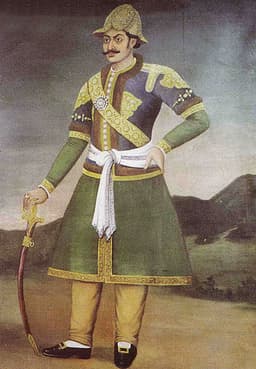
Bhimsen Thapa
Politician · Modern
57.9Total

Kiichi Miyazawa
Politician · Modern
46.4Total
Basic Information
Born
1775
1919
Died
1839
2007
Era
Modern
Modern
Nationality
Nepal
Japan
Occupation
Politician
Politician
Civilization
Indian
Eastern
Score Comparison
Military (10%)
55.0
14.6
Political (20%)
68.0
48.0
Influence (20%)
54.9
54.9
Legacy (20%)
50.0
45.0
Leadership (15%)
68.0
65.0
Strategy (15%)
57.5
30.0
TOTAL
57.9
46.4
Bhimsen Thapa — Complete Timeline
1806 AD
Appointment as Mukhtiyar of NepalPolitical Action
Bhimsen Thapa became the first Mukhtiyar (equivalent to prime minister) of Nepal after the assassination of Rana Bahadur Shah. He consolidated power and became the de facto ruler, serving under the minor king Girvan Yuddha Bikram Shah.
MukhtiyarPrime MinisterPower Consolidation
Impact: national
1810 AD
Modernization of the Nepalese ArmyReform◆ Major
Bhimsen Thapa modernized the Nepalese army by introducing European-style training, weapons, and organization. He established arsenals, recruited Gurkha soldiers, and expanded the army's size, making it a formidable force in the region.
Military ReformModernizationGurkha Army
Impact: nationalconstructive
1814 AD
Anglo-Nepalese War (1814-1816)War
Bhimsen Thapa led Nepal into the Anglo-Nepalese War against the British East India Company. Despite initial Nepalese victories, the war ended with the Treaty of Sugauli in 1816, which forced Nepal to cede territories including Sikkim and Kumaon.
Anglo-Nepalese WarTreaty of SugauliTerritorial Loss
Impact: regionaldestructive
1816 AD
Treaty of SugauliPolitical Action◆ Major
Bhimsen Thapa signed the Treaty of Sugauli with the British, ending the Anglo-Nepalese War. Nepal lost about one-third of its territory, including the Tarai plains, and was forced to accept a British resident in Kathmandu, limiting its sovereignty.
TreatyTerritorial LossBritish Influence
Impact: regionaldestructive
1837 AD
Fall from Power and SuicidePolitical Action◆ Major
Bhimsen Thapa was removed from power in 1837 after a court intrigue and accusations of poisoning the young king. He was imprisoned and later committed suicide in 1839, ending his 31-year dominance over Nepalese politics.
DownfallImprisonmentSuicide
Impact: nationaltragic
Kiichi Miyazawa — Complete Timeline
1991 AD
Elected Prime Minister of JapanPolitical Action◆ Major
Miyazawa was elected as Prime Minister of Japan, succeeding Toshiki Kaifu. He was a veteran LDP politician and former finance minister, taking office during the collapse of the Japanese asset price bubble.
JapanPrime MinisterLDP
Impact: national
1992 AD
Managed response to bubble economy collapsePolitical Action◆ Major
Miyazawa's government faced the bursting of Japan's asset price bubble, leading to a severe recession. He implemented economic stimulus packages and bank bailouts, but the economy entered a prolonged period of stagnation known as the Lost Decade.
JapanEconomic CrisisLost Decade
Impact: nationaltragic
1993 AD
Lost no-confidence vote and resignedPolitical Action◆ Major
Miyazawa lost a no-confidence motion in the Diet after failing to pass political reform bills. This triggered a general election that ended LDP rule, and Miyazawa resigned as prime minister and party leader.
JapanResignationPolitical Reform
Impact: nationaltragic
1998 AD
Served as Finance Minister during Asian financial crisisPolitical Action◆ Major
Miyazawa was appointed Finance Minister under Prime Minister Keizo Obuchi. He played a key role in Japan's response to the Asian financial crisis, including proposing the Miyazawa Initiative to provide financial assistance to affected countries.
JapanFinance MinisterAsian Financial Crisis
Impact: regionalconstructive
Expert Analysis
Origins
Bhimsen Thapa was born in 1775 in Gorkha, Nepal, into a noble family. His father, Amar Singh Thapa, was a prominent military commander. Bhimsen received traditional education and early exposure to court politics. He became a favorite of King Rana Bahadur Shah, which propelled his rise.
Kiichi Miyazawa was born in 1919 in Tokyo, Japan, to a political family. His father was a member of the Diet. Miyazawa studied law at Tokyo Imperial University and later joined the Ministry of Finance, gaining expertise in economic policy. His bureaucratic career provided a foundation for his political ascent.
Rise to Power
Bhimsen Thapa's rise was meteoric after the assassination of King Rana Bahadur Shah in 1806. He suppressed rivals and became the first Mukhtiyar (prime minister) of Nepal, consolidating power through strategic marriages and appointments. By 1806, he was the de facto ruler, controlling the army and administration.
Miyazawa entered politics in 1953, winning a seat in the Diet. He served in various ministerial posts, including Foreign Minister and Finance Minister. His technocratic skills earned him leadership of the Liberal Democratic Party (LDP). He became Prime Minister in 1991, succeeding Toshiki Kaifu, at a time when Japan's economic bubble was beginning to deflate.
Leadership & Governance
Bhimsen Thapa governed as an autocrat, centralizing authority and modernizing the military. He introduced European-style training, weapons, and organization, raising the army's effectiveness. His governance was authoritarian, suppressing dissent and concentrating power in his family. He pursued expansionist policies, leading to conflict with the British East India Company.
Miyazawa led as a consensus-builder, typical of LDP prime ministers. His governance focused on managing Japan's economic downturn. He implemented stimulus packages and bank bailouts, but his leadership was constrained by factional politics and a divided Diet. His failure to pass political reform led to a no-confidence vote and his resignation in 1993.
Triumph & Tragedy
Bhimsen Thapa's greatest success was modernizing the Nepalese army, which performed well initially in the Anglo-Nepalese War (1814-1816). However, his tragic failure was the war's outcome: the Treaty of Sugauli (1816) ceded a third of Nepal's territory. His downfall came in 1837 when he was accused of poisoning the young king, imprisoned, and committed suicide. His legacy of military modernization was overshadowed by territorial losses.
Miyazawa's triumph was his role as Finance Minister during the Asian financial crisis (1997-1998), where he helped stabilize Japan's economy. But his tragedy was his tenure as Prime Minister when the bubble burst, leading to a lost decade. He lost a no-confidence vote in 1993, ending LDP's long rule. His political influence declined thereafter.
Character & Destiny
Bhimsen Thapa was ambitious and ruthless, centralizing power and eliminating rivals. His aggressive foreign policy led to war with a superior power, sealing his fate. Historians note his authoritarian style as a double-edged sword: it enabled reforms but also isolated him.
Miyazawa was cautious and technocratic, relying on economic expertise. His hesitant leadership during the bubble collapse was criticized as inadequate. His character—risk-averse and consensus-oriented—prevented bold reforms, contributing to Japan's prolonged stagnation.
Legacy
Bhimsen Thapa is remembered as a modernizer who strengthened Nepal's military, but his territorial losses define his legacy negatively. Nepal's army retained his reforms, but his authoritarianism set a precedent for later Rana rule. His overall legacy score is 50.0.
Miyazawa's legacy is mixed: he is seen as a competent finance minister but a weak prime minister. His handling of the bubble burst is criticized, yet his later role in the Asian financial crisis is praised. His influence score is 54.9, reflecting his long career.
Conclusion
Bhimsen Thapa had greater overall impact with a total score of 57.9 versus Miyazawa's 46.4. Thapa's military and political reforms shaped Nepal's trajectory, despite his failures. Miyazawa's influence was limited by economic constraints and political gridlock. While both faced crises, Thapa's actions had more enduring consequences for his nation's sovereignty and military structure.
Rankings
🥇
Bhimsen ThapaLeader
Mil: 55.0Pol: 68.0Inf: 54.9
57.9
🥈
Kiichi Miyazawa
Mil: 14.6Pol: 48.0Inf: 54.9
46.4
+11.5 behind
How This Comparison Works
Algorithm
Each figure is scored on 6 dimensions (0—100 scale) based on structured historical data: Military (10%), Political (20%), Influence (20%), Legacy (20%), Leadership (15%), Strategy (15%). The weighted total produces the final ranking.
Data Sources
Scores are computed from structured sub-indicators in the database. Scale factors adjust for era (Ancient ×0.85, Modern ×1.0) and civilization size (Eastern ×1.05, Other ×0.80) to account for differences in population and military scale.
Maximum 3 Figures
Comparisons are limited to 2—3 figures to ensure readability and statistical meaningfulness.
Error Margins
±5 points per dimension — Sub-scores are derived from historical records with inherent uncertainty. Two figures within 5 points on a dimension should be considered roughly equivalent in that area.
Total Score Accuracy
±3 points overall — The weighted combination of 6 dimensions produces a total score with approximately ±3 points of uncertainty. Differences of less than 3 points are not statistically significant— the figures are effectively tied.
Known Limitations
- Historical records are incomplete and uneven across civilizations
- Figures from oral-tradition societies may be underrepresented
- Occupation labels can misclassify multi-role figures
- Scores measure capability and impact, not moral character
- Quantitative scoring is a comparison tool, not absolute truth
Capability Radar
Military (10%) — Battles & Warfare
Battles
45
14
Win Rate
40
19
Expansion
35
18
Political (20%) — Governance & Reform
Reform
60
40
Diplomacy
50
50
Economy
45
30
Influence (20%) — Cultural & Global Reach
Cultural
40
30
Global
30
30
Legacy (20%) — Historical Impact
Historical
55
35
Longevity
45
25
Leadership (15%) — Power & Stability
Tenure
65
55
Stability
40
25
Strategy (15%) — Tactics & Innovation
Strategy
55
24
Tactics
50
27
Reform
70
29
Similar Comparisons
Comments & Discussion
No comments yet. Be the first to share your thoughts!