Loading...
Ahmed Hassan al-Bakr vs Rodion Malinovsky
Rodion Malinovsky leads by 12.7 pts · 2 figures compared
…

Ahmed Hassan al-Bakr
General · Modern
47.3Total
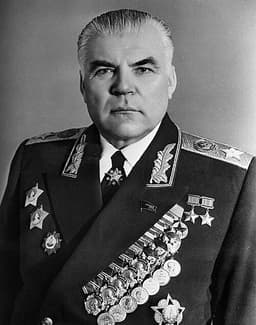
Rodion Malinovsky
General · Modern
60.0Total
Basic Information
Born
1914
1898
Died
1982
1967
Era
Modern
Modern
Nationality
Iraq
USSR
Occupation
General
General
Civilization
Middle Eastern
Western
Score Comparison
Military (10%)
25.9
72.0
Political (20%)
46.6
45.0
Influence (20%)
54.9
55.0
Legacy (20%)
45.0
58.0
Leadership (15%)
65.0
72.0
Strategy (15%)
30.3
69.6
TOTAL
47.3
60.0
Ahmed Hassan al-Bakr — Complete Timeline
1963 AD
Role in the 1963 coupPolitical Action◆ Major
Al-Bakr, a senior Ba'athist officer, helped plan and execute the coup that overthrew Qasim. He became Prime Minister briefly but was forced out by President Arif later that year, marking an early setback for the Ba'ath Party.
CoupBa'ath PartyPower Struggle
Impact: national
1968 AD
Ba'athist return to power (17 July Revolution)Political Action
Al-Bakr led a bloodless coup that brought the Ba'ath Party back to power. He became President and Chairman of the Revolutionary Command Council, establishing a regime that would rule Iraq for decades. Saddam Hussein was his deputy.
CoupBa'ath PartyRegime Change
Impact: national
1972 AD
Nationalization of the Iraq Petroleum CompanyPolitical Action◆ Major
Al-Bakr's government fully nationalized the Iraq Petroleum Company, ending foreign control of the country's oil industry. This move dramatically increased state revenue and funded development projects, but also led to Western sanctions.
OilNationalizationEconomic Policy
Impact: nationalconstructive
1979 AD
Forced resignation and succession by Saddam HusseinPolitical Action
Al-Bakr was forced to resign as President, ostensibly for health reasons, and was succeeded by Saddam Hussein. He was placed under house arrest until his death in 1982. The transition consolidated Saddam's absolute power.
SuccessionSaddam HusseinPower Shift
Impact: nationaldestructive
Rodion Malinovsky — Complete Timeline
1939 AD
Battle of Khalkhin GolWar
Malinovsky served as a division commander during the Battle of Khalkhin Gol against Japan. The Soviet victory secured the eastern border and influenced Japan's decision not to attack the USSR in 1941.
Soviet-Japanese Border WarMongoliaVictory
Impact: regional
1942 AD
Battle of StalingradWar◆ Major
Malinovsky commanded the 2nd Guards Army during the Battle of Stalingrad. His forces played a key role in repelling the German relief attempt by Army Group Don, securing the encirclement of the 6th Army.
World War IIStalingradCounteroffensive
Impact: global
1944 AD
Jassy–Kishinev OffensiveWar◆ Major
Malinovsky commanded the 2nd Ukrainian Front in the Jassy
World War IIRomaniaOffensive
Impact: regional
1957 AD
Appointment as Minister of Defense of the USSRPolitical Action◆ Major
Malinovsky was appointed Minister of Defense of the USSR by Khrushchev. He oversaw the Soviet military during the Cold War, including the Cuban Missile Crisis and the buildup of nuclear forces.
Cold WarDefense MinisterNuclear
Impact: global
Expert Analysis
Origins
Ahmed Hassan al-Bakr was born in 1914 in Tikrit, Iraq, into a Sunni Arab family. He trained as a teacher before entering the Iraqi Military Academy in 1938. His early career was shaped by the anti-British sentiment and pan-Arab nationalism, leading him to join the Ba'ath Party in the 1950s. Al-Bakr participated in the 1958 revolution that overthrew the monarchy but was sidelined under Abdul Karim Qasim.
Rodion Malinovsky was born in 1898 in Odessa, then part of the Russian Empire. Orphaned at an early age, he worked as a farmhand before fleeing conscription during World War I. He served in the Russian Expeditionary Force in France, where he was wounded and awarded the Croix de Guerre. After the Bolshevik Revolution, he joined the Red Army and fought in the Russian Civil War, rising through the ranks.
Rise to Power
Al-Bakr's rise began with the 1963 coup against Qasim, where he played a key role as a Ba'athist officer. He became Prime Minister but was ousted after nine months by President Abdul Salam Arif. Following the 1968 Ba'athist coup, known as the 17 July Revolution, al-Bakr became President and Chairman of the Revolutionary Command Council. He consolidated power by purging rivals and promoting fellow Tikritis, including his relative Saddam Hussein.
Malinovsky's rise was through battlefield success. In 1939, he commanded a division at the Battle of Khalkhin Gol against Japan, scoring a decisive victory. During World War II, he commanded the 2nd Guards Army at Stalingrad in 1942, where his forces repelled the German relief attempt. His greatest triumph came in 1944 with the Jassy–Kishinev Offensive, destroying German Army Group South Ukraine and forcing Romania to switch sides. After the war, he commanded Soviet forces in the Far East and was appointed Minister of Defense in 1957 by Khrushchev.
Leadership & Governance
Al-Bakr led Iraq with a focus on centralizing power and promoting Ba'athist ideology. He nationalized the Iraq Petroleum Company in 1972, ending foreign control and greatly increasing state revenue. He also implemented agrarian reforms and expanded education. However, his leadership was marked by increasing reliance on Saddam Hussein, who managed internal security and the party apparatus. Al-Bakr's style was cautious and consensus-building within the party, but he allowed the creation of a repressive security state.
Malinovsky, as Defense Minister, oversaw the modernization of the Soviet military, including the buildup of nuclear forces and the response to the Cuban Missile Crisis. He was known for his professional, no-nonsense approach, emphasizing practical training and strategic readiness. Unlike some of his contemporaries, he avoided political intrigue, focusing on military affairs. He scored 72.0 in leadership, reflecting his ability to command large formations effectively.
Triumph & Tragedy
Al-Bakr's greatest success was the nationalization of Iraqi oil, which transformed the country's economy and increased state autonomy. He also maintained stability during his presidency. However, his tragedy was being overshadowed and eventually pushed aside by Saddam Hussein, who forced his resignation in 1979 under the guise of ill health. Al-Bakr died under house arrest in 1982, possibly poisoned. His political score of 46.6 reflects his inability to secure his own position.
Malinovsky's triumphs include the Jassy–Kishinev Offensive, which is considered one of the most successful Soviet operations of WWII, and his role at Stalingrad. He also performed well in the Manchurian operation against Japan in 1945. His tragedies include the initial setbacks in the Ukraine in 1941-42, though he recovered. As Defense Minister, he was blamed for the Soviet military's lack of preparedness for the Cuban Missile Crisis, though he advocated for a measured response. His military score of 72.0 underscores his battlefield competence.
Character & Destiny
Al-Bakr was a quiet, uncharismatic figure who relied on party loyalty and family connections. His character—cautious, indecisive, and trusting of his relative Saddam—led to his downfall. He failed to build an independent power base, allowing Saddam to control the security services. His destiny was to be a transitional figure, overshadowed by his successor.
Malinovsky was a blunt, soldierly figure who earned respect through competence. He avoided political factions and focused on his duties. His character—disciplined, strategic, and resilient—allowed him to survive Stalin's purges and rise steadily. His destiny was to be one of the most effective Soviet commanders and a key architect of Cold War military policy.
Legacy
Al-Bakr's legacy is mixed. He is remembered as the president who nationalized oil and stabilized Iraq briefly, but his tenure enabled the rise of Saddam Hussein's dictatorship. The Ba'athist state he helped build led to decades of conflict. His influence score of 54.9 reflects his role in shaping modern Iraq, but his legacy score of 45.0 indicates his overshadowing by Saddam.
Malinovsky's legacy is more positive. He is considered one of the top Soviet commanders of WWII, with a decisive role in several key battles. As Defense Minister, he modernized the Soviet military and steered it through the early Cold War. His legacy score of 58.0 reflects his lasting reputation in military history. He is remembered as a capable and honorable officer.
Conclusion
Rodion Malinovsky had a greater impact than Ahmed Hassan al-Bakr. Malinovsky's military achievements directly shaped the outcome of World War II and the Cold War balance of power. His total score of 60.0 exceeds al-Bakr's 47.3 by 12.7 points, reflecting higher military, leadership, and strategy scores. While al-Bakr's oil nationalization was significant, his legacy is tarnished by his inability to prevent Saddam's rise. Malinovsky's influence on military doctrine and his battlefield successes have a more enduring and positive historical impact.
Rankings
🥇
Rodion MalinovskyLeader
Mil: 72.0Pol: 45.0Inf: 55.0
60.0
🥈
Ahmed Hassan al-Bakr
Mil: 25.9Pol: 46.6Inf: 54.9
47.3
+12.7 behind
How This Comparison Works
Algorithm
Each figure is scored on 6 dimensions (0—100 scale) based on structured historical data: Military (10%), Political (20%), Influence (20%), Legacy (20%), Leadership (15%), Strategy (15%). The weighted total produces the final ranking.
Data Sources
Scores are computed from structured sub-indicators in the database. Scale factors adjust for era (Ancient ×0.85, Modern ×1.0) and civilization size (Eastern ×1.05, Other ×0.80) to account for differences in population and military scale.
Maximum 3 Figures
Comparisons are limited to 2—3 figures to ensure readability and statistical meaningfulness.
Error Margins
±5 points per dimension — Sub-scores are derived from historical records with inherent uncertainty. Two figures within 5 points on a dimension should be considered roughly equivalent in that area.
Total Score Accuracy
±3 points overall — The weighted combination of 6 dimensions produces a total score with approximately ±3 points of uncertainty. Differences of less than 3 points are not statistically significant— the figures are effectively tied.
Known Limitations
- Historical records are incomplete and uneven across civilizations
- Figures from oral-tradition societies may be underrepresented
- Occupation labels can misclassify multi-role figures
- Scores measure capability and impact, not moral character
- Quantitative scoring is a comparison tool, not absolute truth
Capability Radar
Military (10%) — Battles & Warfare
Battles
10
85
Win Rate
10
80
Expansion
10
75
Political (20%) — Governance & Reform
Reform
40
55
Diplomacy
30
60
Economy
30
50
Influence (20%) — Cultural & Global Reach
Cultural
20
45
Global
20
60
Legacy (20%) — Historical Impact
Historical
40
65
Longevity
20
50
Leadership (15%) — Power & Stability
Tenure
60
65
Stability
20
60
Strategy (15%) — Tactics & Innovation
Strategy
10
85
Tactics
10
78
Reform
20
70
Similar Comparisons
Comments & Discussion
No comments yet. Be the first to share your thoughts!