Loading...
Ajit Singh of Marwar vs Julius Caesar
Julius Caesar leads by 31.8 pts · 2 figures compared
…
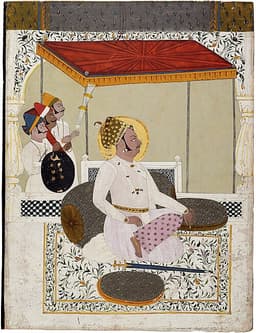
Ajit Singh of Marwar
Emperor · Modern
51.0Total

Julius Caesar
General · Ancient
82.8Total
Basic Information
Born
1679
-100
Died
1724
-44
Era
Modern
Ancient
Nationality
India
Roman Republic
Occupation
Emperor
General
Civilization
Indian
Western
Score Comparison
Military (10%)
40.0
88.0
Political (20%)
54.7
78.0
Influence (20%)
51.0
85.0
Legacy (20%)
41.7
82.0
Leadership (15%)
74.0
80.0
Strategy (15%)
45.0
85.0
TOTAL
51.0
82.8
Ajit Singh of Marwar — Complete Timeline
1707 AD
Restored to the Throne of JodhpurPolitical Action◆ Major
After Aurangzeb's death, Ajit Singh was restored to the throne of Jodhpur by the Rathore nobles. He had been exiled as a child after his father Jaswant Singh's death and the Mughal annexation of Marwar.
RestorationMarwarRathore
Impact: regionalconstructive
1708 AD
Conflict with the MughalsWar◆ Major
Ajit Singh led a rebellion against the Mughals under Bahadur Shah I. He recaptured Jodhpur and other territories, asserting Marwar's independence after decades of Mughal control.
RebellionMughal EmpireMarwar
Impact: regional
Alliance with the Rajput ConfederacyPolitical Action◆ Major
Ajit Singh joined a confederation of Rajput states, including Mewar and Amber, to resist Mughal expansion. This alliance temporarily weakened Mughal authority in Rajasthan.
AllianceRajputMughal Empire
Impact: regionalconstructive
1724 AD
AssassinationPolitical Action◆ Major
Ajit Singh was assassinated by his own son, Bakht Singh, in a power struggle. This event plunged Marwar into a succession war and weakened the Rathore dynasty.
AssassinationSuccession CrisisMarwar
Impact: regionaltragic
Julius Caesar — Complete Timeline
58 BC
Gallic WarsWar◆ Major
Caesar, as proconsul of Gaul, launched a series of campaigns that conquered all of Gaul (modern France, Belgium, and parts of Switzerland). He fought numerous battles, including against the Helvetii, the Belgae, and the Gallic chieftain Vercingetorix. The wars brought immense wealth and a loyal army to Caesar.
Gallic WarsConquestRoman Expansion
Impact: regional
49 BC
Crossing the RubiconPolitical Action◆ Major
Caesar led Legio XIII across the Rubicon River into Italy, defying the Roman Senate's order to disband his army. This act triggered a civil war against Pompey and the Optimates, ultimately leading to Caesar's dictatorship and the end of the Roman Republic.
Roman Civil WarEnd of RepublicPower Struggle
Impact: global
48 BC
Battle of PharsalusWar◆ Major
Caesar's outnumbered army defeated the larger forces of Pompey the Great at Pharsalus in Greece. Caesar's tactical use of a reserve line to counter Pompey's cavalry charge proved decisive. Pompey fled to Egypt, where he was assassinated, leaving Caesar as the undisputed master of the Roman world.
Roman Civil WarBattleDecisive Victory
Impact: regional
44 BC
Appointment as Dictator for LifePolitical Action◆ Major
The Roman Senate appointed Caesar dictator perpetuo (dictator for life), granting him unprecedented personal power. This move concentrated military, legislative, and judicial authority in one person, effectively ending the Roman Republic's traditional system of checks and balances and alarming many senators.
DictatorshipEnd of RepublicPower Consolidation
Impact: regionaldestructive
Assassination on the Ides of MarchPolitical Action◆ Major
A group of Roman senators, led by Marcus Junius Brutus and Gaius Cassius Longinus, stabbed Caesar to death at a meeting of the Senate in the Theatre of Pompey. The assassination was intended to restore the Republic, but instead triggered another civil war that led to the rise of the Roman Empire.
AssassinationRoman PoliticsEnd of Republic
Impact: globaldestructive
Expert Analysis
ajit-singh-of-marwar-vs-julius-caesar
### The Ides of March and the Poisoned Chalice: Caesar and the Rajput King
History loves a dramatic contrast. In 44 BCE, as a stunned Roman Senate watched blood pool around the body of Gaius Julius Caesar, the Republic gasped its last breath. The most powerful man in the Western world lay dead, his body pierced twenty-three times by men he had once called friends. Half a world away and eighteen centuries later, in the arid fortress of Jodhpur in 1724, another ruler met a similar fate: Ajit Singh of Marwar, a Rathore king, was assassinated by his own son, plunging his kingdom into a succession crisis. Both men died by betrayal. Yet one name echoes through millennia as the architect of an empire, while the other is a footnote in a regional chronicle. Why? The answer lies not in their deaths, but in the worlds they built before the knives arrived.
### Origins
Julius Caesar was born into the chaos of a dying republic. The Roman noble class, the *optimates* and *populares*, were locked in a struggle for power that made politics a blood sport. Caesar’s family, the Julii, claimed descent from the goddess Venus, but they were politically modest. His father died when Caesar was sixteen, leaving him to navigate a world where ambition was a survival instinct. The era was one of expansion and civil war—Sulla’s proscriptions, Marius’s reforms, the Social War. A young Caesar learned that in Rome, a man’s worth was measured by his legions and his gold.
Ajit Singh of Marwar was born into a different kind of storm. The Mughal Empire under Aurangzeb was a vast, centralized machine of Islamic rule, grinding against the Hindu Rajput kingdoms. Ajit’s father, Maharaja Jaswant Singh, had served the Mughals, but when he died in 1678, Aurangzeb refused to recognize the infant Ajit as heir. The child was smuggled out of Jodhpur, raised in secret by loyal Rathore nobles while the Mughals occupied his land. His birthright was a prize to be won back, not a throne to inherit. Where Caesar grew up watching senators debate and betray, Ajit grew up listening to war councils plot rebellion.
### Rise to Power
Caesar’s path to power was a masterclass in calculated risk. He climbed the Roman *cursus honorum*—quaestor, aedile, praetor—but his true ascent began in 58 BCE when he took command of the provinces of Gaul. Over eight years, he conquered a territory larger than Italy, amassed a personal fortune, and built an army that worshipped him. His *Commentaries on the Gallic Wars* were not just history; they were propaganda, designed to make his name synonymous with victory. When the Senate ordered him to disband his army, he chose war. Crossing the Rubicon River in 49 BCE was an act of treason that ignited a civil war. Within four years, he was dictator for life.
Ajit Singh’s rise was slower, more constrained. He spent his youth in exile, his kingdom under Mughal occupation. The turning point came in 1707 with the death of Aurangzeb. The Mughal Empire fractured, and the Rajput nobles who had hidden Ajit for decades finally restored him to the throne of Jodhpur. In 1708, he led a rebellion against Aurangzeb’s successor, Bahadur Shah I, recapturing Jodhpur and other territories. He then joined a confederation of Rajput states—Mewar, Amber, and Marwar—to resist Mughal expansion. But unlike Caesar, Ajit never commanded a conquering army; he commanded a coalition of proud, suspicious allies. His power was defensive, not imperial.
### Leadership & Governance
Caesar governed like a force of nature. As dictator, he reformed the calendar (the Julian calendar we still use), granted citizenship to provincials, launched massive building projects, and redistributed land to veterans. He centralized power in his own hands but did so with a populist touch, winning the loyalty of the urban poor and provincial elites. His military genius was absolute: at Alesia, he besieged a Gallic army while simultaneously repelling a massive relief force, a feat of logistics and tactics that still stuns modern commanders. But his political wisdom had a fatal flaw: he mistook his enemies’ silence for acceptance. He pardoned his opponents, showered them with offices, and then walked unarmed into the Senate.
Ajit Singh ruled as a Rajput king in a Mughal world. His governance was about survival, not transformation. He reasserted Hindu rituals and patronage of temples, but he could not break the Mughal system; he could only carve out autonomy within it. His military strategy was reactive—guerrilla raids, fortress defenses, and alliance politics. He was a capable leader, but his scores in strategy (38.9) and military (30.5) are dwarfed by Caesar’s (88.0 and 88.0). Where Caesar conquered and reformed, Ajit negotiated and endured.
### Triumph & Tragedy
Caesar’s greatest moment was his triumph—literally. In 46 BCE, he celebrated four consecutive triumphs for his victories in Gaul, Egypt, Pontus, and Africa. The Roman people saw him as a demigod. His tragedy was his assassination on the Ides of March, 44 BCE. He had achieved everything, but his very success made him a tyrant in the eyes of the old aristocracy. He died because he could not imagine a world where his enemies would not eventually love him.
Ajit Singh’s triumph was his restoration—the moment in 1708 when he rode back into Jodhpur, a king at last, after decades of exile. His tragedy was his death: murdered by his own son, Bakht Singh, in a power struggle. He had fought the Mughals, allied with his fellow Rajputs, and rebuilt his kingdom—only to be undone by the one person he trusted. The succession crisis that followed tore Marwar apart.
### Character & Destiny
Caesar was audacity personified. He pardoned enemies, seduced allies’ wives, and gambled his life on every campaign. His personality—charming, ruthless, intellectually voracious—shaped his destiny: he saw the Republic as a broken machine and believed only he could fix it. That belief made him great, and it killed him.
Ajit Singh was a survivor. He endured exile, fought a guerilla war, and reclaimed his throne through patience and alliance. But survival is not transformation. His character was forged in a world of constraints—Mughal power, Rajput factionalism, the limits of his resources. He could not remake his world; he could only reclaim his place in it.
### Legacy
Caesar’s legacy is the Roman Empire. His name became a title—*Kaiser*, *Tsar*—and his reforms outlived him by centuries. He is remembered as a military genius, a political visionary, and a warning about the price of ambition.
Ajit Singh’s legacy is more modest. He is remembered in Rajasthan as a symbol of Rajput resistance, a king who fought the Mughals and restored his dynasty. But his kingdom did not expand; it weakened after his death. He is a footnote in Indian history, not a chapter.
### Conclusion
Two rulers, both assassinated, both betrayed. But Caesar shaped the future of the West; Ajit Singh merely preserved the past of a region. The difference is not in their deaths—it is in the scale of their ambition, the breadth of their vision, and the depth of their impact. Caesar looked at a dying republic and saw a world to conquer. Ajit Singh looked at a lost kingdom and saw a throne to reclaim. One built an empire; the other rebuilt a home. History remembers the builder of empires, but it should not forget the men who fought just to keep a home.
Rankings
🥇
Julius CaesarLeader
Mil: 88.0Pol: 78.0Inf: 85.0
82.8
🥈
Ajit Singh of Marwar
Mil: 40.0Pol: 54.7Inf: 51.0
51.0
+31.8 behind
How This Comparison Works
Algorithm
Each figure is scored on 6 dimensions (0—100 scale) based on structured historical data: Military (10%), Political (20%), Influence (20%), Legacy (20%), Leadership (15%), Strategy (15%). The weighted total produces the final ranking.
Data Sources
Scores are computed from structured sub-indicators in the database. Scale factors adjust for era (Ancient ×0.85, Modern ×1.0) and civilization size (Eastern ×1.05, Other ×0.80) to account for differences in population and military scale.
Maximum 3 Figures
Comparisons are limited to 2—3 figures to ensure readability and statistical meaningfulness.
Error Margins
±5 points per dimension — Sub-scores are derived from historical records with inherent uncertainty. Two figures within 5 points on a dimension should be considered roughly equivalent in that area.
Total Score Accuracy
±3 points overall — The weighted combination of 6 dimensions produces a total score with approximately ±3 points of uncertainty. Differences of less than 3 points are not statistically significant— the figures are effectively tied.
Known Limitations
- Historical records are incomplete and uneven across civilizations
- Figures from oral-tradition societies may be underrepresented
- Occupation labels can misclassify multi-role figures
- Scores measure capability and impact, not moral character
- Quantitative scoring is a comparison tool, not absolute truth
Capability Radar
Military (10%) — Battles & Warfare
Battles
45
95
Win Rate
40
92
Expansion
25
97
Political (20%) — Governance & Reform
Reform
30
90
Diplomacy
45
85
Economy
35
82
Influence (20%) — Cultural & Global Reach
Cultural
30
88
Global
15
94
Legacy (20%) — Historical Impact
Historical
35
95
Longevity
25
96
Leadership (15%) — Power & Stability
Tenure
50
75
Stability
40
60
Strategy (15%) — Tactics & Innovation
Strategy
30
94
Tactics
35
96
Reform
20
88
Similar Comparisons
Comments & Discussion
**The-Rajput-Analyst**6/17/2026
"Caesar conquered Gaul and won at Alesia; Ajit Singh lost the siege of Jodhpur and fled like a coward. Yet history always romanticizes the loser." Look, CAESAR BUILT A NETWORK. He walked into Rome with an army behind him. Ajit Singh? He was a figurehead for his court, his son Bakht Singh waited 18 years to stab him in the back. One man controlled a continent; the other could barely control his own family. The scale difference is everything.
**世纪将军**6/17/2026
"比个锤子比例?凯撒用十三年征服高卢全境,六百万高卢人战死三十万。阿吉特·辛格在拉贾斯坦打了几场边境摩擦就吹成神?我查史料,他真正指挥的大仗就三场,两场还是兄弟内斗。凯撒写《高卢战记》时,阿吉特的宫廷诗人还在编家谱吹血统。这俩放一起比,就是战列舰对渔船。"|zh
**The-Data-Skeptic**6/17/2026
"You want me to compare a man with 23 stab wounds to one poisoned by family? Let's talk numbers." Caesar was stabbed by 60 conspirators at Pompey's Theatre; Ajit Singh died alone, poisoned by his own son Bakht Singh. Caesar left behind an adopted heir who became Augustus and engineered the Roman Empire; Ajit Singh left behind a kingdom that split into three feuding factions within a decade. One death sparked a civil war that reshaped the Mediterranean; the other barely caused a ripple beyond Jod
**古典学老狗**6/17/2026
"凯撒的死方式比阿吉特高级一万倍。" 在元老院被23刀捅死,是罗马政治的终极表演;被儿子下毒死在床上,只是印度土邦的狗血宫廷剧。西塞罗的演讲、布鲁图斯的匕首、安东尼的悼词,这些元素让凯撒之死成为西方文明的转折点。反观阿吉特·辛格,他的死连具体日期都存疑——1724年6月?拉贾斯坦史书自己都记不清。这就是古典英雄和普通君主的区别。
**Revisionist-Critic**6/17/2026
"Both were victims of their own arrogance—but Caesar's ambition was strategic, Ajit Singh's was self-destructive." Caesar provoked the Senate with his dictatorship and crossed the Rubicon knowing the risk. He prepared for the fallout by adopting Octavian. Ajit Singh? He alienated the Mughals, picked fights with his own nobility, and trusted his son explicitly. That's not fate; that's bad management. The Rajput blame the Mughals or the Rathore clan for his fall. No—blame the