Loading...
Albert I vs Ferdinand II of Aragon
Ferdinand II of Aragon leads by 26.0 pts · 2 figures compared
…

Albert I
Emperor · Medieval
44.4Total
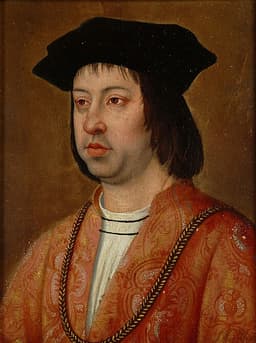
Ferdinand II of Aragon
Emperor · Medieval
70.4Total
Basic Information
Born
1255
1452
Died
1308
1516
Era
Medieval
Medieval
Nationality
Holy Roman Empire
Spain
Occupation
Emperor
Emperor
Civilization
Western
Western
Score Comparison
Military (10%)
47.5
76.0
Political (20%)
36.5
78.0
Influence (20%)
49.4
65.0
Legacy (20%)
40.8
65.0
Leadership (15%)
48.4
80.0
Strategy (15%)
43.7
66.3
TOTAL
44.4
70.4
Albert I — Complete Timeline
1298 AD
Defeated Adolf of Nassau at the Battle of GöllheimWar◆ Major
Albert I of Habsburg defeated and killed Adolf of Nassau at the Battle of G
BattleHabsburgVictory
Impact: regional
Elected King of GermanyPolitical Action◆ Major
Albert I of Habsburg was elected King of Germany after deposing Adolf of Nassau. His election was supported by the prince-electors and marked the return of Habsburg rule to the German throne.
ElectionHabsburgGerman Kingdom
Impact: regional
Crowned Holy Roman EmperorPolitical Action◆ Major
Albert I of Habsburg was crowned Holy Roman Emperor in Aachen. His coronation reaffirmed Habsburg authority in the empire, though his reign was marked by conflicts with the Papacy and the prince-electors.
CoronationHoly Roman EmpireHabsburg
Impact: regional
1308 AD
Assassinated by His Nephew John ParricidaOther◆ Major
Albert I of Habsburg was assassinated by his nephew John Parricida near Windisch, Switzerland. His death ended his reign and led to a period of instability, with the throne passing to Henry VII of Luxembourg.
AssassinationHabsburgDeath
Impact: regionaltragic
Ferdinand II of Aragon — Complete Timeline
1469 AD
Marriage to Isabella I of CastilePolitical Action
Ferdinand II of Aragon married Isabella I of Castile in Valladolid, uniting the two largest Christian kingdoms in Spain. This marriage created the basis for the Kingdom of Spain, though both crowns remained legally separate until the death of Isabella in 1504.
Spanish unificationDynastic union
Impact: globalconstructive
1478 AD
Establishment of the Spanish InquisitionPolitical Action◆ Major
Ferdinand II and Isabella I obtained papal approval to establish the Spanish Inquisition, a tribunal to enforce Catholic orthodoxy. The Inquisition targeted converted Jews (conversos) and Muslims (moriscos) suspected of secretly practicing their former religions, leading to thousands of executions and imprisonments.
InquisitionReligious persecution
Impact: globaldestructive
1492 AD
Conquest of GranadaWar
Ferdinand II and Isabella I completed the Reconquista by capturing the city of Granada, the last Muslim stronghold in the Iberian Peninsula. The surrender of the Nasrid kingdom ended nearly 800 years of Muslim rule in Spain and marked a major victory for the Catholic Monarchs.
ReconquistaGranada
Impact: global
Alhambra DecreePolitical Action◆ Major
Ferdinand II and Isabella I issued the Alhambra Decree, ordering the expulsion of all Jews from the kingdoms of Spain who refused to convert to Catholicism. The decree led to the exile of an estimated 200,000 Jews, causing a significant demographic and economic impact on Spain.
Expulsion of JewsReligious persecution
Impact: globaldestructive
Expert Analysis
Origins
Albert I of Habsburg (born 1255) was the son of King Rudolf I of Germany, the first Habsburg to hold the imperial throne. He inherited the Duchy of Austria and Styria and was raised in the turbulent politics of the Holy Roman Empire. His early life was marked by efforts to consolidate Habsburg lands amid rival noble families.
Ferdinand II of Aragon (born 1452) was the son of King John II of Aragon and Juana Enríquez. He grew up in the complex political landscape of the Iberian Peninsula, where Christian kingdoms vied for dominance against the Emirate of Granada. His education emphasized military strategy and political marriage alliances.
Rise to Power
Albert I was elected King of Germany in 1298 after deposing Adolf of Nassau, whom he defeated and killed at the Battle of Göllheim. This victory secured his claim, and he was crowned Holy Roman Emperor in Aachen. However, his reign was contested by the Electors and the Pope, limiting his authority.
Ferdinand II rose to prominence through his marriage to Isabella I of Castile in 1469, uniting the two largest Christian kingdoms. He became King of Aragon in 1479 and jointly ruled Castile with Isabella. Their partnership led to the completion of the Reconquista with the conquest of Granada in 1492, a pivotal turning point.
Leadership & Governance
Albert I governed the Holy Roman Empire with a focus on centralizing Habsburg power, but he faced constant opposition from the prince-electors and the Swiss Confederacy. His political score of 36.5 reflects his limited success in forging lasting alliances. He imposed taxes and sought to expand Habsburg territories, but his authoritarian style alienated many.
Ferdinand II, with a political score of 78.0, was a master of statecraft. He and Isabella centralized royal authority, curbed the power of the nobility, and established the Spanish Inquisition in 1478 to enforce religious unity. Their Alhambra Decree of 1492 expelled Jews who refused conversion, a controversial but decisive policy. Ferdinand's leadership score of 80.0 highlights his effectiveness in governance.
Triumph & Tragedy
Albert I's greatest triumph was securing the German throne and defeating Adolf of Nassau, but his assassination by his nephew John Parricida in 1308 was a tragic end that plunged the empire into instability. His military score of 47.5 reflects his inability to maintain control.
Ferdinand II's greatest triumph was the conquest of Granada, ending 800 years of Muslim rule in Iberia. His legacy includes sponsoring Columbus's voyages, which led to Spanish colonization. However, the expulsion of Jews and the Inquisition's brutality caused lasting social and economic damage. His legacy score of 65.0 acknowledges both achievements and controversies.
Character & Destiny
Albert I was determined and ambitious but lacked diplomatic finesse, leading to widespread opposition. His fate was sealed by his harsh treatment of his nephew, whom he disinherited, prompting the assassination. His strategy score of 43.7 indicates poor long-term planning.
Ferdinand II was pragmatic, calculating, and religiously devout. He and Isabella complemented each other, with Ferdinand focusing on military and political strategy while Isabella managed domestic affairs. His character enabled the unification of Spain and the expansion of its empire, though his policies sowed seeds of future conflicts.
Legacy
Albert I's legacy is modest; he strengthened the Habsburg hold on Austria but failed to establish a stable imperial rule. His death led to a period of civil war. His overall score of 44.4 places him among lesser medieval emperors.
Ferdinand II's legacy is immense: he laid the foundation for the Spanish Empire, funded Columbus, and initiated the Spanish Inquisition. His policies shaped Spanish identity for centuries. With a total score of 70.4, he is considered one of the most influential monarchs of the late Middle Ages.
Conclusion
Ferdinand II of Aragon had a far greater impact than Albert I. Ferdinand's unification of Spain, completion of the Reconquista, and sponsorship of exploration transformed Europe and the Americas. While Albert I's reign was cut short by assassination and yielded limited achievements, Ferdinand's strategic vision created a global empire. The score gap of 26.0 points underscores this disparity. Ferdinand II was the more consequential ruler.
Rankings
🥇
Ferdinand II of AragonLeader
Mil: 76.0Pol: 78.0Inf: 65.0
70.4
🥈
Albert I
Mil: 47.5Pol: 36.5Inf: 49.4
44.4
+26.0 behind
How This Comparison Works
Algorithm
Each figure is scored on 6 dimensions (0—100 scale) based on structured historical data: Military (10%), Political (20%), Influence (20%), Legacy (20%), Leadership (15%), Strategy (15%). The weighted total produces the final ranking.
Data Sources
Scores are computed from structured sub-indicators in the database. Scale factors adjust for era (Ancient ×0.85, Modern ×1.0) and civilization size (Eastern ×1.05, Other ×0.80) to account for differences in population and military scale.
Maximum 3 Figures
Comparisons are limited to 2—3 figures to ensure readability and statistical meaningfulness.
Error Margins
±5 points per dimension — Sub-scores are derived from historical records with inherent uncertainty. Two figures within 5 points on a dimension should be considered roughly equivalent in that area.
Total Score Accuracy
±3 points overall — The weighted combination of 6 dimensions produces a total score with approximately ±3 points of uncertainty. Differences of less than 3 points are not statistically significant— the figures are effectively tied.
Known Limitations
- Historical records are incomplete and uneven across civilizations
- Figures from oral-tradition societies may be underrepresented
- Occupation labels can misclassify multi-role figures
- Scores measure capability and impact, not moral character
- Quantitative scoring is a comparison tool, not absolute truth
Capability Radar
Military (10%) — Battles & Warfare
Battles
20
75
Win Rate
25
80
Expansion
25
85
Political (20%) — Governance & Reform
Reform
30
80
Diplomacy
35
90
Economy
30
75
Influence (20%) — Cultural & Global Reach
Cultural
20
75
Global
15
80
Legacy (20%) — Historical Impact
Historical
25
85
Longevity
20
80
Leadership (15%) — Power & Stability
Tenure
40
85
Stability
20
70
Strategy (15%) — Tactics & Innovation
Strategy
20
85
Tactics
20
70
Reform
15
60
Similar Comparisons
Comments & Discussion
No comments yet. Be the first to share your thoughts!