Loading...
Ferdinand II of Aragon vs Napoleon Bonaparte
Napoleon Bonaparte leads by 0.5 pts · 2 figures compared
…
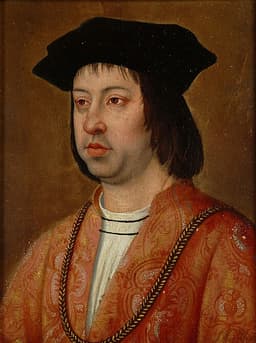
Ferdinand II of Aragon
Emperor · Medieval
70.4Total

Napoleon Bonaparte
General · Modern
70.9Total
Basic Information
Born
1452
1769
Died
1516
1821
Era
Medieval
Modern
Nationality
Spain
France
Occupation
Emperor
General
Civilization
Western
Western
Score Comparison
Military (10%)
76.0
94.0
Political (20%)
78.0
72.0
Influence (20%)
65.0
40.0
Legacy (20%)
65.0
80.0
Leadership (15%)
80.0
78.0
Strategy (15%)
66.3
90.0
TOTAL
70.4
70.9
Ferdinand II of Aragon — Complete Timeline
1469 AD
Marriage to Isabella I of CastilePolitical Action
Ferdinand II of Aragon married Isabella I of Castile in Valladolid, uniting the two largest Christian kingdoms in Spain. This marriage created the basis for the Kingdom of Spain, though both crowns remained legally separate until the death of Isabella in 1504.
Spanish unificationDynastic union
Impact: globalconstructive
1478 AD
Establishment of the Spanish InquisitionPolitical Action◆ Major
Ferdinand II and Isabella I obtained papal approval to establish the Spanish Inquisition, a tribunal to enforce Catholic orthodoxy. The Inquisition targeted converted Jews (conversos) and Muslims (moriscos) suspected of secretly practicing their former religions, leading to thousands of executions and imprisonments.
InquisitionReligious persecution
Impact: globaldestructive
1492 AD
Conquest of GranadaWar
Ferdinand II and Isabella I completed the Reconquista by capturing the city of Granada, the last Muslim stronghold in the Iberian Peninsula. The surrender of the Nasrid kingdom ended nearly 800 years of Muslim rule in Spain and marked a major victory for the Catholic Monarchs.
ReconquistaGranada
Impact: global
Alhambra DecreePolitical Action◆ Major
Ferdinand II and Isabella I issued the Alhambra Decree, ordering the expulsion of all Jews from the kingdoms of Spain who refused to convert to Catholicism. The decree led to the exile of an estimated 200,000 Jews, causing a significant demographic and economic impact on Spain.
Expulsion of JewsReligious persecution
Impact: globaldestructive
Napoleon Bonaparte — Complete Timeline
1799 AD
Coup of 18 BrumaireOther◆ Major
Napoleon Bonaparte, with support from his brother Lucien and key political figures, overthrew the Directory in a bloodless coup. He established the Consulate with himself as First Consul, effectively becoming the ruler of France. This event ended the French Revolution's most unstable period.
French RevolutionCoupRise to Power
Impact: regional
1804 AD
Promulgation of the Napoleonic CodeOther◆ Major
Napoleon enacted the Civil Code of the French, known as the Napoleonic Code, a comprehensive set of laws that replaced the fragmented feudal legal systems. The code established legal equality, protected property rights, and secularized law. It became the basis for legal systems in many European and world countries.
Legal ReformNapoleonic CodeCivil Law
Impact: globalconstructive
1805 AD
Battle of AusterlitzWar◆ Major
Napoleon's Grande Arm
Napoleonic WarsBattleDecisive Victory
Impact: global
1812 AD
Invasion of RussiaWar◆ Major
Napoleon led the Grande Arm
Napoleonic WarsInvasionDisaster
Impact: globaldestructive
1815 AD
Battle of WaterlooWar◆ Major
Napoleon's French army was defeated by the combined forces of the Duke of Wellington's Anglo-Allied army and Gebhard Leberecht von Bl
Napoleonic WarsBattleFinal Defeat
Impact: globaldestructive
Expert Analysis
ferdinand-ii-of-aragon-vs-napoleon-bonaparte
# The Emperor and the King: Two Paths to Power in Europe’s Making
On a frozen December morning in 1804, Napoleon Bonaparte placed the crown upon his own head in Notre Dame Cathedral, a gesture that announced to the world that his authority came from no pope or king, but from his own will. Three centuries earlier, in the sun-scorched halls of the Alhambra, Ferdinand of Aragon knelt before the cross after the fall of Granada, his crown a symbol of a unity forged through marriage and faith. These two men, separated by time and temperament, each reshaped Europe in their image—yet their stories end in radically different places. What drove one to the heights of continental conquest and the other to the quiet consolidation of a kingdom that would birth an empire? The answer lies not merely in their actions, but in the eras that shaped them and the choices that defined them.
Origins
Ferdinand II of Aragon was born in 1452 into a world of fractured kingdoms and religious fervor. Medieval Spain was a patchwork of Christian and Muslim states, where the Reconquista—the centuries-long campaign to reclaim the peninsula from Islamic rule—still burned in the hearts of nobles. Ferdinand grew up in the shadow of his father, John II of Aragon, a man whose reign was plagued by civil war and intrigue. From this crucible, Ferdinand learned that power was not won on battlefields alone, but through marriage alliances, papal favor, and the careful manipulation of rival factions. His world was one of slow, grinding strategy, where a single dynastic union could reshape the map.
Napoleon Bonaparte, born in 1769 on the island of Corsica, entered a world already in flames. The French Revolution had shattered the old order, and the chaos of 1790s France offered unprecedented opportunity for a young artillery officer of modest noble birth. Unlike Ferdinand, who inherited a throne, Napoleon seized his. The revolutionary era had dissolved the constraints of birth and tradition; merit, ambition, and ruthlessness now determined who rose. Where Ferdinand’s training was in diplomacy and patience, Napoleon’s was in speed and shock—the swift maneuvers of cannon and cavalry that could decide a nation’s fate in a single day.
Rise to Power
Ferdinand’s ascent was a masterpiece of political calculation. His marriage to Isabella of Castile in 1469 was not a love match but a strategic union that took years of secret negotiations to arrange, defying the wishes of her brother, King Henry IV. Together, they navigated a web of noble rebellions, Portuguese invasions, and papal politics. Their great turning point came in 1492, when after a decade-long siege, they captured Granada, the last Muslim stronghold in Spain. That same year, Ferdinand and Isabella issued the Alhambra Decree, ordering the expulsion of all Jews who refused conversion—a brutal act of religious unification that consolidated their power but scarred Spain for centuries.
Napoleon’s rise was a blur of gunpowder and glory. In 1795, he saved the revolutionary government from a royalist uprising with a “whiff of grapeshot” on the streets of Paris. By 1796, at just 26, he commanded the French army in Italy, where his lightning campaigns humiliated the Austrians and made him a national hero. Political cunning followed: he staged a coup in 1799, becoming First Consul, and crowned himself Emperor in 1804. Where Ferdinand spent decades building alliances, Napoleon conquered them in months. His path was forged in the crucible of revolution, where the old rules had been burned away, and a man could rise as fast as he could march.
Leadership & Governance
As rulers, Ferdinand and Napoleon embodied two different philosophies of power. Ferdinand was a political animal, not a military genius—his military score of 67.3 reflects a king who relied on generals and siege warfare rather than personal command. His genius lay in statecraft: he used the Spanish Inquisition, established in 1478, to enforce religious uniformity and root out dissent, and he centralized royal authority by curbing the power of nobles and cities. His marriage to Isabella was a true partnership; together, they created the foundation of modern Spain. Yet his vision was inward-looking, focused on consolidation and orthodoxy.
Napoleon was the opposite: a military titan with a political score of 75.0, he was a general first and an administrator second. His Napoleonic Code reformed French law, establishing principles of equality and merit that influenced legal systems across Europe. He built roads, schools, and a centralized bureaucracy. But his governance was inseparable from war. He ruled through conquest, installing his brothers on foreign thrones and demanding tribute from defeated nations. Where Ferdinand sought to unify Spain under one faith, Napoleon sought to unify Europe under one emperor. His leadership score of 80.0 reflects a magnetic commander who inspired loyalty unto death, but his political score reveals a man who never truly mastered the art of lasting peace.
Triumph & Tragedy
Ferdinand’s greatest moment was the conquest of Granada in 1492, a triumph that ended 780 years of Muslim rule in Spain. It was the culmination of a dynastic project that had consumed his marriage and reign. But that same year brought tragedy: the Alhambra Decree expelled tens of thousands of Jews, stripping Spain of a vibrant community and damaging its economy for generations. Ferdinand’s legacy is thus a double-edged sword: the unifier of Spain was also the architect of its intolerance.
Napoleon’s triumphs were more spectacular. At Austerlitz in 1805, he crushed the combined armies of Russia and Austria in what many consider his masterpiece. His empire stretched from Spain to Poland. But his tragedy was equally grand: the invasion of Russia in 1812 destroyed his Grand Army, and his final defeat at Waterloo in 1815 ended his reign. Exiled to Saint Helena, he died in 1821, a prisoner of the British. His downfall was not just military but moral—his insatiable ambition overreached, and Europe united against him.
Character & Destiny
Ferdinand was cautious, calculating, and patient—a fox who built his kingdom brick by brick. Napoleon was audacious, impulsive, and brilliant—a lion who charged into history. Ferdinand’s faith and sense of divine mission drove him to purge Spain of non-Christians. Napoleon’s secular ambition drove him to conquer nations. Their characters shaped their fates: Ferdinand’s caution allowed his kingdom to endure, while Napoleon’s brilliance burned too hot and too fast. The medieval world rewarded the builder; the revolutionary age rewarded the conqueror—but only for a time.
Legacy
Ferdinand’s legacy is the Spanish Empire, which after his death in 1516 passed to his grandson Charles V, who inherited both Spain and the Habsburg domains, creating a global superpower. Today, Ferdinand is remembered as a founder of modern Spain, though his role in the Inquisition and expulsion of the Jews stains his memory. His total score of 74.2 reflects a ruler who achieved lasting political consolidation but at a moral cost.
Napoleon’s legacy is more complex. His military reforms, the Napoleonic Code, and his spread of revolutionary ideals reshaped Europe permanently, earning him a total score of 82.4. Yet he is also remembered as a tyrant who plunged the continent into a decade of war. He inspired both admiration and hatred, and his shadow looms over modern France.
Conclusion
Standing at the crossroads of two eras, Ferdinand and Napoleon represent the two faces of European power: the builder and the conqueror, the king and the emperor. Ferdinand united a kingdom through marriage and faith; Napoleon shattered a continent through war and will. One left a nation; the other left a legend. Their stories remind us that history rewards not just ambition, but the wisdom to know when to stop. In the end, Ferdinand’s Spain endured for centuries; Napoleon’s empire crumbled in a generation. Perhaps that is the deepest lesson of all: the greatest victories are not always won on battlefields, but in the quiet, patient work of building something that lasts.
Rankings
🥇
Napoleon BonaparteLeader
Mil: 94.0Pol: 72.0Inf: 40.0
70.9
🥈
Ferdinand II of Aragon
Mil: 76.0Pol: 78.0Inf: 65.0
70.4
+0.5 behind
How This Comparison Works
Algorithm
Each figure is scored on 6 dimensions (0—100 scale) based on structured historical data: Military (10%), Political (20%), Influence (20%), Legacy (20%), Leadership (15%), Strategy (15%). The weighted total produces the final ranking.
Data Sources
Scores are computed from structured sub-indicators in the database. Scale factors adjust for era (Ancient ×0.85, Modern ×1.0) and civilization size (Eastern ×1.05, Other ×0.80) to account for differences in population and military scale.
Maximum 3 Figures
Comparisons are limited to 2—3 figures to ensure readability and statistical meaningfulness.
Error Margins
±5 points per dimension — Sub-scores are derived from historical records with inherent uncertainty. Two figures within 5 points on a dimension should be considered roughly equivalent in that area.
Total Score Accuracy
±3 points overall — The weighted combination of 6 dimensions produces a total score with approximately ±3 points of uncertainty. Differences of less than 3 points are not statistically significant— the figures are effectively tied.
Known Limitations
- Historical records are incomplete and uneven across civilizations
- Figures from oral-tradition societies may be underrepresented
- Occupation labels can misclassify multi-role figures
- Scores measure capability and impact, not moral character
- Quantitative scoring is a comparison tool, not absolute truth
Capability Radar
Military (10%) — Battles & Warfare
Battles
75
95
Win Rate
80
90
Expansion
85
95
Political (20%) — Governance & Reform
Reform
80
95
Diplomacy
90
80
Economy
75
85
Influence (20%) — Cultural & Global Reach
Cultural
75
85
Global
80
90
Legacy (20%) — Historical Impact
Historical
85
95
Longevity
80
90
Leadership (15%) — Power & Stability
Tenure
85
85
Stability
70
70
Strategy (15%) — Tactics & Innovation
Strategy
85
95
Tactics
70
98
Reform
60
92
Similar Comparisons
Comments & Discussion
FerdinandTheStrategist6/17/2026
Military historians tend to overromanticize Napoleon, but Ferdinand of Aragon was the better empire-builder. Look at the numbers: Napoleon conquered Europe, yes, but his Grand Army was shattered in Russia and he died in exile. Ferdinand, through the joint monarchy with Isabella, unified Spain, funded Columbus, and handed his grandson Charles V an empire that stretched from Mexico to Vienna. No emperor's crown, no grandstanding—just solid statecraft that outlasted him.
数据怀疑论者6/17/2026
说拿破仑比斐迪南伟大?别被战报骗了。看看GDP增长:斐迪南统治下卡斯蒂利亚和阿拉贡的贸易额翻了四倍,而拿破仑的大陆封锁搞垮了法国经济——1810年法国破产次数比之前二十年还多。斐迪南没搞什么凯旋门,但他留给后代的是一台运转了三百年的行政机器,拿破仑只留下了滑铁卢和一堆花哨的军装。
ClassicsChad6/17/2026
Ferdinand of Aragon understood legitimacy in a way Napoleon never could. When he knelt before the cross after Granada's fall in 1492, he was acting in the same tradition as Constantine at the Milvian Bridge—merging faith with political power. Compare that to Napoleon's coronation farce: crowning himself like some Roman pretender? Please. Ferdinand’s piety was genuine, rooted in the Reconquista’s spiritual drama; Napoleon’s was a theatrical prop for a self-made emperor.
历史爱好者老张6/17/2026
拿破仑的故事是浪漫小说,斐迪南的故事是现实主义史诗。你看一个细节:拿破仑败了以后,法国反攻倒算,波旁王朝回来,啥也没剩;斐迪南和伊莎贝拉死后,西班牙在他们的制度上运转了整整三代人,到查理五世手里,还是那套联姻加军事的配方。别忘了,斐迪南没有用六十五万大军去打俄罗斯,他用的是教皇的一纸诏书和几个王族联姻,就把意大利半壁江山收入囊中。这叫聪明,不叫打仗。
RevisionistCritic6/17/2026
Everyone fawns over Napoleon’s "genius," but that’s just Bonapartist propaganda filtered through generations of French schooling. The real story? Ferdinand of Aragon exemplifies what a ruler should be—pragmatic, adaptive, and ruthless without the self-aggrandizing theatrics. He crushed the Catalan rebellion in the 1470s without a pageantry parade, whereas Napoleon turned every campaign into a personal myth-making machine. If you're judging by results, Ferdinand gave Spain a century of dominance;