Loading...
This comparison has not been analyzed yet.
One-time AI generation (~1 minute). Scores and timeline are already available below.
Albert II of Belgium vs Maximilian III Joseph of Bavaria
Maximilian III Joseph of Bavaria leads by 7.9 pts · 2 figures compared
…

Albert II of Belgium
Emperor · Modern
42.1Total
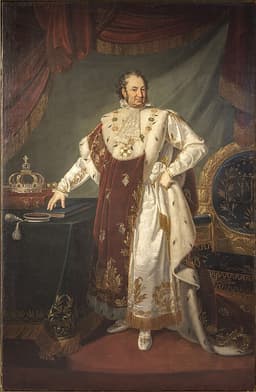
Maximilian III Joseph of Bavaria
Emperor · Modern
50.0Total
Basic Information
Born
1934
1727
Died
—
1777
Era
Modern
Modern
Nationality
Belgium
Bavaria
Occupation
Emperor
Emperor
Civilization
Western
Western
Score Comparison
Military (10%)
48.1
21.2
Political (20%)
30.8
60.0
Influence (20%)
46.3
55.7
Legacy (20%)
34.2
43.3
Leadership (15%)
51.9
66.0
Strategy (15%)
47.4
42.3
TOTAL
42.1
50.0
Albert II of Belgium — Complete Timeline
1990 AD
Refusal to sign abortion lawPolitical Action◆ Major
King Albert II refused to sign a law liberalizing abortion, citing conscientious objection. The government declared the king temporarily unable to reign, passed the law, and then reinstated him. This constitutional crisis was resolved by a unique legal mechanism.
AbortionConstitutional CrisisMonarchy
Impact: national
1993 AD
Accession to the thronePolitical Action◆ Major
Albert II became King of the Belgians upon the death of his brother, King Baudouin. He inherited a constitutional monarchy in a federalizing state. His reign focused on national unity amid linguistic tensions.
AccessionBelgian Monarchy
Impact: national
2013 AD
Abdication of Albert IIPolitical Action◆ Major
King Albert II abdicated the Belgian throne in favor of his son Philippe. Citing health reasons, he ended a 20-year reign. The abdication was a constitutional act that transferred the crown without political crisis.
AbdicationBelgian MonarchySuccession
Impact: national
Maximilian III Joseph of Bavaria — Complete Timeline
1745 AD
Accession as Elector of BavariaPolitical Action◆ Major
Maximilian III Joseph became Elector of Bavaria after the death of his father, Charles VII. He inherited a state devastated by the War of the Austrian Succession and faced significant financial and political challenges.
AccessionWar of the Austrian SuccessionFinancial Crisis
Impact: regional
Treaty of FüssenPolitical Action◆ Major
Maximilian III Joseph signed the Treaty of F
Treaty of FüssenWar of the Austrian SuccessionPragmatic Sanction
Impact: regional
1750 AD
Promotion of Enlightened Reforms in BavariaReform◆ Major
Maximilian III Joseph implemented enlightened reforms in Bavaria, including promoting education, reducing the influence of the Jesuits, and encouraging economic development. He supported the arts and sciences, making Munich a cultural center.
Enlightened ReformsEducationEconomic Development
Impact: regionalprogressive
1759 AD
Establishment of the Bavarian Academy of SciencesCultural
Maximilian III Joseph founded the Bavarian Academy of Sciences and Humanities in Munich. This institution promoted scientific research and intellectual discourse, contributing to the Enlightenment in Bavaria.
Academy of SciencesEnlightenmentIntellectual Life
constructive
This comparison has not been analyzed yet.
One-time AI generation (~1 minute). Scores and timeline are already available below.
Rankings
🥇
Maximilian III Joseph of BavariaLeader
Mil: 21.2Pol: 60.0Inf: 55.7
50.0
🥈
Albert II of Belgium
Mil: 48.1Pol: 30.8Inf: 46.3
42.1
+7.9 behind
How This Comparison Works
Algorithm
Each figure is scored on 6 dimensions (0—100 scale) based on structured historical data: Military (10%), Political (20%), Influence (20%), Legacy (20%), Leadership (15%), Strategy (15%). The weighted total produces the final ranking.
Data Sources
Scores are computed from structured sub-indicators in the database. Scale factors adjust for era (Ancient ×0.85, Modern ×1.0) and civilization size (Eastern ×1.05, Other ×0.80) to account for differences in population and military scale.
Maximum 3 Figures
Comparisons are limited to 2—3 figures to ensure readability and statistical meaningfulness.
Error Margins
±5 points per dimension — Sub-scores are derived from historical records with inherent uncertainty. Two figures within 5 points on a dimension should be considered roughly equivalent in that area.
Total Score Accuracy
±3 points overall — The weighted combination of 6 dimensions produces a total score with approximately ±3 points of uncertainty. Differences of less than 3 points are not statistically significant— the figures are effectively tied.
Known Limitations
- Historical records are incomplete and uneven across civilizations
- Figures from oral-tradition societies may be underrepresented
- Occupation labels can misclassify multi-role figures
- Scores measure capability and impact, not moral character
- Quantitative scoring is a comparison tool, not absolute truth
Capability Radar
Military (10%) — Battles & Warfare
Battles
25
10
Win Rate
26
10
Expansion
28
10
Political (20%) — Governance & Reform
Reform
10
65
Diplomacy
30
55
Economy
20
60
Influence (20%) — Cultural & Global Reach
Cultural
10
55
Global
5
20
Legacy (20%) — Historical Impact
Historical
10
40
Longevity
5
30
Leadership (15%) — Power & Stability
Tenure
20
60
Stability
25
55
Strategy (15%) — Tactics & Innovation
Strategy
31
10
Tactics
36
10
Reform
39
15
Similar Comparisons
Comments & Discussion
No comments yet. Be the first to share your thoughts!