Loading...
Maximilian III Joseph of Bavaria vs Napoleon Bonaparte
Napoleon Bonaparte leads by 20.9 pts · 2 figures compared
…
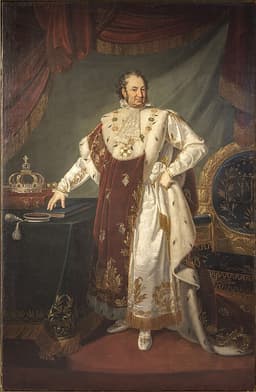
Maximilian III Joseph of Bavaria
Emperor · Modern
50.0Total

Napoleon Bonaparte
General · Modern
70.9Total
Basic Information
Born
1727
1769
Died
1777
1821
Era
Modern
Modern
Nationality
Bavaria
France
Occupation
Emperor
General
Civilization
Western
Western
Score Comparison
Military (10%)
21.2
94.0
Political (20%)
60.0
72.0
Influence (20%)
55.7
40.0
Legacy (20%)
43.3
80.0
Leadership (15%)
66.0
78.0
Strategy (15%)
42.3
90.0
TOTAL
50.0
70.9
Maximilian III Joseph of Bavaria — Complete Timeline
1745 AD
Accession as Elector of BavariaPolitical Action◆ Major
Maximilian III Joseph became Elector of Bavaria after the death of his father, Charles VII. He inherited a state devastated by the War of the Austrian Succession and faced significant financial and political challenges.
AccessionWar of the Austrian SuccessionFinancial Crisis
Impact: regional
Treaty of FüssenPolitical Action◆ Major
Maximilian III Joseph signed the Treaty of F
Treaty of FüssenWar of the Austrian SuccessionPragmatic Sanction
Impact: regional
1750 AD
Promotion of Enlightened Reforms in BavariaReform◆ Major
Maximilian III Joseph implemented enlightened reforms in Bavaria, including promoting education, reducing the influence of the Jesuits, and encouraging economic development. He supported the arts and sciences, making Munich a cultural center.
Enlightened ReformsEducationEconomic Development
Impact: regionalprogressive
1759 AD
Establishment of the Bavarian Academy of SciencesCultural
Maximilian III Joseph founded the Bavarian Academy of Sciences and Humanities in Munich. This institution promoted scientific research and intellectual discourse, contributing to the Enlightenment in Bavaria.
Academy of SciencesEnlightenmentIntellectual Life
constructive
Napoleon Bonaparte — Complete Timeline
1799 AD
Coup of 18 BrumaireOther◆ Major
Napoleon Bonaparte, with support from his brother Lucien and key political figures, overthrew the Directory in a bloodless coup. He established the Consulate with himself as First Consul, effectively becoming the ruler of France. This event ended the French Revolution's most unstable period.
French RevolutionCoupRise to Power
Impact: regional
1804 AD
Promulgation of the Napoleonic CodeOther◆ Major
Napoleon enacted the Civil Code of the French, known as the Napoleonic Code, a comprehensive set of laws that replaced the fragmented feudal legal systems. The code established legal equality, protected property rights, and secularized law. It became the basis for legal systems in many European and world countries.
Legal ReformNapoleonic CodeCivil Law
Impact: globalconstructive
1805 AD
Battle of AusterlitzWar◆ Major
Napoleon's Grande Arm
Napoleonic WarsBattleDecisive Victory
Impact: global
1812 AD
Invasion of RussiaWar◆ Major
Napoleon led the Grande Arm
Napoleonic WarsInvasionDisaster
Impact: globaldestructive
1815 AD
Battle of WaterlooWar◆ Major
Napoleon's French army was defeated by the combined forces of the Duke of Wellington's Anglo-Allied army and Gebhard Leberecht von Bl
Napoleonic WarsBattleFinal Defeat
Impact: globaldestructive
Expert Analysis
maximilian-iii-joseph-of-bavaria-vs-napoleon-bonaparte
# The Conqueror and the Reformer: Napoleon Bonaparte and Maximilian III Joseph
On a frozen December morning in 1805, Napoleon Bonaparte stood atop a hill in Austerlitz, watching his Grand Army crush the combined forces of Russia and Austria. His name would soon echo through the ages as the man who remade Europe through fire and sword. Just sixty years earlier, another ruler had faced a very different crossroads: Maximilian III Joseph, the young Elector of Bavaria, chose peace over glory, signing the Treaty of Füssen in 1745 to end his nation’s suffering. Both men inherited shattered realms. One chose to conquer; the other chose to build. Their divergent paths reveal how character, circumstance, and ambition shape the arc of history.
Origins
Napoleon was born in 1769 on the Mediterranean island of Corsica, a place recently annexed by France. His family was minor nobility, but poor. From childhood, he felt the sting of being an outsider—a Corsican among Frenchmen, a short boy among tall officers. This hunger for recognition drove him relentlessly. He devoured military history, studied artillery, and dreamed of glory. The French Revolution, which toppled the old order, became his ladder. In an era of chaos, a man of talent could rise faster than a cannonball.
Maximilian III Joseph, born in 1727, was the son of Charles VII, a Holy Roman Emperor whose ambitions had bankrupted Bavaria. The young prince grew up in the shadow of defeat. His father’s war against Austria for the imperial crown had left Bavaria occupied, its treasury empty, its people starving. Where Napoleon saw opportunity in crisis, Maximilian saw catastrophe. He learned early that power was not a prize to seize but a burden to bear wisely. His education emphasized Enlightenment philosophy, not military drills; he read Voltaire and Montesquieu, not Caesar and Hannibal.
Rise to Power
Napoleon’s ascent was a masterpiece of speed and audacity. At twenty-four, he crushed a royalist uprising in Paris with a "whiff of grapeshot." At twenty-seven, he conquered Italy, turning a ragged army into a legend. By thirty, he had invaded Egypt, staged a coup, and made himself First Consul of France. Each victory fed the next. He understood that in revolutionary France, legitimacy came from success alone. "I am not a man," he once said, "but a thing—a force."
Maximilian’s rise was quieter but no less decisive. In 1745, at age eighteen, he inherited a state in ruins. His father’s death left Bavaria exposed to Austrian revenge. The young elector faced a choice: continue the war or surrender. He chose surrender—but on his own terms. The Treaty of Füssen ended Bavarian participation in the War of the Austrian Succession, but it also secured Bavaria’s survival. Where Napoleon gambled everything on battle, Maximilian gambled on diplomacy. He understood that for a small state, survival was victory.
Leadership & Governance
Napoleon governed as he fought: with energy, brilliance, and a will to dominate. He centralized France, created the Napoleonic Code—a legal system that influenced the world—and reformed education, finance, and administration. But his rule was also a dictatorship. He suppressed dissent, censored the press, and crowned himself emperor. His military genius was undeniable—his score of 94 in military skill reflects a man who could win battles against overwhelming odds—but his political wisdom lagged behind. He trusted only himself.
Maximilian governed as a reformer, not a conqueror. His score of 76.6 in political acumen matched Napoleon’s 75, but his approach was opposite. He reduced the influence of the Church, promoted education, and founded the Bavarian Academy of Sciences in 1759. He commissioned the Nymphenburg Palace, not as a monument to his power, but as a center of culture. He was, by all accounts, a beloved ruler—his leadership score of 79.4 reflects a man who led by persuasion, not fear. He understood that a small state could not afford great wars, so it must invest in great ideas.
Triumph & Tragedy
Napoleon’s greatest moment was Austerlitz in 1805, where he destroyed a larger army with a single brilliant maneuver. His worst was the invasion of Russia in 1812, where the winter and his own overreach destroyed the Grand Army. He died in exile on Saint Helena in 1821, a prisoner of the British. His tragedy was that he could not stop. Victory was never enough; he needed more—more battles, more crowns, more glory.
Maximilian’s triumph was quieter: he transformed Bavaria from a war-torn backwater into a model of enlightened governance. His tragedy was that he died young, in 1777, at just fifty years old, leaving no heir. The Wittelsbach dynasty passed to a distant cousin, and Bavaria’s reforms stalled. His legacy was cut short—his influence score of 74.2 is high for a minor prince, but his legacy score of 59.5 reflects how quickly his work faded.
Character & Destiny
Napoleon was driven by an insatiable hunger. He once wrote, "There are but two powers in the world, the sword and the mind. In the long run, the sword is always beaten by the mind." Yet he lived by the sword. His personality—brilliant, arrogant, impatient—shaped a destiny of conquest and collapse. He could not share power; he could not compromise. His total score of 82.4 reflects a man of immense capacity but fatal flaws.
Maximilian was driven by prudence. He understood that wisdom is often the better part of valor. His personality—thoughtful, moderate, humane—shaped a destiny of peace and progress. He could negotiate; he could wait. His total score of 61.5 is lower than Napoleon’s, but it measures a different kind of greatness: not the greatness of conquest, but the greatness of governance.
Legacy
Napoleon’s legacy is immense and ambiguous. He spread the ideals of the French Revolution—legal equality, meritocracy, nationalism—across Europe, but he also brought war and tyranny. His name is synonymous with ambition, both glorious and destructive. Today, he is remembered as a military genius, a reformer, and a cautionary tale.
Maximilian’s legacy is smaller but purer. He is remembered in Bavaria as a good ruler, a patron of the arts, and a man who chose peace. His Academy of Sciences still stands; his reforms laid the groundwork for Bavaria’s later prosperity. He is not a household name, but he is a model of what a ruler can achieve when he puts his people before his pride.
Conclusion
Napoleon and Maximilian III Joseph offer two visions of leadership. One sought to reshape the world through force; the other sought to improve his corner of it through wisdom. Napoleon’s story is a tragedy of overreach; Maximilian’s is a story of quiet success. In the end, the conqueror conquered nothing that lasted, while the reformer built something that endured. Perhaps the greatest lesson is this: history remembers the loudest, but it is often the quietest who change the world for the better.
Rankings
🥇
Napoleon BonaparteLeader
Mil: 94.0Pol: 72.0Inf: 40.0
70.9
🥈
Maximilian III Joseph of Bavaria
Mil: 21.2Pol: 60.0Inf: 55.7
50.0
+20.9 behind
How This Comparison Works
Algorithm
Each figure is scored on 6 dimensions (0—100 scale) based on structured historical data: Military (10%), Political (20%), Influence (20%), Legacy (20%), Leadership (15%), Strategy (15%). The weighted total produces the final ranking.
Data Sources
Scores are computed from structured sub-indicators in the database. Scale factors adjust for era (Ancient ×0.85, Modern ×1.0) and civilization size (Eastern ×1.05, Other ×0.80) to account for differences in population and military scale.
Maximum 3 Figures
Comparisons are limited to 2—3 figures to ensure readability and statistical meaningfulness.
Error Margins
±5 points per dimension — Sub-scores are derived from historical records with inherent uncertainty. Two figures within 5 points on a dimension should be considered roughly equivalent in that area.
Total Score Accuracy
±3 points overall — The weighted combination of 6 dimensions produces a total score with approximately ±3 points of uncertainty. Differences of less than 3 points are not statistically significant— the figures are effectively tied.
Known Limitations
- Historical records are incomplete and uneven across civilizations
- Figures from oral-tradition societies may be underrepresented
- Occupation labels can misclassify multi-role figures
- Scores measure capability and impact, not moral character
- Quantitative scoring is a comparison tool, not absolute truth
Capability Radar
Military (10%) — Battles & Warfare
Battles
10
95
Win Rate
10
90
Expansion
10
95
Political (20%) — Governance & Reform
Reform
65
95
Diplomacy
55
80
Economy
60
85
Influence (20%) — Cultural & Global Reach
Cultural
55
85
Global
20
90
Legacy (20%) — Historical Impact
Historical
40
95
Longevity
30
90
Leadership (15%) — Power & Stability
Tenure
60
85
Stability
55
70
Strategy (15%) — Tactics & Innovation
Strategy
10
95
Tactics
10
98
Reform
15
92
Similar Comparisons
Comments & Discussion
Sledgehammer of the Alps6/17/2026
Maximilian III Joseph is my guy. This is the classic "peace is better than glory" argument. The Treaty of Füssen saved Bavaria from being Balkanized by Austria. Napoleon’s "brilliance" at Austerlitz just set him up for his eventual doom in Russia—logistical overreach masked as genius. Maximilian chose quiet competence: tax reform, agricultural investment, letting his people live. I'll take a stable, prosperous electorate over a fireworks display of tyranny any day.
The Corsican Ghost6/17/2026
Let's be real, Maximilian was a footnote in his own time; Napoleon remade Europe. The Treaty of Füssen was surrender, not strategy. Napoleon’s Civil Code, the abolition of feudalism, the metric system—those are permanent. Maximilian's "reforms" were just competent management of a doomed minor state. One man laid the foundations of the modern world; the other kept his little corner tidy. There’s no comparison: it’s the architect versus the caretaker.
平庸和平主义者6/17/2026
拿马克西米利安跟拿破仑比根本是欺负老实人。前者靠签投降条约苟活,后者让全欧洲颤抖。就说1745年的菲森条约,那是巴伐利亚跪着求奥地利饶命,跟拿破仑在奥斯特里茨歼灭俄奥联军是一个档次?拿破仑输在1812年才输,马克西米利安从来就没上过牌桌。历史记住的是改变世界的人,不是会算账的管家。
数据打假人6/17/2026
别吹什么改革了,看硬数字:巴伐利亚在马克西米利安治下人口大概120万,拿破仑皇帝直接统治近4500万人。前者GDP是农业自给自足,后者控制着欧洲工业心脏。一个搞了十年小修小补,一个十年内改变了欧洲法律、行政区划和战争模式。拿"国泰民安"当功劳?那和平年代的瑞士农场主也是伟人了。伟大需要规模,而规模从不善待懦夫。