Loading...
Alejandro Toledo vs Julius Caesar
Julius Caesar leads by 30.2 pts · 2 figures compared
…
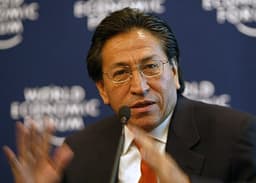
Alejandro Toledo
Politician · Modern
52.6Total

Julius Caesar
General · Ancient
82.8Total
Basic Information
Born
1946
-100
Died
—
-44
Era
Modern
Ancient
Nationality
Peru
Roman Republic
Occupation
Politician
General
Civilization
Western
Western
Score Comparison
Military (10%)
27.7
88.0
Political (20%)
61.3
78.0
Influence (20%)
57.2
85.0
Legacy (20%)
44.2
82.0
Leadership (15%)
62.2
80.0
Strategy (15%)
60.0
85.0
TOTAL
52.6
82.8
Alejandro Toledo — Complete Timeline
2001 AD
Presidency and Economic Recovery (2001-2006)Political Action◆ Major
Alejandro Toledo assumed the presidency of Peru, becoming the first democratically elected president of indigenous Quechua descent. His administration focused on macroeconomic stability, attracting foreign investment, and reducing poverty. He oversaw a period of steady economic growth following the Fujimori era.
First Indigenous PresidentEconomic StabilityDemocracy
Impact: nationalconstructive
2019 AD
Corruption Conviction and Extradition (2019-2023)Political Action◆ Major
Toledo was arrested in the United States on extradition charges related to the Odebrecht scandal. He was accused of accepting $20 million in bribes from the Brazilian construction company in exchange for contracts during his presidency. In 2023, he was extradited to Peru to face trial.
CorruptionOdebrechtExtradition
Impact: nationaldestructive
Julius Caesar — Complete Timeline
58 BC
Gallic WarsWar◆ Major
Caesar, as proconsul of Gaul, launched a series of campaigns that conquered all of Gaul (modern France, Belgium, and parts of Switzerland). He fought numerous battles, including against the Helvetii, the Belgae, and the Gallic chieftain Vercingetorix. The wars brought immense wealth and a loyal army to Caesar.
Gallic WarsConquestRoman Expansion
Impact: regional
49 BC
Crossing the RubiconPolitical Action◆ Major
Caesar led Legio XIII across the Rubicon River into Italy, defying the Roman Senate's order to disband his army. This act triggered a civil war against Pompey and the Optimates, ultimately leading to Caesar's dictatorship and the end of the Roman Republic.
Roman Civil WarEnd of RepublicPower Struggle
Impact: global
48 BC
Battle of PharsalusWar◆ Major
Caesar's outnumbered army defeated the larger forces of Pompey the Great at Pharsalus in Greece. Caesar's tactical use of a reserve line to counter Pompey's cavalry charge proved decisive. Pompey fled to Egypt, where he was assassinated, leaving Caesar as the undisputed master of the Roman world.
Roman Civil WarBattleDecisive Victory
Impact: regional
44 BC
Appointment as Dictator for LifePolitical Action◆ Major
The Roman Senate appointed Caesar dictator perpetuo (dictator for life), granting him unprecedented personal power. This move concentrated military, legislative, and judicial authority in one person, effectively ending the Roman Republic's traditional system of checks and balances and alarming many senators.
DictatorshipEnd of RepublicPower Consolidation
Impact: regionaldestructive
Assassination on the Ides of MarchPolitical Action◆ Major
A group of Roman senators, led by Marcus Junius Brutus and Gaius Cassius Longinus, stabbed Caesar to death at a meeting of the Senate in the Theatre of Pompey. The assassination was intended to restore the Republic, but instead triggered another civil war that led to the rise of the Roman Empire.
AssassinationRoman PoliticsEnd of Republic
Impact: globaldestructive
Expert Analysis
alejandro-toledo-vs-julius-caesar
# The Ides of March and the Fall of a Democrat: Caesar and Toledo Across Two Millennia
On a March morning in 44 BCE, Julius Caesar walked into the Senate chamber, confident in his absolute power, only to be stabbed twenty-three times by men he had once called friends. Two thousand years later, in 2019, Alejandro Toledo—the first indigenous president of Peru—was arrested in California, not by assassins, but by FBI agents acting on a corruption extradition request. Both men rose from humble beginnings to the pinnacle of political power. Both promised reform. But where Caesar’s story ended in a blood-soaked curia, Toledo’s ended in a courtroom. The difference tells us something profound about the distance between ancient ambition and modern accountability.
Origins
Julius Caesar was born into a patrician family that had seen better days. The Rome of 100 BCE was a republic in name only—riven by class conflict, civil wars, and the ambitions of military strongmen. Caesar’s aunt had married Gaius Marius, the populist general who had rewritten the rules of Roman politics. This connection marked him. From childhood, Caesar understood that in Rome, power flowed not from law but from legions and loyalty.
Alejandro Toledo was born in 1946 in a small Andean village in Peru, the son of Quechua-speaking peasants. He shined shoes and sold newspapers to help his family survive. The Peru of his youth was a nation of deep racial and economic divides, where indigenous people were systematically excluded from power. Toledo’s rise was not through inherited status but through scholarships: first to the University of San Francisco, then to Stanford. He became an economist, a technocrat, a man who believed in institutions and international development.
Caesar grew up in a world where the state was weak and the individual strongman was the ultimate reality. Toledo grew up in a world where the state, however flawed, was the only path to legitimacy. This difference—between a republic collapsing into autocracy and a democracy struggling to be born—shaped everything that followed.
Rise to Power
Caesar’s path was paved with debt, military commands, and calculated risk. He climbed the *cursus honorum*—the ladder of Roman offices—through a combination of bribery, marriage alliances, and battlefield glory. His conquest of Gaul (58–50 BCE) was not merely a war; it was a political machine. He used the spoils to buy support, the veterans to build a personal army, and the victories to craft a legend. When the Senate ordered him to disband his legions, he crossed the Rubicon River in 49 BCE, committing treason. He gambled that his soldiers loved him more than the Republic.
Toledo’s rise was democratic, fragile, and delayed. He ran for president in 2000 against Alberto Fujimori, a strongman who had ruled Peru for a decade. The election was marred by fraud, and Toledo withdrew, but his protests helped trigger Fujimori’s collapse. In 2001, Toledo won the presidency with a mandate for change. His rise was not a conquest but a negotiation—with voters, with international observers, with the institutions of a recovering democracy.
Caesar seized power. Toledo was elected to it. One was a general who became a politician; the other was a politician who had never commanded an army. Their scores reflect this: Caesar’s military rating is 88, his strategy 88. Toledo’s military score is 55.8, his strategy 35.3. They were playing different games on different boards.
Leadership & Governance
Caesar’s rule was a whirlwind of reform and consolidation. As dictator, he reorganized the calendar, granted citizenship to provincials, reformed debt laws, and initiated public works. He centralized power in his own hands, reducing the Senate to a rubber stamp. His governance was efficient, ambitious, and utterly dependent on his personal authority. He was a political master (score 78) but not a builder of institutions—he built himself.
Toledo governed in a different key. His presidency (2001–2006) focused on economic growth, which averaged over 5% annually, and on consolidating Peru’s fragile democracy. He fought corruption, though with mixed results. He was the first president of indigenous descent, a symbol of inclusion in a country scarred by racism. His leadership score is 73.9—solid, not spectacular. He was a democrat, not a dictator. He did not cross a Rubicon; he filled out budgets and signed trade agreements.
Caesar’s reforms died with him; the Empire that followed was not his design. Toledo’s reforms, however imperfect, were absorbed into Peru’s democratic fabric. Caesar governed through fear and glory; Toledo through persuasion and compromise. The difference is not just of skill but of system.
Triumph & Tragedy
Caesar’s greatest triumph was Gaul—a decade of conquest that made him the richest and most feared man in Rome. His greatest tragedy was his own success: by destroying the Republic, he made his own murder inevitable. The Ides of March was not a failure of power but a paradox of it. He had become so powerful that his peers saw no choice but to kill him.
Toledo’s triumph was breaking Peru’s cycle of authoritarianism. He was the first democratically elected president of indigenous Quechua descent, a moment of national hope. His tragedy is the Odebrecht scandal. In 2019, he was arrested in the United States for allegedly accepting $20 million in bribes from the Brazilian construction giant. The man who had campaigned against corruption was now accused of embodying it. His legacy score, 60.6, reflects this fall.
Caesar was killed by his enemies. Toledo was undone by his own. The ancient world punished ambition with daggers; the modern world punishes it with extradition treaties.
Character & Destiny
Caesar was audacious, charismatic, and ruthless. He forgave his enemies—and was killed by those he had pardoned. He believed in his own star. “The die is cast,” he said at the Rubicon. “Veni, vidi, vici,” he wrote after a swift victory. His personality was his fate: he could not imagine a world where he was not the center.
Toledo was a survivor, a striver, a man who had climbed from poverty to power. But survival can become a habit. The corruption charges suggest a man who, once in power, could not resist the temptations that had always surrounded the powerful. His character was shaped by scarcity; his destiny by abundance.
Caesar’s flaw was hubris. Toledo’s seems to have been a failure of integrity. Both are human, but one is ancient and the other modern.
Legacy
Caesar’s legacy is vast and ambiguous. He destroyed the Roman Republic and made the Empire possible. His name became a title: Kaiser, Tsar. He is remembered as a military genius, a reformer, and a tyrant. His influence score is 85, his legacy 82.
Toledo’s legacy is more modest. He is remembered as a democratic pioneer and a cautionary tale. His presidency was a step forward for Peru, but the corruption scandal has stained his name. His influence score is 73.2, his legacy 60.6.
One man’s story is etched in marble and myth. The other’s is written in court documents and news archives. Both are warnings, but of different kinds.
Conclusion
Caesar and Toledo are separated by two thousand years, yet they share a common arc: from the margins to the center, from hope to compromise, from triumph to ruin. Caesar’s fall was a tragedy of ambition in a world without law. Toledo’s fall is a tragedy of ambition in a world with too much law—or at least, too much temptation. The Ides of March is a dagger. The Odebrecht scandal is a wire transfer. Both kill. But only one of them leaves a democracy standing.
Rankings
🥇
Julius CaesarLeader
Mil: 88.0Pol: 78.0Inf: 85.0
82.8
🥈
Alejandro Toledo
Mil: 27.7Pol: 61.3Inf: 57.2
52.6
+30.2 behind
How This Comparison Works
Algorithm
Each figure is scored on 6 dimensions (0—100 scale) based on structured historical data: Military (10%), Political (20%), Influence (20%), Legacy (20%), Leadership (15%), Strategy (15%). The weighted total produces the final ranking.
Data Sources
Scores are computed from structured sub-indicators in the database. Scale factors adjust for era (Ancient ×0.85, Modern ×1.0) and civilization size (Eastern ×1.05, Other ×0.80) to account for differences in population and military scale.
Maximum 3 Figures
Comparisons are limited to 2—3 figures to ensure readability and statistical meaningfulness.
Error Margins
±5 points per dimension — Sub-scores are derived from historical records with inherent uncertainty. Two figures within 5 points on a dimension should be considered roughly equivalent in that area.
Total Score Accuracy
±3 points overall — The weighted combination of 6 dimensions produces a total score with approximately ±3 points of uncertainty. Differences of less than 3 points are not statistically significant— the figures are effectively tied.
Known Limitations
- Historical records are incomplete and uneven across civilizations
- Figures from oral-tradition societies may be underrepresented
- Occupation labels can misclassify multi-role figures
- Scores measure capability and impact, not moral character
- Quantitative scoring is a comparison tool, not absolute truth
Capability Radar
Military (10%) — Battles & Warfare
Battles
48
95
Win Rate
50
92
Expansion
56
97
Political (20%) — Governance & Reform
Reform
45
90
Diplomacy
50
85
Economy
35
82
Influence (20%) — Cultural & Global Reach
Cultural
55
88
Global
30
94
Legacy (20%) — Historical Impact
Historical
40
95
Longevity
25
96
Leadership (15%) — Power & Stability
Tenure
40
75
Stability
20
60
Strategy (15%) — Tactics & Innovation
Strategy
53
94
Tactics
59
96
Reform
64
88
Similar Comparisons
Comments & Discussion
No comments yet. Be the first to share your thoughts!