Loading...
Alessandro Farnese Duke of Parma vs Julius Caesar
Julius Caesar leads by 12.9 pts · 2 figures compared
…
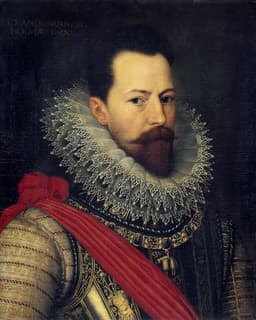
Alessandro Farnese Duke of Parma
General · Modern
69.9Total

Julius Caesar
General · Ancient
82.8Total
Basic Information
Born
1545
-100
Died
1592
-44
Era
Modern
Ancient
Nationality
Spain
Roman Republic
Occupation
General
General
Civilization
Western
Western
Score Comparison
Military (10%)
79.9
88.0
Political (20%)
69.2
78.0
Influence (20%)
68.0
85.0
Legacy (20%)
72.0
82.0
Leadership (15%)
62.0
80.0
Strategy (15%)
72.0
85.0
TOTAL
69.9
82.8
Alessandro Farnese Duke of Parma — Complete Timeline
1579 AD
Siege of MaastrichtWar◆ Major
Farnese led Spanish forces in a successful siege of Maastricht, a key rebel stronghold. The city was stormed after a brutal four-month siege, and its defenders were massacred, demonstrating Farnese's military effectiveness.
SiegeDutch RevoltSpanish Army
Impact: regionaldestructive
1585 AD
Siege of AntwerpWar
Farnese captured Antwerp, the largest city in the Netherlands, after a year-long siege. He constructed a bridge of boats across the Scheldt River to blockade the city, forcing its surrender and splitting the rebel provinces.
SiegeDutch RevoltMilitary Engineering
Impact: regional
Reconquest of the Southern NetherlandsWar◆ Major
Through a series of campaigns, Farnese reconquered the southern provinces of the Netherlands (modern-day Belgium) for Spain. This established the basis for the later split between the Dutch Republic and the Spanish Netherlands.
ReconquestNetherlandsSpanish Empire
Impact: regional
1590 AD
Invasion of FranceWar◆ Major
Farnese led a Spanish army into France to support the Catholic League against Henry of Navarre. He relieved the Siege of Paris and later the Siege of Rouen, but his campaigns were hampered by supply issues and political constraints.
French Wars of ReligionSpanish InterventionMilitary Campaign
Impact: regional
Julius Caesar — Complete Timeline
58 BC
Gallic WarsWar◆ Major
Caesar, as proconsul of Gaul, launched a series of campaigns that conquered all of Gaul (modern France, Belgium, and parts of Switzerland). He fought numerous battles, including against the Helvetii, the Belgae, and the Gallic chieftain Vercingetorix. The wars brought immense wealth and a loyal army to Caesar.
Gallic WarsConquestRoman Expansion
Impact: regional
49 BC
Crossing the RubiconPolitical Action◆ Major
Caesar led Legio XIII across the Rubicon River into Italy, defying the Roman Senate's order to disband his army. This act triggered a civil war against Pompey and the Optimates, ultimately leading to Caesar's dictatorship and the end of the Roman Republic.
Roman Civil WarEnd of RepublicPower Struggle
Impact: global
48 BC
Battle of PharsalusWar◆ Major
Caesar's outnumbered army defeated the larger forces of Pompey the Great at Pharsalus in Greece. Caesar's tactical use of a reserve line to counter Pompey's cavalry charge proved decisive. Pompey fled to Egypt, where he was assassinated, leaving Caesar as the undisputed master of the Roman world.
Roman Civil WarBattleDecisive Victory
Impact: regional
44 BC
Appointment as Dictator for LifePolitical Action◆ Major
The Roman Senate appointed Caesar dictator perpetuo (dictator for life), granting him unprecedented personal power. This move concentrated military, legislative, and judicial authority in one person, effectively ending the Roman Republic's traditional system of checks and balances and alarming many senators.
DictatorshipEnd of RepublicPower Consolidation
Impact: regionaldestructive
Assassination on the Ides of MarchPolitical Action◆ Major
A group of Roman senators, led by Marcus Junius Brutus and Gaius Cassius Longinus, stabbed Caesar to death at a meeting of the Senate in the Theatre of Pompey. The assassination was intended to restore the Republic, but instead triggered another civil war that led to the rise of the Roman Empire.
AssassinationRoman PoliticsEnd of Republic
Impact: globaldestructive
Expert Analysis
alessandro-farnese-duke-of-parma-vs-julius-caesar
### The Ides of March and the Bridge of Boats
On a winter day in 49 BCE, a Roman general stood at the banks of a small, sacred river in northern Italy. To cross the Rubicon with his army was to declare war on his own republic. Julius Caesar, defying the Senate's order, uttered a phrase that would echo through millennia: *“Alea iacta est”*—the die is cast. He crossed, and the ancient world was transformed. Fifteen centuries later, in the spring of 1585, another general stood before a very different river. Alessandro Farnese, Duke of Parma, gazed at the Scheldt, which protected the great city of Antwerp. He did not merely cross it; he built a bridge of boats across it, a marvel of military engineering that would strangle the city into submission. Both men were titans of warfare, yet one became a legend whose name still defines ambition, while the other remains a footnote known only to specialists. Why did Caesar’s star burn so brightly, while Farnese’s light faded into the shadows of history?
### Origins
The difference begins in their bloodlines and their eras. Caesar was born into the patrician Julian clan, one of Rome’s oldest families, but one that had fallen into political obscurity. His Rome was a republic in crisis, a cauldron of senatorial infighting and popular unrest where a man of talent could rise by sheer audacity. Caesar was a gambler from birth, steeped in the cutthroat world of Roman politics and the brutal discipline of the legions. Alessandro Farnese, born in 1545, was a prince of the Renaissance. His grandfather was Pope Paul III, and his mother was a Portuguese princess. He was raised in the Spanish court of Philip II, the most powerful monarch in Europe, a world of rigid hierarchy, Catholic orthodoxy, and cold, bureaucratic calculation. Farnese was a master of siegecraft, not a revolutionary. He was born to serve an empire, not to build one.
### Rise to Power
Caesar’s ascent was a masterpiece of political theater. He climbed the *cursus honorum*—the ladder of Roman offices—with calculated brilliance, forming the First Triumvirate with Pompey and Crassus, then securing command in Gaul. There, over eight years (58–50 BCE), he conquered a vast territory, built a loyal army, and wrote his own propaganda in the *Commentaries*. His rise was a direct challenge to the old order; he did not wait for power, he seized it. Farnese, by contrast, rose through inheritance and royal favor. He was the nephew of King Philip II, and his military career began as a commander in the Spanish Army of Flanders. His great opportunity came in 1578, when he was appointed Governor-General of the Spanish Netherlands after the death of Don John of Austria. Farnese did not create his own path; he was handed a mission: reconquer the rebellious provinces for Spain and the Catholic Church.
### Leadership & Governance
Their styles of leadership reveal the chasm between them. Caesar was a political animal who led from the front, sharing the hardships of his soldiers and winning their fanatical loyalty. He was a reformer who, as dictator, overhauled the Roman calendar, granted citizenship to provincials, and centralized power. His governance was personal, visionary, and ultimately autocratic. Farnese was a master of the slow, methodical art of siege warfare. His siege of Maastricht in 1579 was a textbook operation of trenches, mines, and artillery. His greatest triumph, the Siege of Antwerp (1584–1585), was a feat of patience and engineering: he built a fortified bridge of boats across the Scheldt, blocking all supplies while his guns battered the walls. As a governor, he was a diplomat, skillfully using the Union of Arras to reconcile the Catholic southern provinces to Spanish rule. But he was never a ruler in his own right; he was the king’s instrument, not the king.
### Triumph & Tragedy
Caesar’s greatest moment was his swift, brutal victory in the Civil War (49–45 BCE), culminating in the defeat of Pompey at Pharsalus. His tragedy came on the Ides of March, 44 BCE, when a conspiracy of senators stabbed him to death in the Curia of Pompey. He died believing he had saved Rome, only to have his blood stain the floor of the republic he had destroyed. Farnese’s triumph was the Reconquest of the Southern Netherlands by 1585, restoring Spanish control over modern-day Belgium. His tragedy was that his victories were never complete. He was diverted to invade France in 1590 to support the Catholic League, a campaign that drained his resources and led to his death in 1592 at the age of 47. He died in Arras, far from Antwerp, a servant who had given his king everything but had never been allowed to finish his work.
### Character & Destiny
Caesar’s character was a volatile compound of ambition, charm, and ruthlessness. He believed in his own star, in the destiny that made him a god among men. This hubris drove him to cross the Rubicon and to refuse a bodyguard, trusting that his clemency would disarm his enemies. It did not. Farnese was cautious, disciplined, and loyal. He was a brilliant technician of war, but he lacked the revolutionary fire. He was a prince who served a king, not a man who would become one. Their destinies were shaped by this: Caesar’s ambition broke the world and created a new one; Farnese’s competence preserved an old world that was already dying.
### Legacy
Caesar’s legacy is immortal. His name became a title—*Kaiser* in German, *Tsar* in Russian. His writings are studied, his reforms endure, and his assassination is a cultural touchstone. He is remembered as the father of the Roman Empire. Farnese’s legacy is a footnote in the history of the Eighty Years’ War. He is admired by military historians for his sieges, but his reconquest was undone by the Dutch Revolt, and his name is unknown to the public. He was a great general in a losing cause, a servant of a declining empire.
### Conclusion
One man crossed a river and changed the world. Another built a bridge across one and held a city for a season. Caesar’s story is a tragedy of ambition; Farnese’s is a tragedy of service. The difference lies not in their skill, but in the scale of their vision. Caesar dreamed of a world remade in his image; Farnese dreamed only of doing his duty. In the end, history remembers the dreamers, not the dutiful. The Ides of March echo still; the bridge of boats is long gone.
Rankings
🥇
Julius CaesarLeader
Mil: 88.0Pol: 78.0Inf: 85.0
82.8
🥈
Alessandro Farnese Duke of Parma
Mil: 79.9Pol: 69.2Inf: 68.0
69.9
+12.9 behind
How This Comparison Works
Algorithm
Each figure is scored on 6 dimensions (0—100 scale) based on structured historical data: Military (10%), Political (20%), Influence (20%), Legacy (20%), Leadership (15%), Strategy (15%). The weighted total produces the final ranking.
Data Sources
Scores are computed from structured sub-indicators in the database. Scale factors adjust for era (Ancient ×0.85, Modern ×1.0) and civilization size (Eastern ×1.05, Other ×0.80) to account for differences in population and military scale.
Maximum 3 Figures
Comparisons are limited to 2—3 figures to ensure readability and statistical meaningfulness.
Error Margins
±5 points per dimension — Sub-scores are derived from historical records with inherent uncertainty. Two figures within 5 points on a dimension should be considered roughly equivalent in that area.
Total Score Accuracy
±3 points overall — The weighted combination of 6 dimensions produces a total score with approximately ±3 points of uncertainty. Differences of less than 3 points are not statistically significant— the figures are effectively tied.
Known Limitations
- Historical records are incomplete and uneven across civilizations
- Figures from oral-tradition societies may be underrepresented
- Occupation labels can misclassify multi-role figures
- Scores measure capability and impact, not moral character
- Quantitative scoring is a comparison tool, not absolute truth
Capability Radar
Military (10%) — Battles & Warfare
Battles
85
95
Win Rate
88
92
Expansion
80
97
Political (20%) — Governance & Reform
Reform
65
90
Diplomacy
78
85
Economy
60
82
Influence (20%) — Cultural & Global Reach
Cultural
60
88
Global
70
94
Legacy (20%) — Historical Impact
Historical
75
95
Longevity
65
96
Leadership (15%) — Power & Stability
Tenure
70
75
Stability
55
60
Strategy (15%) — Tactics & Innovation
Strategy
90
94
Tactics
92
96
Reform
75
88
Similar Comparisons
Comments & Discussion
BridgeBurner6/17/2026
Caesar's Rubicon crossing is a mythologized moment that historians love to romanticize, but Farnese's Scheldt bridge was *actual* engineering genius. Caesar gambled on a civil war; Farnese planned a siege that required building a bridge-spanning fortification under cannon fire. Yet nobody builds a "crossing the Rubicon" video game—because strategic engineering isn't sexy. Show me one statue of Farnese in a modern city square. Exactly.
撒桥工6/17/2026
数据控必须说:恺撒跨鲁比孔河是历史教科书上的标题党。法尔内塞在1585年造的船桥长730米,跨越谢尔德河,还带浮动堡垒和炮台,防住了荷兰水军的突袭。恺撒的“骰子已掷”就一句话,法尔内塞的桥用了数月木材、绳索和人力。结果呢?前者是经典笑话梗,后者连Wikipedia页面都短得像简历。这票投给实干派,没悬念。
JuliaCaesar6/17/2026
Look, Farnese was a brilliant tactician, but Caesar *invented* the playbook Farnese used. Caesar's crossing wasn't about engineering—it was about *political theater*. He knew crossing that river meant an illegal war. He knew optics mattered more than any bridge. The fact that we still debate his motivations proves his genius. Farnese built a bridge; Caesar rewrote history. That's the difference between a general and a legend.
青铜纪6/17/2026
要我说,这比较本身就是个时代错位。恺撒活在城邦共和国转型帝国时期,法尔内塞则身处宗教战争和火药革命年代。工程上讲,法尔内塞的船桥是16世纪军事科学的高峰,但恺撒的战争塑造了整个西方政治语汇。你见过哪个会议大厅挂“法尔内塞大桥”画?没有。但每个人都知道“跨过鲁比孔河”意味着不可逆的决定。这就是历史记忆的筛选器——不是谁更厉害,是谁的故事更能被后人借用。