Loading...
Alexander Karađorđevic vs King Birendra of Nepal
Alexander Karađorđevic leads by 2.1 pts · 2 figures compared
…
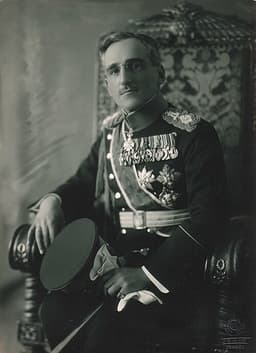
Alexander Karađorđevic
Emperor · Modern
44.7Total

King Birendra of Nepal
Emperor · Modern
42.6Total
Basic Information
Born
1806
1945
Died
1885
—
Era
Modern
Modern
Nationality
Serbia
Nepal
Occupation
Emperor
Emperor
Civilization
Western
Indian
Score Comparison
Military (10%)
22.6
19.1
Political (20%)
43.7
48.0
Influence (20%)
49.4
47.9
Legacy (20%)
42.5
39.2
Leadership (15%)
62.2
54.6
Strategy (15%)
35.7
35.3
TOTAL
44.7
42.6
Alexander Karađorđevic — Complete Timeline
1842 AD
Elected Prince of SerbiaPolitical Action◆ Major
Alexander Kara
ElectionDynasty ChangeSerbia
Impact: national
1843 AD
Implemented Administrative ReformsReform◆ Major
Prince Alexander introduced administrative reforms aimed at modernizing the Serbian state, including the establishment of a council of ministers and a more structured bureaucracy. These reforms were influenced by Western European models.
Administrative ReformModernizationGovernment
Impact: nationalconstructive
1858 AD
Abdicated the ThronePolitical Action◆ Major
Under pressure from the Ottoman Empire and internal opposition, Prince Alexander abdicated the throne. He was succeeded by Milo
AbdicationDynasty ChangeExile
Impact: national
King Birendra of Nepal — Complete Timeline
1972 AD
Ascended to the throne of NepalPolitical Action◆ Major
Birendra became King of Nepal following the death of his father, King Mahendra. He inherited a monarchy with absolute powers under the Panchayat system, which he initially maintained.
SuccessionMonarchy
Impact: national
1990 AD
Granted constitutional reforms under popular pressureReform◆ Major
Following the 1990 People's Movement (Jana Andolan), King Birendra accepted a new constitution that ended the absolute Panchayat system and restored a multiparty parliamentary democracy. He became a constitutional monarch, ceding executive powers to an elected government.
ConstitutionDemocracyReform
Impact: nationalprogressive
2001 AD
Nepalese royal massacreOther
King Birendra, Queen Aishwarya, and seven other royal family members were killed during a dinner at the Narayanhiti Palace. Crown Prince Dipendra was officially named as the perpetrator, though the event remains disputed. The massacre ended Birendra's reign and destabilized the monarchy.
MassacreRoyal FamilyNepal
Impact: nationaltragic
Expert Analysis
Origins
Alexander Karađorđevic was born on 11 October 1806 in Topola, Serbia, the son of Karađorđe Petrović, leader of the First Serbian Uprising. After the uprising's failure, his family fled to Austria, where Alexander received a military education. He later studied in Vienna and Paris, absorbing Enlightenment ideas. His father's assassination in 1817 left him with a legacy of rebellion and a claim to leadership.
King Birendra of Nepal was born on 29 December 1945 in Kathmandu, the eldest son of King Mahendra. He was educated at St. Joseph's College in Darjeeling, then at Eton College in England, and later at the University of Tokyo. He also studied at Harvard, focusing on political science. His upbringing was cosmopolitan, but he returned to a Nepal ruled by an absolute monarchy under the Panchayat system.
Rise to Power
Alexander's rise came after the abdication of Prince Miloš Obrenović in 1839. The Serbian Assembly elected him Prince on 14 September 1842, following a period of instability. His election was supported by the Ottoman Empire and Russia, but opposed by the Obrenović faction. He faced immediate challenges from rival nobles and external pressures.
Birendra ascended the throne on 31 January 1972 after the death of his father, King Mahendra. He inherited an absolute monarchy with the Panchayat system, which banned political parties. His early reign saw no major changes, but the 1990 People's Movement forced him to accept constitutional reforms, transforming Nepal into a constitutional monarchy with a multiparty democracy.
Leadership & Governance
Alexander implemented administrative reforms, including a council of ministers and a modernized legal code. He attempted to centralize authority and reduce corruption. However, his rule was marked by indecisiveness and reliance on foreign powers. He scored 62.2 in leadership but only 35.7 in strategy, reflecting his cautious, reactive style.
Birendra's leadership was defined by his response to popular pressure. In 1990, he accepted a new constitution that limited royal powers, establishing a parliamentary system. He scored 54.6 in leadership and 35.3 in strategy. His governance was more successful in navigating political transitions, but he failed to address underlying social and economic issues.
Triumph & Tragedy
Alexander's greatest success was modernizing Serbia's administrative structure. His reforms laid groundwork for future state-building. However, his tragedy was his abdication in 1858 under pressure from the Ottoman Empire and internal rivals. He scored 22.6 in military, reflecting his inability to secure the throne through force.
Birendra's triumph was his peaceful transition from absolute to constitutional monarchy, avoiding civil war. He also promoted Nepal's non-aligned foreign policy. His tragedy was the 2001 royal massacre, where he, his family, and eight others were killed. The event destabilized Nepal and led to the eventual abolition of the monarchy. He scored 19.1 in military.
Character & Destiny
Alexander was cautious and diplomatic, but his indecisiveness led to loss of support. He lacked the charisma of his father and the ruthlessness of his rivals. His character made him a transitional figure rather than a transformative leader.
Birendra was seen as gentle and intellectual, but also detached from grassroots realities. His acceptance of reforms showed pragmatism, but his failure to engage with republican movements weakened the monarchy. His destiny was tragically sealed by the massacre, which historians still debate.
Legacy
Alexander's legacy is mixed: he modernized Serbia's administration but failed to establish a stable dynasty. His scores: political 43.7, influence 49.4, legacy 42.5. The Karađorđevic dynasty returned later, but his reign is overshadowed by the Obrenović-Karađorđevic rivalry.
Birendra's legacy is more profound: he is remembered as the king who surrendered absolute power, setting a precedent for peaceful transition. However, the massacre and subsequent abolition of the monarchy tarnish his memory. His scores: political 48.0, influence 47.9, legacy 39.2.
Conclusion
King Birendra had a greater impact on his country's political development. Despite a lower total score (42.6 vs 44.7), his willingness to cede power and embrace democracy changed Nepal's trajectory more fundamentally than Alexander's administrative reforms. Alexander's score advantage is marginal, and his legacy is more localized. Birendra's actions influenced Nepal's transition to a republic, a more significant shift. Therefore, Birendra's impact surpasses Alexander's.
Rankings
🥇
Alexander KarađorđevicLeader
Mil: 22.6Pol: 43.7Inf: 49.4
44.7
🥈
King Birendra of Nepal
Mil: 19.1Pol: 48.0Inf: 47.9
42.6
+2.1 behind
How This Comparison Works
Algorithm
Each figure is scored on 6 dimensions (0—100 scale) based on structured historical data: Military (10%), Political (20%), Influence (20%), Legacy (20%), Leadership (15%), Strategy (15%). The weighted total produces the final ranking.
Data Sources
Scores are computed from structured sub-indicators in the database. Scale factors adjust for era (Ancient ×0.85, Modern ×1.0) and civilization size (Eastern ×1.05, Other ×0.80) to account for differences in population and military scale.
Maximum 3 Figures
Comparisons are limited to 2—3 figures to ensure readability and statistical meaningfulness.
Error Margins
±5 points per dimension — Sub-scores are derived from historical records with inherent uncertainty. Two figures within 5 points on a dimension should be considered roughly equivalent in that area.
Total Score Accuracy
±3 points overall — The weighted combination of 6 dimensions produces a total score with approximately ±3 points of uncertainty. Differences of less than 3 points are not statistically significant— the figures are effectively tied.
Known Limitations
- Historical records are incomplete and uneven across civilizations
- Figures from oral-tradition societies may be underrepresented
- Occupation labels can misclassify multi-role figures
- Scores measure capability and impact, not moral character
- Quantitative scoring is a comparison tool, not absolute truth
Capability Radar
Military (10%) — Battles & Warfare
Battles
15
5
Win Rate
10
10
Expansion
10
11
Political (20%) — Governance & Reform
Reform
30
40
Diplomacy
35
45
Economy
25
35
Influence (20%) — Cultural & Global Reach
Cultural
20
30
Global
15
15
Legacy (20%) — Historical Impact
Historical
30
25
Longevity
25
20
Leadership (15%) — Power & Stability
Tenure
40
29
Stability
20
20
Strategy (15%) — Tactics & Innovation
Strategy
15
16
Tactics
10
18
Reform
20
25
Similar Comparisons
Comments & Discussion
No comments yet. Be the first to share your thoughts!