Loading...
Alexandru cel Bun vs Louis the Pious
Alexandru cel Bun leads by 7.9 pts · 2 figures compared
…
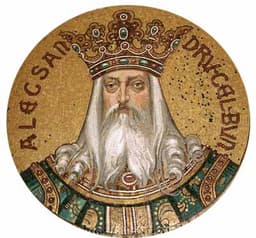
Alexandru cel Bun
Emperor · Medieval
56.8Total
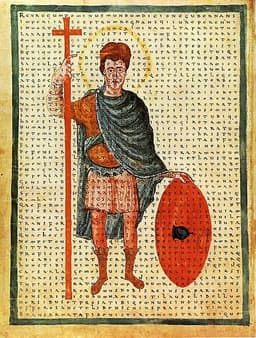
Louis the Pious
Emperor · Medieval
48.9Total
Basic Information
Born
1375
778
Died
1432
840
Era
Medieval
Medieval
Nationality
Moldavia
Frankish Empire
Occupation
Emperor
Emperor
Civilization
Western
Western
Score Comparison
Military (10%)
55.0
50.0
Political (20%)
68.0
39.4
Influence (20%)
53.3
54.1
Legacy (20%)
47.5
45.0
Leadership (15%)
66.0
62.2
Strategy (15%)
60.0
38.6
TOTAL
56.8
48.9
Alexandru cel Bun — Complete Timeline
1400 AD
Reform of the Orthodox ChurchReform◆ Major
Alexandru reorganized the Moldavian Orthodox Church, establishing the Metropolitanate of Suceava. He granted lands and privileges to monasteries, strengthening the church's role in state administration.
Church ReformOrthodoxy
Impact: nationalconstructive
Stabilization of MoldaviaPolitical Action◆ Major
Alexandru ended internal conflicts and stabilized Moldavia after a period of civil war. His reign brought peace and economic growth, earning him the epithet 'cel Bun' (the Good).
StabilizationMoldavia
Impact: nationalconstructive
1412 AD
Treaty of LublauPolitical Action◆ Major
Alexandru signed the Treaty of Lublau with Poland, establishing a defensive alliance. This treaty secured Moldavia's western border and aligned the principality with Poland against the Ottoman Empire.
TreatyPoland
Impact: regionalconstructive
1420 AD
Campaign against the Ottoman EmpireWar
Alexandru led a campaign against the Ottoman Empire, defending Moldavia's southern borders. He successfully repelled Ottoman incursions, maintaining Moldavian independence.
Ottoman WarsDefense
Impact: regionalconstructive
Louis the Pious — Complete Timeline
817 AD
Ordinatio ImperiiPolitical Action◆ Major
Louis issued the Ordinatio Imperii, dividing the Frankish Empire among his three sons: Lothair, Pepin, and Louis the German. This plan aimed to maintain unity under Lothair's seniority but led to civil wars after Pepin's death.
SuccessionDivisionCivil War
Impact: regional
822 AD
Penance at AttignyPolitical Action
Louis performed public penance at Attigny for the death of his nephew Bernard of Italy, whom he had blinded. This act weakened his authority and set a precedent for ecclesiastical intervention in royal affairs.
PenanceChurchBernard of Italy
Impact: nationaltragic
841 AD
Battle of FontenoyWar◆ Major
After Louis's death, his sons fought the Battle of Fontenoy, where Charles the Bald and Louis the German defeated Lothair. This battle was a key event in the Carolingian civil wars that led to the empire's fragmentation.
Civil WarCarolingianDivision
Impact: regionaldestructive
Expert Analysis
Origins
Alexandru cel Bun (Alexander the Good) was born around 1375 in Moldavia, a principality in Eastern Europe. He was the son of Roman I, a voivode who had expanded Moldavia's territory. Little is known of his early education, but he was likely trained in military and administrative skills typical for a medieval ruler. He ascended to the throne in 1400 after a period of civil war following the death of his predecessor, Iuga. Alexandru's background was rooted in the turbulent politics of the region, where Moldavia faced threats from Poland, Hungary, and the Ottoman Empire.
Louis the Pious was born in 778 in Aquitaine, the son of Charlemagne and Hildegard. He was raised in the Frankish court and educated by scholars such as Alcuin, learning Latin, theology, and governance. His father appointed him King of Aquitaine in 781, giving him early experience in ruling. Louis's upbringing was heavily influenced by the Carolingian Renaissance and the ideals of Christian kingship. His background positioned him as the heir to a vast empire that stretched across Western Europe.
Rise to Power
Alexandru cel Bun rose to power in 1400 after the death of Iuga, whom he may have deposed. He quickly consolidated his rule by securing recognition from Poland. In 1412, he signed the Treaty of Lublau with King Władysław II Jagiełło of Poland, forming a defensive alliance against the Teutonic Knights and Hungary. This treaty aligned Moldavia with Poland and provided Alexandru with external support. He also strengthened his position by reforming the Orthodox Church, establishing the Metropolitanate of Suceava in 1401, which gave him control over religious affairs and legitimized his rule.
Louis the Pious became co-emperor with Charlemagne in 813 and sole emperor upon his father's death in 814. His rise was smooth due to his status as the sole surviving legitimate son. However, he faced challenges from his relatives and nobles. In 817, he issued the Ordinatio Imperii, dividing the empire among his three sons: Lothair, Pepin, and Louis the German. This plan aimed to maintain unity but instead sowed discord. His reign saw early rebellions, including by his nephew Bernard of Italy, whom he blinded in 818, leading to Bernard's death and Louis's public penance at Attigny in 822.
Leadership & Governance
Alexandru cel Bun's leadership focused on stabilization and institutional development. He ended internal conflicts and promoted economic growth through trade agreements with Poland and the Ottoman Empire. His governance was characterized by decentralization, granting lands and privileges to boyars (nobles) and monasteries to secure loyalty. He reformed the Orthodox Church, making it more independent from Constantinople, which strengthened Moldavian identity. His military strategy was defensive, scoring 55.0 in military metrics, relying on alliances rather than expansion. Politically, he scored 68.0, reflecting his ability to navigate regional power dynamics.
Louis the Pious attempted to maintain the Carolingian Empire through administrative reforms and religious piety. He issued laws promoting church reform and supported monasticism. However, his governance was undermined by his attempts to partition the empire, which led to conflicts among his sons. His political score of 39.4 reflects his failure to manage succession. His military score of 50.0 indicates modest capabilities, with no major conquests. His strategy score of 38.6 is low due to inconsistent policies and inability to enforce his will.
Triumph & Tragedy
Alexandru's greatest success was stabilizing Moldavia and establishing a period of peace and prosperity. He successfully defended against Ottoman incursions and secured his borders. His reform of the Orthodox Church created a lasting ecclesiastical structure. However, his reign saw no major territorial expansion, and his reliance on Poland sometimes limited Moldavian independence. After his death in 1432, Moldavia again fell into civil war, showing the fragility of his achievements.
Louis's triumph was inheriting and initially ruling the largest empire in Western Europe since Rome. He maintained it for over a decade without major wars. However, his tragedy was the disintegration of the empire after his death. The Ordinatio Imperii led to civil wars, culminating in the Battle of Fontenoy in 841, where his sons fought. His penance at Attigny weakened his authority, and he spent his later years dealing with rebellions. He died in 840, and the empire was divided into three kingdoms that never reunited.
Character & Destiny
Alexandru was pragmatic and diplomatic, earning the epithet "cel Bun" (the Good) for his peaceful rule. He prioritized stability over conquest, which suited Moldavia's vulnerable position. His character shaped a destiny of relative peace, but his lack of aggressive expansion left Moldavia vulnerable after his death. Historians view him as a capable administrator who strengthened institutions.
Louis was deeply religious and idealistic, but his piety sometimes led to political weakness. His decision to perform public penance set a precedent for royal humility but undermined his authority. He was a devoted father, but his attempts to ensure fairness among his sons backfired. His character, marked by indecision and a desire for order, contributed to the empire's fragmentation. Historians often see him as a well-intentioned ruler who failed to match his father's stature.
Legacy
Alexandru cel Bun's legacy is enduring in Moldavia (modern-day Romania and Moldova). He is remembered as a founding figure of the Moldavian Orthodox Church, and his reforms shaped the principality's identity. His reign is seen as a golden age of stability. However, his influence outside the region is limited, with a legacy score of 47.5. His impact is primarily local, compared to Louis's broader European significance.
Louis the Pious's legacy is tied to the Carolingian decline. His reign marks the transition from the unified Frankish Empire to the feudal kingdoms of France and Germany. The Ordinatio Imperii influenced later succession practices. His support for church reform continued the Carolingian Renaissance. Despite his failures, his influence score of 54.1 reflects his role in shaping medieval Europe. However, his legacy is often overshadowed by Charlemagne's.
Conclusion
Alexandru cel Bun had a greater impact relative to his context. With a total score of 56.8 compared to Louis's 48.9, Alexandru achieved his goals of stabilization and institutional building, whereas Louis failed to preserve his father's empire. Alexandru's reforms had lasting effects on Moldavian identity, while Louis's reign is primarily a cautionary tale. The 7.9-point gap reflects Alexandru's superior political and strategic acumen. In the contest of medieval rulers, Alexandru's pragmatic success outweighs Louis's inherited grandeur.
Rankings
🥇
Alexandru cel BunLeader
Mil: 55.0Pol: 68.0Inf: 53.3
56.8
🥈
Louis the Pious
Mil: 50.0Pol: 39.4Inf: 54.1
48.9
+7.9 behind
How This Comparison Works
Algorithm
Each figure is scored on 6 dimensions (0—100 scale) based on structured historical data: Military (10%), Political (20%), Influence (20%), Legacy (20%), Leadership (15%), Strategy (15%). The weighted total produces the final ranking.
Data Sources
Scores are computed from structured sub-indicators in the database. Scale factors adjust for era (Ancient ×0.85, Modern ×1.0) and civilization size (Eastern ×1.05, Other ×0.80) to account for differences in population and military scale.
Maximum 3 Figures
Comparisons are limited to 2—3 figures to ensure readability and statistical meaningfulness.
Error Margins
±5 points per dimension — Sub-scores are derived from historical records with inherent uncertainty. Two figures within 5 points on a dimension should be considered roughly equivalent in that area.
Total Score Accuracy
±3 points overall — The weighted combination of 6 dimensions produces a total score with approximately ±3 points of uncertainty. Differences of less than 3 points are not statistically significant— the figures are effectively tied.
Known Limitations
- Historical records are incomplete and uneven across civilizations
- Figures from oral-tradition societies may be underrepresented
- Occupation labels can misclassify multi-role figures
- Scores measure capability and impact, not moral character
- Quantitative scoring is a comparison tool, not absolute truth
Capability Radar
Military (10%) — Battles & Warfare
Battles
30
25
Win Rate
35
30
Expansion
40
10
Political (20%) — Governance & Reform
Reform
65
40
Diplomacy
60
35
Economy
55
30
Influence (20%) — Cultural & Global Reach
Cultural
40
30
Global
20
25
Legacy (20%) — Historical Impact
Historical
45
40
Longevity
40
30
Leadership (15%) — Power & Stability
Tenure
70
60
Stability
65
20
Strategy (15%) — Tactics & Innovation
Strategy
45
25
Tactics
40
20
Reform
50
15
Similar Comparisons
Comments & Discussion
No comments yet. Be the first to share your thoughts!