Loading...
Alexios III Angelos vs Zhu Youjian
Zhu Youjian leads by 0.4 pts · 2 figures compared
…
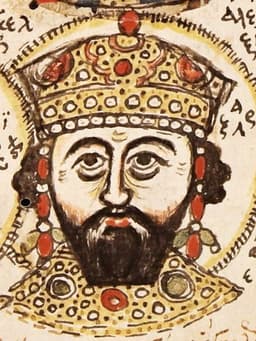
Alexios III Angelos
Emperor · Medieval
37.5Total

Zhu Youjian
Emperor · Medieval
37.9Total
Basic Information
Born
1153
1611
Died
1211
1644
Era
Medieval
Medieval
Nationality
Byzantine Empire
China
Occupation
Emperor
Emperor
Civilization
Western
Eastern
Score Comparison
Military (10%)
20.0
21.2
Political (20%)
32.1
27.9
Influence (20%)
45.5
48.6
Legacy (20%)
35.8
40.8
Leadership (15%)
39.0
38.1
Strategy (15%)
45.0
35.7
TOTAL
37.5
37.9
Alexios III Angelos — Complete Timeline
1195 AD
Usurpation of the throne from Isaac IIPolitical Action◆ Major
Alexios III Angelos overthrew his brother Isaac II in a palace coup, blinding and imprisoning him. Alexios III then ruled as emperor, but his reign was marked by corruption, fiscal mismanagement, and the weakening of Byzantine defenses.
CoupDynastic ConflictUsurpation
Impact: nationaldestructive
1203 AD
Flight from Constantinople during the Fourth CrusadePolitical Action◆ Major
When the Fourth Crusade besieged Constantinople in 1203, Alexios III fled the city with the imperial treasury, abandoning his subjects. His cowardly flight left the capital defenseless and allowed the crusaders to restore Isaac II and Alexios IV, but also set the stage for the eventual sack of Constantinople in 1204.
Fourth CrusadeFlightAbandonment
Impact: regionaltragic
1211 AD
Capture and death in Nicaean captivityPolitical Action
Alexios III was captured by Theodore I Laskaris, the Nicaean emperor, after attempting to regain power with Seljuk support. He was imprisoned in a monastery in Nicaea, where he died later that year, ending his attempts to reclaim the Byzantine throne.
CaptivityNicaean EmpireSeljuk Alliance
tragic
Zhu Youjian — Complete Timeline
1627 AD
Ascension as Chongzhen EmperorPolitical Action
Zhu Youjian became the Chongzhen Emperor at age 16 after the death of his brother. He inherited a dynasty plagued by fiscal crisis, peasant rebellions, and Manchu threats, and he attempted to reform the government but faced insurmountable challenges.
Ming DynastyImperial SuccessionCrisis
Impact: national
Execution of Wei ZhongxianPolitical Action◆ Major
Chongzhen ordered the execution of the powerful eunuch Wei Zhongxian, who had dominated the previous reign. This purge aimed to restore imperial authority but alienated the eunuch faction and destabilized the court.
Eunuch PowerCourt PoliticsMing Dynasty
Impact: nationalconstructive
1644 AD
Fall of Beijing and suicidePolitical Action
As Li Zicheng's rebel army approached Beijing, Chongzhen refused to flee. He hanged himself on Jingshan Hill, ending the Ming dynasty. His death marked the dynasty's collapse and the beginning of the Qing conquest of China.
Ming-Qing TransitionImperial SuicideDynastic Fall
Impact: globaltragic
Refusal to negotiate with Li ZichengPolitical Action◆ Major
Chongzhen rejected Li Zicheng's offers of a negotiated settlement, insisting on unconditional surrender. This decision eliminated the possibility of a peaceful transition and led to the violent sack of Beijing.
Ming-Qing TransitionDiplomacyPeasant Rebellion
Impact: nationaldestructive
Expert Analysis
Origins
Alexios III Angelos was born into the Byzantine imperial family around 1153. His father was Andronikos Doukas Angelos, a military commander, but the family had a history of usurpation. Alexios III rose through court intrigue, not military prowess. In contrast, Zhu Youjian was born in 1611 as the fifth son of the Ming Wanli Emperor. He received a Confucian education emphasizing moral rectitude and imperial duty. Unlike Alexios, Zhu was not expected to rule; his older brother the Tianqi Emperor took the throne. Zhu's early life was marked by isolation and fear of court eunuchs.
Rise to Power
Alexios III seized the throne in 1195 by overthrowing his brother Isaac II Angelos. He blinded Isaac and imprisoned him, a typical Byzantine coup. His reign began with a weak legitimacy due to the violent usurpation. Zhu Youjian became emperor in 1627 at age 16 after his brother's sudden death. He immediately purged the powerful eunuch Wei Zhongxian, executing him and his faction. This move earned him initial popularity but alienated key court figures. Both came to power in crises, but Alexios's path was more treacherous.
Leadership & Governance
Alexios III governed through nepotism and corruption. He appointed family members to high positions, regardless of competence. He raised taxes to fund lavish spending, weakening the empire's finances. During the Fourth Crusade (1203-1204), he failed to organize a defense, instead fleeing with the treasury. His military score of 20.0 reflects his cowardice. Zhu Youjian, by contrast, was industrious but paranoid. He micromanaged campaigns against the Manchu and peasant rebels, dismissing capable generals like Yuan Chonghuan on suspicion. His political score of 27.9 shows poor decision-making. Zhu refused to negotiate with Li Zicheng, leading to the fall of Beijing.
Triumph & Tragedy
Alexios III's greatest success was surviving for three years on the throne despite his weak rule. His greatest failure was abandoning Constantinople during the Fourth Crusade, leading to the empire's fragmentation. The city fell in 1204, and Alexios's flight ensured the sack by crusaders. Zhu Youjian's triumph was briefly stabilizing the Ming after purging eunuchs. His tragedy was his suicide on Jingshan Hill in 1644 as Li Zicheng's rebels entered Beijing. He refused to flee, writing "I have no face to see my ancestors." Both emperors presided over the collapse of their dynasties.
Character & Destiny
Alexios III was a coward and opportunist. He prioritized personal safety over duty, fleeing with gold while his people suffered. His character ensured his legacy as a traitor. Zhu Youjian was stubborn and honor-bound. His Confucian ideals prevented pragmatic compromise, leading to his death. Historians note his indecisiveness: he executed loyal ministers yet failed to control rebels. Alexios scored 39.0 in leadership, Zhu 38.1. Both were ill-suited for crisis.
Legacy
Alexios III is remembered as the emperor who lost Constantinople. His flight enabled the Latin Empire, weakening Byzantium permanently. Zhu Youjian's legacy is the Ming dynasty's end. His suicide symbolizes dynastic loyalty but also incompetence. The Ming collapse led to Qing rule, which lasted until 1912. Alexios's influence score is 45.5, Zhu's 48.6. Both left negative examples of failed leadership.
Conclusion
Zhu Youjian had a slightly higher total score of 37.9 vs Alexios's 37.5, but the gap is negligible. However, Zhu's impact on Chinese history is greater: his death ended a 276-year dynasty and ushered in the Qing. Alexios's flight only accelerated a decline already underway. Zhu's refusal to negotiate sealed his fate, while Alexios's cowardice was more contemptible. Therefore, Zhu Youjian had greater impact, albeit both were among history's least effective rulers.
Rankings
🥇
Zhu YoujianLeader
Mil: 21.2Pol: 27.9Inf: 48.6
37.9
🥈
Alexios III Angelos
Mil: 20.0Pol: 32.1Inf: 45.5
37.5
+0.4 behind
How This Comparison Works
Algorithm
Each figure is scored on 6 dimensions (0—100 scale) based on structured historical data: Military (10%), Political (20%), Influence (20%), Legacy (20%), Leadership (15%), Strategy (15%). The weighted total produces the final ranking.
Data Sources
Scores are computed from structured sub-indicators in the database. Scale factors adjust for era (Ancient ×0.85, Modern ×1.0) and civilization size (Eastern ×1.05, Other ×0.80) to account for differences in population and military scale.
Maximum 3 Figures
Comparisons are limited to 2—3 figures to ensure readability and statistical meaningfulness.
Error Margins
±5 points per dimension — Sub-scores are derived from historical records with inherent uncertainty. Two figures within 5 points on a dimension should be considered roughly equivalent in that area.
Total Score Accuracy
±3 points overall — The weighted combination of 6 dimensions produces a total score with approximately ±3 points of uncertainty. Differences of less than 3 points are not statistically significant— the figures are effectively tied.
Known Limitations
- Historical records are incomplete and uneven across civilizations
- Figures from oral-tradition societies may be underrepresented
- Occupation labels can misclassify multi-role figures
- Scores measure capability and impact, not moral character
- Quantitative scoring is a comparison tool, not absolute truth
Capability Radar
Military (10%) — Battles & Warfare
Battles
5
15
Win Rate
5
10
Expansion
5
5
Political (20%) — Governance & Reform
Reform
10
20
Diplomacy
10
15
Economy
10
10
Influence (20%) — Cultural & Global Reach
Cultural
5
20
Global
5
10
Legacy (20%) — Historical Impact
Historical
10
30
Longevity
5
15
Leadership (15%) — Power & Stability
Tenure
20
40
Stability
5
5
Strategy (15%) — Tactics & Innovation
Strategy
5
15
Tactics
5
20
Reform
5
10
Similar Comparisons
Comments & Discussion
No comments yet. Be the first to share your thoughts!