Loading...
Alexios III Angelos vs Julius Caesar
Julius Caesar leads by 45.3 pts · 2 figures compared
…
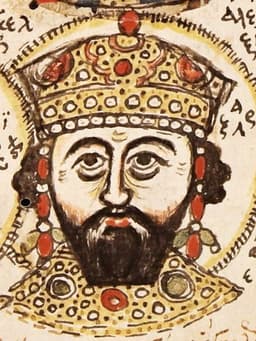
Alexios III Angelos
Emperor · Medieval
37.5Total

Julius Caesar
General · Ancient
82.8Total
Basic Information
Born
1153
-100
Died
1211
-44
Era
Medieval
Ancient
Nationality
Byzantine Empire
Roman Republic
Occupation
Emperor
General
Civilization
Western
Western
Score Comparison
Military (10%)
20.0
88.0
Political (20%)
32.1
78.0
Influence (20%)
45.5
85.0
Legacy (20%)
35.8
82.0
Leadership (15%)
39.0
80.0
Strategy (15%)
45.0
85.0
TOTAL
37.5
82.8
Alexios III Angelos — Complete Timeline
1195 AD
Usurpation of the throne from Isaac IIPolitical Action◆ Major
Alexios III Angelos overthrew his brother Isaac II in a palace coup, blinding and imprisoning him. Alexios III then ruled as emperor, but his reign was marked by corruption, fiscal mismanagement, and the weakening of Byzantine defenses.
CoupDynastic ConflictUsurpation
Impact: nationaldestructive
1203 AD
Flight from Constantinople during the Fourth CrusadePolitical Action◆ Major
When the Fourth Crusade besieged Constantinople in 1203, Alexios III fled the city with the imperial treasury, abandoning his subjects. His cowardly flight left the capital defenseless and allowed the crusaders to restore Isaac II and Alexios IV, but also set the stage for the eventual sack of Constantinople in 1204.
Fourth CrusadeFlightAbandonment
Impact: regionaltragic
1211 AD
Capture and death in Nicaean captivityPolitical Action
Alexios III was captured by Theodore I Laskaris, the Nicaean emperor, after attempting to regain power with Seljuk support. He was imprisoned in a monastery in Nicaea, where he died later that year, ending his attempts to reclaim the Byzantine throne.
CaptivityNicaean EmpireSeljuk Alliance
tragic
Julius Caesar — Complete Timeline
58 BC
Gallic WarsWar◆ Major
Caesar, as proconsul of Gaul, launched a series of campaigns that conquered all of Gaul (modern France, Belgium, and parts of Switzerland). He fought numerous battles, including against the Helvetii, the Belgae, and the Gallic chieftain Vercingetorix. The wars brought immense wealth and a loyal army to Caesar.
Gallic WarsConquestRoman Expansion
Impact: regional
49 BC
Crossing the RubiconPolitical Action◆ Major
Caesar led Legio XIII across the Rubicon River into Italy, defying the Roman Senate's order to disband his army. This act triggered a civil war against Pompey and the Optimates, ultimately leading to Caesar's dictatorship and the end of the Roman Republic.
Roman Civil WarEnd of RepublicPower Struggle
Impact: global
48 BC
Battle of PharsalusWar◆ Major
Caesar's outnumbered army defeated the larger forces of Pompey the Great at Pharsalus in Greece. Caesar's tactical use of a reserve line to counter Pompey's cavalry charge proved decisive. Pompey fled to Egypt, where he was assassinated, leaving Caesar as the undisputed master of the Roman world.
Roman Civil WarBattleDecisive Victory
Impact: regional
44 BC
Appointment as Dictator for LifePolitical Action◆ Major
The Roman Senate appointed Caesar dictator perpetuo (dictator for life), granting him unprecedented personal power. This move concentrated military, legislative, and judicial authority in one person, effectively ending the Roman Republic's traditional system of checks and balances and alarming many senators.
DictatorshipEnd of RepublicPower Consolidation
Impact: regionaldestructive
Assassination on the Ides of MarchPolitical Action◆ Major
A group of Roman senators, led by Marcus Junius Brutus and Gaius Cassius Longinus, stabbed Caesar to death at a meeting of the Senate in the Theatre of Pompey. The assassination was intended to restore the Republic, but instead triggered another civil war that led to the rise of the Roman Empire.
AssassinationRoman PoliticsEnd of Republic
Impact: globaldestructive
Expert Analysis
alexios-iii-angelos-vs-julius-caesar
The Eagle and the Angelos: Two Paths from the Summit of Power
On a winter night in 49 BCE, a Roman general stood at the banks of a small stream in northern Italy, the Rubicon. He knew that crossing it meant civil war, the death of the Republic, and the end of his life as a lawful citizen. He crossed anyway. On a summer morning in 1203, a Byzantine emperor stood on the walls of Constantinople, watching the sails of the Fourth Crusade fill the Bosphorus. He knew that the city’s fall would mean centuries of exile, humiliation, and the shattering of an empire. He fled, taking the treasury with him. Why did one man gamble everything on a river, while the other abandoned his world to the sea?
Origins
Julius Caesar was born into the twilight of the Roman Republic, a world of brittle institutions and ferocious ambition. His family, the Julii, claimed descent from the goddess Venus, but their real currency was debt and patronage. Rome in the first century BCE was a machine of conquest and corruption, where a talented general could buy loyalty, crush rivals, and rewrite the law. Caesar was raised in this forge: he learned that the Republic’s old rules were paper, and that a man with legions could tear through paper.
Alexios III Angelos was born into the Byzantine Empire’s long afternoon, a world of fading glory and intricate treachery. The Angelos family had clawed their way to the throne through marriage and murder, but the empire they ruled was a hollow shell. The Komnenian restoration had bled dry, the treasury was strained, and the Seljuk Turks were gnawing at the Anatolian heartland. Alexios learned that power was a game of whispers, bribes, and blinding irons—not of open battle. His era taught him that survival meant keeping your options open, even if that meant leaving your post.
Rise to Power
Caesar’s ascent was a masterpiece of calculated risk. He climbed the political ladder through the cursus honorum, but his real breakthrough came in Gaul. Over eight years, he conquered a vast territory, built a personal army of veterans who worshipped him, and amassed enough wealth to buy the Senate. The key turning point was the Rubicon: he chose open rebellion over political extinction. He gambled that his military genius and the loyalty of his men could outrun the Senate’s decrees.
Alexios III’s rise was a coup, not a campaign. In 1195, while his brother Isaac II was away on a hunting expedition, Alexios bribed the palace guard, seized the capital, and had Isaac blinded and thrown into a dungeon. There was no battlefield glory, no grand strategy—only a cold, quiet betrayal. He became emperor not by earning the loyalty of armies, but by exploiting the paranoia of a court that had seen too many coups. The difference is already stark: Caesar earned his power through conquest; Alexios stole his through conspiracy.
Leadership & Governance
Caesar governed like a storm. As dictator, he reformed the calendar, granted citizenship to provincials, launched public works, and redistributed land to veterans. His military genius was matched by a political instinct that understood that Rome needed a single master—but that master had to pretend to be a servant of the Republic. He was ruthless but never petty: he pardoned enemies, promoted talent, and built a coalition of the ambitious. His strategy was to centralize power while spreading its benefits.
Alexios III governed like a spider. He hoarded the treasury, raised taxes to crush the provinces, and appointed relatives to every key post. His military record is a blank: he never led an army in a significant campaign. When the Fourth Crusade arrived—supposedly to restore his nephew Alexios IV to the throne—he did not rally the city’s defenses. Instead, he negotiated, delayed, and then, on the night of July 17, 1203, he slipped out of the city with as much gold as he could carry. His leadership was a zero-sum game: he could not imagine sharing power, so he saved himself and let the empire burn.
Triumph & Tragedy
Caesar’s greatest moment was the Battle of Alesia (52 BCE), where he besieged and defeated a massive Gallic coalition led by Vercingetorix. It was a feat of engineering, patience, and tactical brilliance that sealed Gaul for Rome. His greatest failure was his own success: he became so powerful that the Senate could not tolerate him. On the Ides of March, 44 BCE, he was stabbed to death by men he had pardoned. He died because he could not conceive of a world where his enemies were not grateful for his mercy.
Alexios III’s greatest moment was, in a perverse sense, his escape. He fled with the treasury, which allowed him to live as a wealthy exile for years. His greatest failure was the fall of Constantinople in 1204. The Crusaders sacked the city, raped its women, burned its libraries, and carved up the empire. Alexios’s flight did not save him in the end: he was captured by Theodore I Laskaris in 1211, after a failed attempt to reclaim power with Seljuk support, and died in a Nicaean prison. His tragedy was not a dramatic assassination but a slow, pathetic unraveling.
Character & Destiny
Caesar was driven by an insatiable need for glory—*gloria* in the Roman sense of eternal fame. He wrote his own commentaries, controlled his own narrative, and believed that history would forgive him if he won. His arrogance was his strength and his flaw: he thought his charm could disarm the Senate, but some wounds are never forgiven. He shaped his destiny like a sculptor, even when the statue shattered.
Alexios III was driven by fear. He blinded his brother because he feared a coup; he fled because he feared death; he hoarded gold because he feared poverty. His decisions were reactive, defensive, and short-sighted. He never understood that an emperor’s destiny is tied to his city’s fate. By saving himself, he destroyed his legacy. Character is not just fate—it is the difference between a legend and a footnote.
Legacy
Caesar’s legacy is the Roman Empire. His name became a title: *Caesar* meant emperor for centuries, from Rome to Russia to Germany. He changed the course of Western history, and his writings are still read in classrooms. He is remembered as a genius, a tyrant, and a martyr—a man who broke the old world to build a new one.
Alexios III’s legacy is the Fourth Crusade’s sack of Constantinople. He is remembered as a coward who sold his empire for a few years of exile. His name is a cautionary tale, not a title. He did not build; he only broke. The Byzantines never forgave him, and history has not either.
Conclusion
Standing at the Rubicon, Caesar understood that a leader must sometimes burn the bridge behind him. Standing on the walls of Constantinople, Alexios understood only that he wanted to save his own skin. One man crossed a river to claim an empire; the other fled a city to lose one. Their difference is not just of skill or luck, but of vision. Caesar saw a world he could remake; Alexios saw only a world that was ending. In the end, the difference between a legend and a footnote is not the size of your army, but the size of your courage to stay.
Rankings
🥇
Julius CaesarLeader
Mil: 88.0Pol: 78.0Inf: 85.0
82.8
🥈
Alexios III Angelos
Mil: 20.0Pol: 32.1Inf: 45.5
37.5
+45.3 behind
How This Comparison Works
Algorithm
Each figure is scored on 6 dimensions (0—100 scale) based on structured historical data: Military (10%), Political (20%), Influence (20%), Legacy (20%), Leadership (15%), Strategy (15%). The weighted total produces the final ranking.
Data Sources
Scores are computed from structured sub-indicators in the database. Scale factors adjust for era (Ancient ×0.85, Modern ×1.0) and civilization size (Eastern ×1.05, Other ×0.80) to account for differences in population and military scale.
Maximum 3 Figures
Comparisons are limited to 2—3 figures to ensure readability and statistical meaningfulness.
Error Margins
±5 points per dimension — Sub-scores are derived from historical records with inherent uncertainty. Two figures within 5 points on a dimension should be considered roughly equivalent in that area.
Total Score Accuracy
±3 points overall — The weighted combination of 6 dimensions produces a total score with approximately ±3 points of uncertainty. Differences of less than 3 points are not statistically significant— the figures are effectively tied.
Known Limitations
- Historical records are incomplete and uneven across civilizations
- Figures from oral-tradition societies may be underrepresented
- Occupation labels can misclassify multi-role figures
- Scores measure capability and impact, not moral character
- Quantitative scoring is a comparison tool, not absolute truth
Capability Radar
Military (10%) — Battles & Warfare
Battles
5
95
Win Rate
5
92
Expansion
5
97
Political (20%) — Governance & Reform
Reform
10
90
Diplomacy
10
85
Economy
10
82
Influence (20%) — Cultural & Global Reach
Cultural
5
88
Global
5
94
Legacy (20%) — Historical Impact
Historical
10
95
Longevity
5
96
Leadership (15%) — Power & Stability
Tenure
20
75
Stability
5
60
Strategy (15%) — Tactics & Innovation
Strategy
5
94
Tactics
5
96
Reform
5
88
Similar Comparisons
Comments & Discussion
CAESAR'S_SHADOW6/17/2026
The comparison misses the fundamental difference: Caesar was a revolutionary who built his power from nothing, while Alexios III inherited an empire in decline and chose self-preservation over duty. Caesar crossed the Rubicon knowing he might die but believing he could reshape Rome. Alexios fled Constantinople clutching gold, proving he was always a caretaker, not a leader. The Angelos dynasty produced bureaucrats, not conquerors.
历史粉碎机6/17/2026
别拿Alexios III和凯撒比,这简直是侮辱了凯撒。凯撒在49 BCE跨过卢比孔河时,扛着的是整个共和国的命运;而1203年的Alexios III,面对十字军围城,只想着卷走国库金币跑路。两人最大的区别:凯撒有策略、有勇气、有追随者,而Alexios III只擅长宫廷阴谋。历史评价从不骗人,成王败寇,凯撒的名字是传奇,Alexios III只是脚注。
DATA_SKEPTIC6/17/2026
These comparisons are historically lazy. Caesar's reign was cut short at 56 by assassination; Alexios III reigned until 1211 despite losing Constantinople. The "abandoned his world" narrative ignores that Alexios III was deposed in a coup years before the Fourth Crusade sacked the city. The real question is why we romanticize Caesar's ambition while condemning Alexios III's survival instinct. Both were politicians, just in different systems.
古典学人6/17/2026
从经典史学角度看,这个对比忽略了关键的制度差异。凯撒活在罗马共和末期,元老院和公民大会还在运转,他的行动可以被视为对腐败体制的挑战。而Alexios III处于拜占庭专制君主制下,皇权已神圣化,但他却像个富商一样抛弃了帝国象征——圣索菲亚大教堂和皇室家族。凯撒至少没逃走,他死在元老院的地板上,这就是勇气和怯懦的分界线。
REVISIONIST_BARBARIAN6/17/2026
Stop pretending Alexios III was worse than Caesar. Caesar crossed the Rubicon and started a civil war that killed hundreds of thousands for personal ambition. Alexios III fled to preserve himself in a game he couldn't win. The Fourth Crusade was a Venetian conspiracy anyway—Dandolo used the Angelos family squabbles as a pretext. If Alexios III had stayed, he'd have been killed like his nephew Alexios IV. Self-preservation is rational, not cowardly.