Loading...
Alexis I of Russia vs Julius Caesar
Julius Caesar leads by 23.3 pts · 2 figures compared
…
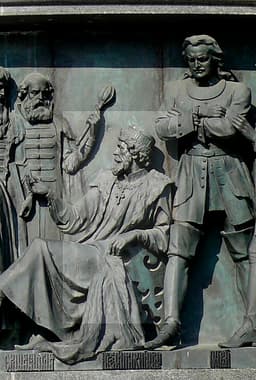
Alexis I of Russia
Emperor · Modern
59.5Total

Julius Caesar
General · Ancient
82.8Total
Basic Information
Born
1629
-100
Died
1676
-44
Era
Modern
Ancient
Nationality
Russia
Roman Republic
Occupation
Emperor
General
Civilization
Western
Western
Score Comparison
Military (10%)
55.0
88.0
Political (20%)
60.0
78.0
Influence (20%)
55.0
85.0
Legacy (20%)
58.0
82.0
Leadership (15%)
72.0
80.0
Strategy (15%)
60.0
85.0
TOTAL
59.5
82.8
Alexis I of Russia — Complete Timeline
1649 AD
Enacted the 1649 Sobornoye Ulozheniye (Code of Laws)Reform◆ Major
Alexis I enacted the Sobornoye Ulozheniye, a comprehensive legal code that consolidated Russian law and strengthened serfdom by making peasants permanently bound to the land. The code also centralized state authority and defined the rights of nobles, clergy, and townspeople.
Legal CodeSerfdomCentralization
Impact: national
1654 AD
Led the 1654-1667 Russo-Polish WarWar◆ Major
Alexis I launched a war against the Polish-Lithuanian Commonwealth, initially capturing Smolensk and much of eastern Poland. The war, which included the Khmelnytsky Uprising and Swedish intervention, ended with the Truce of Andrusovo, gaining Russia left-bank Ukraine and Kiev.
WarPolandUkraine
Impact: regional
1662 AD
Suppressed the 1662 Copper RiotPolitical Action◆ Major
Alexis I's government brutally suppressed the Copper Riot in Moscow, a protest against the devaluation of copper coins and economic hardship. Thousands of rioters were killed or executed, and the rebellion led to the withdrawal of copper currency, restoring silver coinage.
RiotCopperEconomic
Impact: nationaldestructive
1666 AD
Supported the 1666-1667 Church Council that condemned the Old BelieversCultural◆ Major
Alexis I supported the Great Moscow Synod, which condemned the Old Believers and their leader Avvakum for opposing Patriarch Nikon's liturgical reforms. The council excommunicated the dissenters, leading to a schism (Raskol) in the Russian Orthodox Church that persisted for centuries.
ChurchSchismOld Believers
Impact: nationaldestructive
Julius Caesar — Complete Timeline
58 BC
Gallic WarsWar◆ Major
Caesar, as proconsul of Gaul, launched a series of campaigns that conquered all of Gaul (modern France, Belgium, and parts of Switzerland). He fought numerous battles, including against the Helvetii, the Belgae, and the Gallic chieftain Vercingetorix. The wars brought immense wealth and a loyal army to Caesar.
Gallic WarsConquestRoman Expansion
Impact: regional
49 BC
Crossing the RubiconPolitical Action◆ Major
Caesar led Legio XIII across the Rubicon River into Italy, defying the Roman Senate's order to disband his army. This act triggered a civil war against Pompey and the Optimates, ultimately leading to Caesar's dictatorship and the end of the Roman Republic.
Roman Civil WarEnd of RepublicPower Struggle
Impact: global
48 BC
Battle of PharsalusWar◆ Major
Caesar's outnumbered army defeated the larger forces of Pompey the Great at Pharsalus in Greece. Caesar's tactical use of a reserve line to counter Pompey's cavalry charge proved decisive. Pompey fled to Egypt, where he was assassinated, leaving Caesar as the undisputed master of the Roman world.
Roman Civil WarBattleDecisive Victory
Impact: regional
44 BC
Appointment as Dictator for LifePolitical Action◆ Major
The Roman Senate appointed Caesar dictator perpetuo (dictator for life), granting him unprecedented personal power. This move concentrated military, legislative, and judicial authority in one person, effectively ending the Roman Republic's traditional system of checks and balances and alarming many senators.
DictatorshipEnd of RepublicPower Consolidation
Impact: regionaldestructive
Assassination on the Ides of MarchPolitical Action◆ Major
A group of Roman senators, led by Marcus Junius Brutus and Gaius Cassius Longinus, stabbed Caesar to death at a meeting of the Senate in the Theatre of Pompey. The assassination was intended to restore the Republic, but instead triggered another civil war that led to the rise of the Roman Empire.
AssassinationRoman PoliticsEnd of Republic
Impact: globaldestructive
Expert Analysis
alexis-i-of-russia-vs-julius-caesar
# The Dictator and the Tsar: Two Paths to Power in an Age of Transformation
The Ides of March, 44 BCE. Sixty Roman senators surround Gaius Julius Caesar, their daggers concealed beneath togas. As the first blade strikes, Caesar's world—the world of the Roman Republic—begins to bleed out with him. Across two millennia and half a continent, in the year 1676, Tsar Alexis I of Russia dies in his bed, surrounded by icons and incense, having reigned for thirty-one years. One man is murdered by his peers; the other expires naturally, his dynasty secure. What separates these two fates is not merely time or geography, but the very nature of power itself—how it is seized, how it is held, and what it demands of those who wield it.
Origins
Julius Caesar was born into a patrician family in 100 BCE, a time when the Roman Republic was already cracking under the weight of its own ambition. His uncle by marriage, Gaius Marius, had been a populist general; his father died when Caesar was sixteen. The young Roman learned early that in a world of civil strife, survival meant forging alliances and cultivating an image of invincibility. He was not born to rule—he was born to compete.
Alexis I, by contrast, entered the world in 1629 as the heir to the Romanov throne, a dynasty barely sixteen years old. His father, Michael, had been elected tsar after the Time of Troubles, a period of foreign invasion and internal collapse that had nearly destroyed Russia. Alexis inherited not a republic in flux but a fragile autocracy in need of stabilization. Where Caesar had to claw his way upward through a crowd of equals, Alexis had only to survive long enough to wear the crown—and to keep it on his head.
Rise to Power
Caesar's ascent was a masterclass in calculated risk. As a young man, he fled Rome to avoid Sulla's proscriptions, then returned to climb the political ladder: quaestor, aedile, pontifex maximus, praetor. His military command in Gaul from 58 to 50 BCE was not merely conquest—it was a personal empire built on loot, loyalty, and legend. When the Senate ordered him to disband his army, he crossed the Rubicon River in 49 BCE, igniting a civil war. He had chosen: better to be first in a village than second in Rome.
Alexis I became tsar at sixteen, in 1645, without a single battle. His rise required no coup, no crossing of forbidden rivers. Yet his early reign was no less precarious. He was surrounded by boyars—noble families who had torn Russia apart during the Time of Troubles—and by a bureaucracy riddled with corruption. His first major act, the Sobornoye Ulozheniye of 1649, was not a declaration of war but a legal code: 967 articles that consolidated Russian law, strengthened serfdom, and centralized the state. Where Caesar seized Rome with a sword, Alexis bound Russia with a document.
Leadership and Governance
Caesar governed as a military genius who understood that politics was war by other means. His reforms were swift and sweeping: he reorganized the calendar, granted citizenship to provincials, initiated public works, and packed the Senate with his supporters. His strategy was to concentrate power in his own hands while appearing to restore order. He pardoned former enemies—then appointed them to offices that kept them watched. His military mind saw every political problem as a siege to be won.
Alexis I governed as a pious autocrat who believed the tsar was God's deputy on earth. His military campaigns, particularly the Russo-Polish War of 1654–1667, were less about personal glory than about reclaiming lost Orthodox lands. He captured Smolensk and much of eastern Poland, but his wars were grinding, expensive, and inconclusive. His political wisdom lay not in battlefield brilliance but in patience: he weathered the Copper Riot of 1662, when angry Muscovites protested currency devaluation, and he supported the Church Council of 1666–1667 that condemned the Old Believers. He crushed dissent, but he did not eliminate it—he merely postponed the reckoning that would explode under his son, Peter the Great.
Triumph and Tragedy
Caesar's greatest triumph was Gaul—a decade of conquest that made him the richest and most feared man in Rome. His Commentaries on the Gallic Wars remain a masterpiece of propaganda and military literature. His greatest tragedy was his own success: by becoming dictator for life in 44 BCE, he made the Republic's survival impossible and his own murder inevitable. The Ides of March was not a betrayal by enemies but by friends who believed they were saving something Caesar had already destroyed.
Alexis I's triumph was the consolidation of the Romanov dynasty. He fathered three sons and six daughters, ensuring the line would continue. His tragedy was subtler: he codified serfdom, binding millions of Russians to the land in a system that would cripple the country for centuries. He also failed to modernize Russia as his son would. The legal code of 1649 was a step forward—but it was a step into a cage, not into the future.
Character and Destiny
Caesar was restless, brilliant, and ruthless. He gambled constantly—on his life, on his soldiers, on his luck. He forgave his enemies because he was supremely confident he could control them. That confidence, bordering on arrogance, cost him everything. He believed his own legend, and legends do not survive the dagger.
Alexis I was cautious, devout, and methodical. He was called "the Quietest" for his gentle demeanor, but his policies were anything but gentle. He did not seek to change the world; he sought to stabilize it. His character was shaped by the chaos he inherited: the Time of Troubles had taught him that order, however harsh, was preferable to anarchy. He did not want to be remembered—he wanted Russia to survive.
Legacy
Caesar's legacy is the Roman Empire. His adopted heir, Octavian, became Augustus, the first emperor. The Republic Caesar destroyed gave way to a system that lasted five hundred years in the West and another thousand in the East. His name became a title: Kaiser, Tsar, Czar. He is remembered as a conqueror, a reformer, and a warning.
Alexis I's legacy is Peter the Great. Without Alexis's stabilization of the state, his codification of law, his suppression of rebellion, Peter would have had no foundation on which to build his modernizing revolution. Alexis is often overshadowed—a quiet father to a thunderous son. Yet the legal code of 1649 shaped Russian society until the nineteenth century. He is remembered less as a ruler than as a bridge: the man who held Russia together so someone else could tear it apart and rebuild it.
Conclusion
Caesar and Alexis I never met, but their stories speak to the same truth: power is a mirror. It reflects the ambitions and fears of the one who holds it. Caesar saw the world as a battlefield to be conquered; Alexis saw it as a kingdom to be preserved. One died by the sword he had lived by; the other died in peace, surrounded by the icons of a faith he had used to bind his people. Which path was wiser? The answer depends on whether you value glory or stability—and how long you expect either to last.
Rankings
🥇
Julius CaesarLeader
Mil: 88.0Pol: 78.0Inf: 85.0
82.8
🥈
Alexis I of Russia
Mil: 55.0Pol: 60.0Inf: 55.0
59.5
+23.3 behind
How This Comparison Works
Algorithm
Each figure is scored on 6 dimensions (0—100 scale) based on structured historical data: Military (10%), Political (20%), Influence (20%), Legacy (20%), Leadership (15%), Strategy (15%). The weighted total produces the final ranking.
Data Sources
Scores are computed from structured sub-indicators in the database. Scale factors adjust for era (Ancient ×0.85, Modern ×1.0) and civilization size (Eastern ×1.05, Other ×0.80) to account for differences in population and military scale.
Maximum 3 Figures
Comparisons are limited to 2—3 figures to ensure readability and statistical meaningfulness.
Error Margins
±5 points per dimension — Sub-scores are derived from historical records with inherent uncertainty. Two figures within 5 points on a dimension should be considered roughly equivalent in that area.
Total Score Accuracy
±3 points overall — The weighted combination of 6 dimensions produces a total score with approximately ±3 points of uncertainty. Differences of less than 3 points are not statistically significant— the figures are effectively tied.
Known Limitations
- Historical records are incomplete and uneven across civilizations
- Figures from oral-tradition societies may be underrepresented
- Occupation labels can misclassify multi-role figures
- Scores measure capability and impact, not moral character
- Quantitative scoring is a comparison tool, not absolute truth
Capability Radar
Military (10%) — Battles & Warfare
Battles
45
95
Win Rate
50
92
Expansion
50
97
Political (20%) — Governance & Reform
Reform
65
90
Diplomacy
60
85
Economy
55
82
Influence (20%) — Cultural & Global Reach
Cultural
55
88
Global
50
94
Legacy (20%) — Historical Impact
Historical
65
95
Longevity
60
96
Leadership (15%) — Power & Stability
Tenure
70
75
Stability
50
60
Strategy (15%) — Tactics & Innovation
Strategy
55
94
Tactics
40
96
Reform
60
88
Similar Comparisons
Comments & Discussion
RomeSkeptic6/17/2026
Caesar wasn't assassinated just because he was a dictator—he was murdered because he humiliated the Senate by publicly snubbing their honors. Alexis I played the same power game but smarter: he let the Zemsky Sobor rubber-stamp his laws, keeping nobles in line. Caesar underestimated optics; Alexis mastered them, dying in bed while Caesar bled out on the Senate floor.|罗马真相党|zh|说凯撒死于独裁?太天真了!元老院那帮人不是恨他掌权,而是恨他当众打脸——拒绝加冕时那副轻蔑样。阿列克谢一世才是玩政治的高手:他把法律都让缙绅会议走个过场,贵族们觉得有参与感。凯撒输在不会假装尊重制度,而俄国沙皇把“形式民主”玩成了护身符。一个