Loading...
Alfonso V of Aragon vs Monomotapa
Alfonso V of Aragon leads by 8.7 pts · 2 figures compared
…
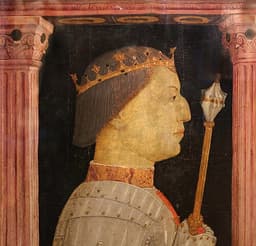
Alfonso V of Aragon
Emperor · Medieval
58.7Total

Monomotapa
Emperor · Medieval
50.0Total
Basic Information
Born
1396
1480
Died
1458
1530
Era
Medieval
Medieval
Nationality
Aragon
Mutapa Empire
Occupation
Emperor
Emperor
Civilization
Western
Other
Score Comparison
Military (10%)
67.5
25.0
Political (20%)
62.7
54.7
Influence (20%)
59.0
54.9
Legacy (20%)
49.2
46.7
Leadership (15%)
68.0
65.0
Strategy (15%)
52.5
41.7
TOTAL
58.7
50.0
Alfonso V of Aragon — Complete Timeline
1442 AD
Conquest of NaplesWar
Alfonso V of Aragon captured the city of Naples after a prolonged siege, defeating the Angevin claimant Ren
Italian conquestMediterranean empire
Impact: regional
1443 AD
Patronage of the arts in NaplesCultural◆ Major
Alfonso V established a humanist court in Naples, patronizing scholars, artists, and writers. He commissioned translations of classical works, supported the construction of the Castel Nuovo, and fostered a cultural renaissance in southern Italy, earning him the epithet 'the Magnanimous'.
Renaissance patronageHumanism
Impact: regionalconstructive
1454 AD
Peace of LodiPolitical Action◆ Major
Alfonso V was a signatory to the Peace of Lodi, a treaty that ended decades of warfare between the Italian states of Milan, Venice, Florence, and Naples. The agreement established a balance of power in Italy that lasted for forty years, with Alfonso's Kingdom of Naples as a key player.
Italian peaceBalance of power
Impact: regionalconstructive
Monomotapa — Complete Timeline
1500 AD
Consolidated Mutapa Empire under Monomotapa titlePolitical Action◆ Major
The Monomotapa ruler consolidated the Mutapa Empire, centralizing power and establishing the title as the supreme authority over the Shona kingdoms. This period saw the empire's peak in wealth from gold and ivory trade.
EmpireCentralizationGold Trade
Impact: regionalconstructive
1520 AD
Resisted Portuguese incursionsWar◆ Major
The Monomotapa ruler resisted Portuguese attempts to control the gold trade and establish forts in the interior. This led to military conflicts along the Zambezi River, with the Mutapa state maintaining its independence for decades.
ResistancePortugueseGold Trade
Impact: regional
Expert Analysis
Origins
Alfonso V of Aragon was born in 1396 in Medina del Campo, Castile, to Ferdinand I of Aragon and Eleanor of Alburquerque. As a member of the Trastámara dynasty, he inherited a strong Aragonese kingdom that controlled territories in the Mediterranean, including Sicily and Sardinia. His upbringing in the courts of Aragon and Castile exposed him to chivalric ideals and Renaissance humanism, which later shaped his patronage of the arts.
In contrast, the Monomotapa (also spelled Munhumutapa) was a title held by rulers of the Mutapa Empire, a Shona kingdom in southern Africa. The empire emerged in the 15th century, likely founded by Nyatsimba Mutota, who expanded from Great Zimbabwe. The Monomotapa rulers, such as Mutota and his son Matope, consolidated control over the gold-rich plateau between the Zambezi and Limpopo rivers. Their authority was rooted in spiritual and economic power, controlling trade routes to the Swahili coast.
Rise to Power
Alfonso V ascended to the throne of Aragon in 1416 at age 20. His early reign focused on consolidating power in Aragon and expanding influence in Italy. In 1420, he launched a campaign to claim the Kingdom of Naples, which he saw as his right through the will of Queen Joanna II of Naples. After a series of conflicts with the Angevin claimant René of Anjou, Alfonso captured Naples in 1442 after a prolonged siege, marking his greatest turning point. This victory established the Aragonese dynasty in southern Italy.
The Monomotapa title was inherited through a system of succession, often contested among royal family members. The empire's rise to prominence occurred under Mutota, who conquered the Tavara people and established a new capital at Zvongombe. His son Matope further expanded the empire, incorporating neighboring kingdoms and controlling the gold trade. The Monomotapa's power was legitimized through spiritual authority, with the ruler acting as a mediator between the people and the ancestors.
Leadership & Governance
Alfonso V ruled with a centralized but courtly style. He established a humanist court in Naples, patronizing scholars like Lorenzo Valla and commissioning translations of classical works. He fostered a vibrant cultural environment, earning the epithet "the Magnanimous" for his generosity to artists and intellectuals. Politically, he was a skilled diplomat, signing the Peace of Lodi in 1454, which temporarily stabilized Italy. However, his focus on Italian affairs often neglected Aragon, leading to administrative inefficiencies. His military score of 67.5 reflects his success in conquest but also his reliance on mercenaries and expensive campaigns.
The Monomotapa ruled through a decentralized system, with local chiefs paying tribute. The emperor controlled the gold mines and trade, which generated immense wealth. The Monomotapa was both a political and religious leader, performing rituals to ensure rain and fertility. Portuguese attempts to establish forts and monopolize trade were resisted through military force, but internal divisions weakened the empire. The Monomotapa's leadership score of 65.0 indicates effective control over a vast territory, but his political score of 54.7 reflects challenges in maintaining unity against external pressures.
Triumph & Tragedy
Alfonso V's greatest triumph was the conquest of Naples in 1442, which fulfilled his ambition and brought prestige to Aragon. He also successfully negotiated the Peace of Lodi, demonstrating diplomatic acumen. His patronage of the arts left a lasting cultural legacy in Naples. However, his reign saw financial strain from constant warfare, and he failed to secure a stable succession—his son Ferdinand I inherited Naples but faced rebellion. Alfonso's influence score of 59.0 indicates limited long-term impact beyond his lifetime.
The Monomotapa's triumphs included consolidating the Mutapa Empire and controlling the lucrative gold trade, which attracted Portuguese traders. The empire's wealth was legendary, with tales of golden palaces. However, the Monomotapa faced tragedy as Portuguese incursions intensified after initial resistance. Internal succession disputes and the rise of rival states like the Rozvi Empire led to decline. The Monomotapa's legacy score of 46.7 reflects the empire's eventual fragmentation and loss of autonomy.
Character & Destiny
Alfonso V was ambitious, cultured, and generous, but also prone to overextension. His decision to focus on Naples rather than Aragon weakened his home kingdom. He was a patron of learning but also a pragmatist who used diplomacy and war in equal measure. His character shaped his destiny: his magnanimity earned him allies, but his expensive campaigns drained resources. Historical assessments note his role in spreading Renaissance ideas to southern Italy.
The Monomotapa rulers were seen as divine kings, but their reliance on spiritual authority made them vulnerable to challenges. The empire's destiny was tied to the gold trade; when Portuguese control of coastal trade routes undermined the interior economy, the Monomotapa's power waned. Their resistance to Portuguese incursions showed determination, but internal factionalism prevented a unified response.
Legacy
Alfonso V's legacy is mixed: he established Aragonese rule in Naples, which lasted until 1501, and his patronage fostered a cultural flowering. The Neapolitan Renaissance owed much to his court. However, his neglect of Aragon led to a loss of influence there. His total score of 58.7 reflects a moderately significant figure, remembered for his cultural contributions more than his political achievements.
The Monomotapa's legacy is the memory of a powerful African empire that controlled gold and resisted colonialism. The title persisted into the 19th century, but the empire's decline opened the door for Portuguese dominance. The Monomotapa's influence score of 54.9 and legacy score of 46.7 indicate that while the empire was significant regionally, its global impact was limited.
Conclusion
Alfonso V of Aragon had a greater impact on world history than the Monomotapa rulers. His conquest of Naples and patronage of the arts influenced European politics and culture, earning him a total score of 58.7 compared to the Monomotapa's 50.0. While the Monomotapa controlled vast territories and wealth, their influence was more localized and ultimately eroded by Portuguese colonialism. Alfonso V's actions shaped the Italian Renaissance and the balance of power in the Mediterranean, whereas the Monomotapa's legacy is largely confined to southern African history. Thus, Alfonso V stands as the more consequential figure.
Rankings
🥇
Alfonso V of AragonLeader
Mil: 67.5Pol: 62.7Inf: 59.0
58.7
🥈
Monomotapa
Mil: 25.0Pol: 54.7Inf: 54.9
50.0
+8.7 behind
How This Comparison Works
Algorithm
Each figure is scored on 6 dimensions (0—100 scale) based on structured historical data: Military (10%), Political (20%), Influence (20%), Legacy (20%), Leadership (15%), Strategy (15%). The weighted total produces the final ranking.
Data Sources
Scores are computed from structured sub-indicators in the database. Scale factors adjust for era (Ancient ×0.85, Modern ×1.0) and civilization size (Eastern ×1.05, Other ×0.80) to account for differences in population and military scale.
Maximum 3 Figures
Comparisons are limited to 2—3 figures to ensure readability and statistical meaningfulness.
Error Margins
±5 points per dimension — Sub-scores are derived from historical records with inherent uncertainty. Two figures within 5 points on a dimension should be considered roughly equivalent in that area.
Total Score Accuracy
±3 points overall — The weighted combination of 6 dimensions produces a total score with approximately ±3 points of uncertainty. Differences of less than 3 points are not statistically significant— the figures are effectively tied.
Known Limitations
- Historical records are incomplete and uneven across civilizations
- Figures from oral-tradition societies may be underrepresented
- Occupation labels can misclassify multi-role figures
- Scores measure capability and impact, not moral character
- Quantitative scoring is a comparison tool, not absolute truth
Capability Radar
Military (10%) — Battles & Warfare
Battles
65
35
Win Rate
60
40
Expansion
65
40
Political (20%) — Governance & Reform
Reform
55
30
Diplomacy
70
35
Economy
60
45
Influence (20%) — Cultural & Global Reach
Cultural
55
40
Global
40
30
Legacy (20%) — Historical Impact
Historical
50
45
Longevity
45
35
Leadership (15%) — Power & Stability
Tenure
70
50
Stability
55
30
Strategy (15%) — Tactics & Innovation
Strategy
60
35
Tactics
55
30
Reform
40
25
Similar Comparisons
Comments & Discussion
No comments yet. Be the first to share your thoughts!