Loading...
This comparison has not been analyzed yet.
One-time AI generation (~1 minute). Scores and timeline are already available below.
Algirdas vs Oduduwa
Algirdas leads by 1.7 pts · 2 figures compared
…

Algirdas
Emperor · Medieval
61.4Total
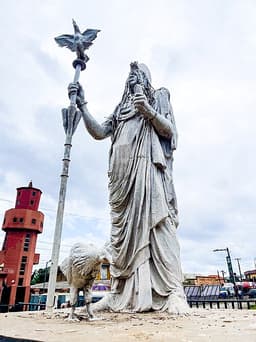
Oduduwa
Emperor · Medieval
59.7Total
Basic Information
Born
1296
950
Died
1377
1020
Era
Medieval
Medieval
Nationality
Lithuania
Ife
Occupation
Emperor
Emperor
Civilization
Western
Other
Score Comparison
Military (10%)
67.3
50.0
Political (20%)
68.0
46.6
Influence (20%)
58.0
68.0
Legacy (20%)
50.0
68.0
Leadership (15%)
72.0
67.0
Strategy (15%)
66.3
36.8
TOTAL
61.4
59.7
Algirdas — Complete Timeline
1345 AD
Co-ruler with KęstutisPolitical Action◆ Major
Algirdas became Grand Duke of Lithuania, ruling jointly with his brother K
DiarchyLithuania
Impact: regionalconstructive
1358 AD
Expansion into SmolenskWar◆ Major
Algirdas conquered the Principality of Smolensk, bringing it under Lithuanian suzerainty. This expanded Lithuanian control over key trade routes between the Baltic and Black Seas.
ExpansionSmolensk
Impact: regional
1362 AD
Battle of Blue WatersWar
Algirdas defeated the Mongol Golden Horde at the Battle of Blue Waters near the Southern Bug River. This victory ended Mongol dominance over the principalities of Kiev and Podolia, incorporating them into Lithuania.
Mongol HordeExpansion
Impact: regionalconstructive
1368 AD
Siege of MoscowWar◆ Major
Algirdas besieged Moscow during the Lithuanian-Muscovite War. The siege failed due to Moscow's fortifications and the arrival of reinforcements, but it demonstrated Lithuanian military power.
MuscovySiege
Impact: regional
Oduduwa — Complete Timeline
1000 AD
Foundation of the Yoruba civilization at Ile-IfeCultural
According to Yoruba oral tradition, Oduduwa descended from heaven at Ile-Ife and founded the Yoruba civilization. He is credited with establishing the first Yoruba kingdom and the sacred city of Ile-Ife, which became the spiritual and cultural heartland of the Yoruba people.
Impact: regionalconstructive
1010 AD
Establishment of the Yoruba royal dynastiesPolitical Action◆ Major
Oduduwa is said to have sent his sons and grandsons to found the various Yoruba kingdoms, including Oyo, Benin, and Ketu. This act established the royal lineages that ruled these states for centuries, creating a network of related kingdoms under the spiritual authority of the Ooni of Ife.
Impact: regionalconstructive
This comparison has not been analyzed yet.
One-time AI generation (~1 minute). Scores and timeline are already available below.
Rankings
🥇
AlgirdasLeader
Mil: 67.3Pol: 68.0Inf: 58.0
61.4
🥈
Oduduwa
Mil: 50.0Pol: 46.6Inf: 68.0
59.7
+1.7 behind
How This Comparison Works
Algorithm
Each figure is scored on 6 dimensions (0—100 scale) based on structured historical data: Military (10%), Political (20%), Influence (20%), Legacy (20%), Leadership (15%), Strategy (15%). The weighted total produces the final ranking.
Data Sources
Scores are computed from structured sub-indicators in the database. Scale factors adjust for era (Ancient ×0.85, Modern ×1.0) and civilization size (Eastern ×1.05, Other ×0.80) to account for differences in population and military scale.
Maximum 3 Figures
Comparisons are limited to 2—3 figures to ensure readability and statistical meaningfulness.
Error Margins
±5 points per dimension — Sub-scores are derived from historical records with inherent uncertainty. Two figures within 5 points on a dimension should be considered roughly equivalent in that area.
Total Score Accuracy
±3 points overall — The weighted combination of 6 dimensions produces a total score with approximately ±3 points of uncertainty. Differences of less than 3 points are not statistically significant— the figures are effectively tied.
Known Limitations
- Historical records are incomplete and uneven across civilizations
- Figures from oral-tradition societies may be underrepresented
- Occupation labels can misclassify multi-role figures
- Scores measure capability and impact, not moral character
- Quantitative scoring is a comparison tool, not absolute truth
Capability Radar
Military (10%) — Battles & Warfare
Battles
65
10
Win Rate
70
10
Expansion
80
30
Political (20%) — Governance & Reform
Reform
45
50
Diplomacy
65
40
Economy
55
40
Influence (20%) — Cultural & Global Reach
Cultural
50
80
Global
40
70
Legacy (20%) — Historical Impact
Historical
55
80
Longevity
45
80
Leadership (15%) — Power & Stability
Tenure
70
40
Stability
60
50
Strategy (15%) — Tactics & Innovation
Strategy
75
10
Tactics
60
10
Reform
40
10
Similar Comparisons
Comments & Discussion
No comments yet. Be the first to share your thoughts!