Loading...
Charles de Gaulle vs Oduduwa
Charles de Gaulle leads by 8.5 pts · 2 figures compared
…
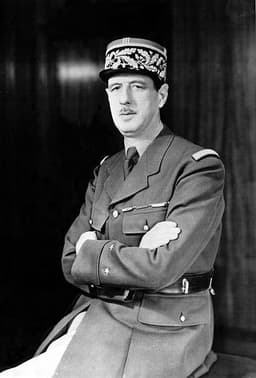
Charles de Gaulle
Politician · Modern
68.2Total
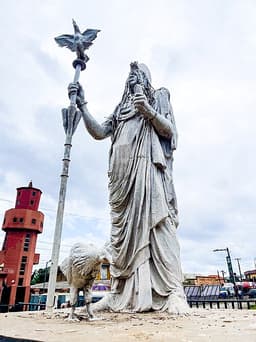
Oduduwa
Emperor · Medieval
59.7Total
Basic Information
Born
1890
950
Died
1970
1020
Era
Modern
Medieval
Nationality
France
Ife
Occupation
Politician
Emperor
Civilization
Western
Other
Score Comparison
Military (10%)
55.0
50.0
Political (20%)
75.0
46.6
Influence (20%)
65.0
68.0
Legacy (20%)
68.0
68.0
Leadership (15%)
78.0
67.0
Strategy (15%)
65.0
36.8
TOTAL
68.2
59.7
Charles de Gaulle — Complete Timeline
1940 AD
Appeal of 18 June 1940Political Action
From London, de Gaulle broadcast a radio appeal urging French resistance against Nazi occupation. He called on French soldiers and citizens to continue the fight, founding the Free French Forces and becoming the symbol of French defiance.
World War IIResistanceLeadership
Impact: nationalconstructive
1958 AD
Founding of the Fifth RepublicPolitical Action
De Gaulle returned to power during the Algerian crisis and oversaw the drafting of a new constitution. The Fifth Republic established a strong executive presidency, replacing the unstable parliamentary system of the Fourth Republic.
ConstitutionGovernment ReformPolitical System
Impact: nationalconstructive
1962 AD
End of the Algerian WarPolitical Action◆ Major
De Gaulle negotiated the
DecolonizationPeace TreatyAlgeria
Impact: regionalconstructive
1968 AD
May 1968 CrisisPolitical Action◆ Major
Mass student protests and general strikes paralyzed France, challenging de Gaulle's government. De Gaulle briefly fled to Germany, then returned to dissolve the National Assembly and call elections, which his party won, but his authority was weakened.
ProtestPolitical CrisisSocial Unrest
Impact: nationaldestructive
1969 AD
Resignation as PresidentPolitical Action
De Gaulle resigned after losing a referendum on regional reform and Senate restructuring. The defeat marked the end of his political career, as he withdrew from public life and died the following year.
ResignationPolitical DefeatReferendum
Impact: nationaltragic
Oduduwa — Complete Timeline
1000 AD
Foundation of the Yoruba civilization at Ile-IfeCultural
According to Yoruba oral tradition, Oduduwa descended from heaven at Ile-Ife and founded the Yoruba civilization. He is credited with establishing the first Yoruba kingdom and the sacred city of Ile-Ife, which became the spiritual and cultural heartland of the Yoruba people.
Impact: regionalconstructive
1010 AD
Establishment of the Yoruba royal dynastiesPolitical Action◆ Major
Oduduwa is said to have sent his sons and grandsons to found the various Yoruba kingdoms, including Oyo, Benin, and Ketu. This act established the royal lineages that ruled these states for centuries, creating a network of related kingdoms under the spiritual authority of the Ooni of Ife.
Impact: regionalconstructive
Expert Analysis
Charles de Gaulle vs Oduduwa
# The General and the Progenitor
On a June evening in 1940, a tall, awkward Frenchman stepped before a BBC microphone in London and spoke to a nation that had just fallen. Across the Channel, France was in chaos, its government capitulating to Hitler. Charles de Gaulle, a brigadier general barely known outside military circles, told his countrymen that "the flame of French resistance must not be extinguished." It was a solitary act of defiance, a single voice against an empire. Nine hundred years earlier, in the forests of West Africa, another leader had performed a different kind of founding. According to Yoruba tradition, Oduduwa descended from the heavens at Ile-Ife, carrying a handful of earth and a five-toed chicken, and created the land upon which a civilization would rise. One man defied history; the other, legend says, began it. What drives such different paths to becoming the father of a nation?
Origins
Charles de Gaulle was born in 1890 into a devoutly Catholic, patriotic family in Lille, northern France. His father taught philosophy and history, instilling in young Charles a sense of France's eternal greatness and a belief in destiny. The humiliation of France's defeat in the Franco-Prussian War (1870–71) hung over his childhood like a shadow. De Gaulle grew up reading the classics, dreaming of military glory, and developing an almost mystical conviction that France was destined for grandeur. His era was one of rapid industrialization, colonial expansion, and the gathering storm of world war. He was shaped by the twin forces of national trauma and personal ambition.
Oduduwa's origins are not recorded in archives but enshrined in myth. He is said to have lived around 950 to 1020 CE, in an era when the Yoruba people were organizing into city-states and kingdoms. The oral tradition describes him as a prince from the east—perhaps from the ancient kingdom of Mecca or the Sudanic region—who arrived at Ile-Ife after a long journey. There, he found a world of competing local chieftains and spiritual forces. His era was one of migration, trade, and the slow crystallization of a distinct Yoruba identity, shaped by the savanna and forest, by ironworking and the worship of a pantheon of gods. If de Gaulle was forged by defeat, Oduduwa was forged by possibility.
Rise to Power
De Gaulle's ascent was slow, then sudden. A decorated officer in World War I, he was captured at Verdun and spent years as a prisoner of war, writing and reflecting. Between the wars, he published books arguing for mobile armored warfare—ideas ignored by the French high command. When Germany invaded in 1940, de Gaulle briefly commanded a tank division, but it was too little, too late. His true rise began with that radio broadcast on June 18, 1940. From London, he built the Free French Forces from a handful of volunteers into a legitimate government-in-exile. His turning point came not through battlefield victory but through sheer force of will, convincing Churchill and later Roosevelt that he, and he alone, represented the real France.
Oduduwa's rise is told as a sacred drama. According to tradition, the original inhabitants of Ife had no king, only warring factions. The gods sent Oduduwa to establish order. He descended from the sky on an iron chain, carrying the symbols of kingship: a crown, a scepter, and a palm frond. He defeated the local powers, not through military conquest alone, but through spiritual authority. His rise was instantaneous, a divine appointment that required no gradual accumulation of power. Where de Gaulle had to persuade, Oduduwa had only to appear.
Leadership & Governance
De Gaulle governed through a combination of iron will and constitutional innovation. As president of the Fifth Republic, which he founded in 1958, he centralized executive power, creating a strong presidency that could act decisively. He believed in a "certain idea of France"—independent, proud, and sovereign. His military thinking was bold but flawed; his strategy score of 55 reflects a man who was more political visionary than battlefield genius. He ended the Algerian War in 1962 through the Évian Accords, a decision that horrified his own military supporters but saved France from a colonial quagmire. He withdrew France from NATO's integrated command, developed an independent nuclear deterrent, and vetoed British entry into the European Economic Community. His leadership was autocratic, paternalistic, and deeply effective—until it wasn't.
Oduduwa's governance was the founding of a civilization. He is credited with establishing the political and religious institutions of Ife, including the concept of the *Ooni* (king) as both a secular ruler and a spiritual intermediary. He sent his sons and grandsons to found the kingdoms of Oyo, Benin, and Ketu, creating a network of dynasties that would endure for centuries. His leadership score of 81.7 reflects his role as a unifier and a progenitor. He did not govern a state so much as he created the template for governance itself—a system of checks and balances between kings, chiefs, and priests that would define Yoruba political culture.
Triumph & Tragedy
De Gaulle's greatest triumph was the survival of France as a sovereign power. In 1944, he marched down the Champs-Élysées as the liberator of Paris, a moment of pure vindication. His second triumph was the peaceful end of the Algerian War, a conflict that had torn France apart. But his tragedy came in May 1968, when student protests and a general strike paralyzed the nation. De Gaulle, the man of order, was caught off guard. He briefly fled to Germany to consult with French generals, a moment of panic that damaged his authority. He never fully recovered. In 1969, he resigned after losing a referendum on regional reform—a minor issue that became a referendum on his leadership.
Oduduwa's triumph was the foundation itself: the creation of a civilization that still thrives today. His tragedy is the silence of history. We know him only through myth and ritual. He has no recorded words, no known battles, no personal failures to analyze. His death is not a moment of political drama but a transition into the pantheon of ancestors, where he continues to be worshipped.
Character & Destiny
De Gaulle was aloof, arrogant, and stubborn. He once said, "The graveyards are full of indispensable men." Yet he believed himself indispensable. His personality—cold, calculating, yet capable of great emotion—drove every decision. He saw himself as the embodiment of France, and this conviction gave him the strength to resist, to reform, and ultimately to resign when the French people no longer agreed. His destiny was to be the man who saved French honor and then French democracy.
Oduduwa's character is unknowable in human terms. He is a mythic figure, a culture hero whose personality is subsumed into symbol. His destiny was not to lead a nation but to found a people. He did not make decisions; he set patterns.
Legacy
De Gaulle left behind the Fifth Republic, a constitution that still governs France, and a tradition of presidential authority that his successors have both embraced and struggled against. He is remembered as the savior of French dignity, but also as a difficult, divisive figure. His legacy score of 75 reflects a man who is revered but not universally loved.
Oduduwa's legacy is the Yoruba civilization itself—an estimated 40 million people across West Africa and the diaspora. He is remembered not as a politician but as a father, a source of identity. His legacy score of 69.9 understates his cultural weight, for he is not merely remembered; he is worshipped.
Conclusion
Two founders, separated by a millennium and a world of difference. De Gaulle fought history; Oduduwa made it. One spoke into a microphone; the other descended from the sky. Both gave their people a sense of identity that outlasted their own lives. De Gaulle once wrote, "France cannot be France without greatness." Oduduwa might have said the same of the Yoruba. In the end, what unites them is not strategy or politics, but the profound human need for a father—someone to say, in the darkest hour, "I am here. Follow me."
Rankings
🥇
Charles de GaulleLeader
Mil: 55.0Pol: 75.0Inf: 65.0
68.2
🥈
Oduduwa
Mil: 50.0Pol: 46.6Inf: 68.0
59.7
+8.5 behind
How This Comparison Works
Algorithm
Each figure is scored on 6 dimensions (0—100 scale) based on structured historical data: Military (10%), Political (20%), Influence (20%), Legacy (20%), Leadership (15%), Strategy (15%). The weighted total produces the final ranking.
Data Sources
Scores are computed from structured sub-indicators in the database. Scale factors adjust for era (Ancient ×0.85, Modern ×1.0) and civilization size (Eastern ×1.05, Other ×0.80) to account for differences in population and military scale.
Maximum 3 Figures
Comparisons are limited to 2—3 figures to ensure readability and statistical meaningfulness.
Error Margins
±5 points per dimension — Sub-scores are derived from historical records with inherent uncertainty. Two figures within 5 points on a dimension should be considered roughly equivalent in that area.
Total Score Accuracy
±3 points overall — The weighted combination of 6 dimensions produces a total score with approximately ±3 points of uncertainty. Differences of less than 3 points are not statistically significant— the figures are effectively tied.
Known Limitations
- Historical records are incomplete and uneven across civilizations
- Figures from oral-tradition societies may be underrepresented
- Occupation labels can misclassify multi-role figures
- Scores measure capability and impact, not moral character
- Quantitative scoring is a comparison tool, not absolute truth
Capability Radar
Military (10%) — Battles & Warfare
Battles
60
10
Win Rate
55
10
Expansion
20
30
Political (20%) — Governance & Reform
Reform
95
50
Diplomacy
90
40
Economy
70
40
Influence (20%) — Cultural & Global Reach
Cultural
70
80
Global
80
70
Legacy (20%) — Historical Impact
Historical
85
80
Longevity
75
80
Leadership (15%) — Power & Stability
Tenure
85
40
Stability
75
50
Strategy (15%) — Tactics & Innovation
Strategy
85
10
Tactics
70
10
Reform
80
10
Similar Comparisons
Comments & Discussion
IronBrigadier6/16/2026
As a military historian, this comparison is fundamentally flawed. De Gaulle led Free French Forces against Nazi panzers with actual radio broadcasts and armored divisions. Oduduwa's "military" campaign is allegorical chickens and soil from heaven. Let's not pretend mythical earth-scattering equals commanding the 4th Armored Division at Montcornet in May 1940. France needed a real general, not a creation myth.
SkyChickenSage6/16/2026
You classical scholars fetishize this Oduduwa figure, but the "five-toed chicken" detail screams later embellishment—likely 17th-century Christian missionaries retrofitting Genesis onto Yoruba origin stories. Compare this to Paul Valéry's analysis: De Gaulle's French eternity was forged in 1940, not 900 AD. One is verifiable history; the other is nationalist folklore dressed as anthropology.
白杆老兵6/16/2026
作为华人历史爱好者,我认为戴高乐与奥杜杜瓦根本不能相提并论。戴高乐是真实存在的军事统帅,1944年8月26日巴黎解放时,他在凯旋门下走过香榭丽舍大街,数百万法国人亲眼见证。而奥杜杜瓦只是一个神话人物,类似我们的大禹治水——有价值但不是同一种历史比较。一个对抗纳粹德国,一个在森林里撒土,这叫什么对比?
数据老狐狸6/16/2026
分析报告说奥杜杜瓦“900年前开创文明”,但尼日利亚最早的伊费文化有考古证据吗?我查过,伊费城最早的陶器断代为公元11世纪,但所谓“奥杜杜瓦从天而降”完全没有实物支撑。反观戴高乐,从BBC讲话录音到1940年6月18日抵抗运动的每一个电报都有档案记录。用神话对比历史,这是学术懒惰,不是比较历史学。
凤梨小钢炮6/16/2026
我看这对比根本是西方中心主义的翻版——硬要把非洲神话人物拔高到现代国家奠基者的水平。戴高乐在阿尔及利亚问题上可没那么高尚,1958年他重返政坛后镇压了无数阿尔及利亚独立运动。至于奥杜杜瓦,约鲁巴传统承认他是父权神话,但他有什么具体政治遗产?没有宪法,没有议会,只有一只鸡和一把土。别糊弄人。