Loading...
This comparison has not been analyzed yet.
One-time AI generation (~1 minute). Scores and timeline are already available below.
Ali Abdullah Saleh al-Ahmar vs Wang Hongwen
Ali Abdullah Saleh al-Ahmar leads by 9.2 pts · 2 figures compared
…
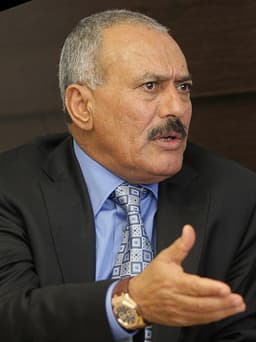
Ali Abdullah Saleh al-Ahmar
Politician · Modern
46.4Total

Wang Hongwen
Politician · Modern
37.2Total
Basic Information
Born
1947
1935
Died
—
—
Era
Modern
Modern
Nationality
Yemen
China
Occupation
Politician
Politician
Civilization
Middle Eastern
Eastern
Score Comparison
Military (10%)
45.0
15.8
Political (20%)
46.6
29.3
Influence (20%)
54.1
47.1
Legacy (20%)
45.0
36.7
Leadership (15%)
40.0
45.0
Strategy (15%)
41.0
35.5
TOTAL
46.4
37.2
Ali Abdullah Saleh al-Ahmar — Complete Timeline
1978 AD
Became President of North YemenPolitical Action
Ali Abdullah Saleh became President of the Yemen Arab Republic (North Yemen) after the assassination of President Ahmad al-Ghashmi. He consolidated power through a combination of tribal alliances and military force.
SuccessionNorth Yemen
Impact: national
1990 AD
Unified North and South YemenPolitical Action
Saleh oversaw the unification of North Yemen and the People's Democratic Republic of Yemen (South Yemen) into the Republic of Yemen. He became the first president of the unified state, though tensions between the former regions persisted.
UnificationYemen
Impact: regionalconstructive
1994 AD
Won the 1994 civil warWar◆ Major
After South Yemen seceded, Saleh's forces defeated the southern separatists in a brief civil war. The victory reasserted his control over the entire country and solidified his authoritarian rule.
Civil WarYemenSeparatism
Impact: nationaldestructive
2011 AD
Resigned during the Arab SpringPolitical Action
After months of mass protests, Saleh agreed to a Gulf Cooperation Council-brokered transition plan. He resigned as president in exchange for immunity, ending his 33-year rule. The transition led to a power vacuum and eventual civil war.
Arab SpringResignationYemen
Impact: nationaltragic
2017 AD
Killed by Houthi forcesWar◆ Major
After switching sides to ally with the Houthi movement, Saleh was killed by Houthi forces when he attempted to defect back to the Saudi-led coalition. His death marked the end of his political influence and deepened the Yemeni civil war.
DeathYemen Civil WarHouthi
Impact: nationaltragic
Wang Hongwen — Complete Timeline
1967 AD
Rose to Prominence During the Cultural RevolutionPolitical Action◆ Major
Wang Hongwen, a factory worker, became a leader of the Shanghai Workers' Revolutionary Rebel Headquarters during the Cultural Revolution. He was promoted rapidly due to his working-class background and radicalism.
Cultural RevolutionShanghaiWorker
Impact: nationaldestructive
1973 AD
Became Vice Chairman of the CCPPolitical Action◆ Major
Wang Hongwen was appointed Vice Chairman of the CCP at the 10th National Congress in 1973, making him the third-highest ranking official after Mao and Zhou. He was the youngest member of the Gang of Four.
Gang of FourVice ChairmanCCP
Impact: national
1976 AD
Arrested as a Member of the Gang of FourPolitical Action◆ Major
Wang Hongwen was arrested on October 6, 1976, along with other Gang of Four members. He was tried and sentenced to life imprisonment for his role in the Cultural Revolution. He died in prison in 1992.
Gang of FourArrestImprisonment
Impact: national
This comparison has not been analyzed yet.
One-time AI generation (~1 minute). Scores and timeline are already available below.
Rankings
🥇
Ali Abdullah Saleh al-AhmarLeader
Mil: 45.0Pol: 46.6Inf: 54.1
46.4
🥈
Wang Hongwen
Mil: 15.8Pol: 29.3Inf: 47.1
37.2
+9.2 behind
How This Comparison Works
Algorithm
Each figure is scored on 6 dimensions (0—100 scale) based on structured historical data: Military (10%), Political (20%), Influence (20%), Legacy (20%), Leadership (15%), Strategy (15%). The weighted total produces the final ranking.
Data Sources
Scores are computed from structured sub-indicators in the database. Scale factors adjust for era (Ancient ×0.85, Modern ×1.0) and civilization size (Eastern ×1.05, Other ×0.80) to account for differences in population and military scale.
Maximum 3 Figures
Comparisons are limited to 2—3 figures to ensure readability and statistical meaningfulness.
Error Margins
±5 points per dimension — Sub-scores are derived from historical records with inherent uncertainty. Two figures within 5 points on a dimension should be considered roughly equivalent in that area.
Total Score Accuracy
±3 points overall — The weighted combination of 6 dimensions produces a total score with approximately ±3 points of uncertainty. Differences of less than 3 points are not statistically significant— the figures are effectively tied.
Known Limitations
- Historical records are incomplete and uneven across civilizations
- Figures from oral-tradition societies may be underrepresented
- Occupation labels can misclassify multi-role figures
- Scores measure capability and impact, not moral character
- Quantitative scoring is a comparison tool, not absolute truth
Capability Radar
Military (10%) — Battles & Warfare
Battles
40
15
Win Rate
35
17
Expansion
30
18
Political (20%) — Governance & Reform
Reform
30
10
Diplomacy
60
10
Economy
25
5
Influence (20%) — Cultural & Global Reach
Cultural
30
5
Global
35
5
Legacy (20%) — Historical Impact
Historical
40
15
Longevity
30
5
Leadership (15%) — Power & Stability
Tenure
75
30
Stability
20
5
Strategy (15%) — Tactics & Innovation
Strategy
40
23
Tactics
30
25
Reform
25
29
Similar Comparisons
Comments & Discussion
No comments yet. Be the first to share your thoughts!