Loading...
Ali Abdullah Saleh al-Ahmar vs Napoleon Bonaparte
Napoleon Bonaparte leads by 24.5 pts · 2 figures compared
…
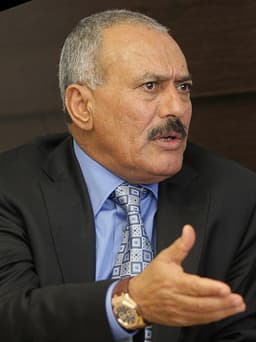
Ali Abdullah Saleh al-Ahmar
Politician · Modern
46.4Total

Napoleon Bonaparte
General · Modern
70.9Total
Basic Information
Born
1947
1769
Died
—
1821
Era
Modern
Modern
Nationality
Yemen
France
Occupation
Politician
General
Civilization
Middle Eastern
Western
Score Comparison
Military (10%)
45.0
94.0
Political (20%)
46.6
72.0
Influence (20%)
54.1
40.0
Legacy (20%)
45.0
80.0
Leadership (15%)
40.0
78.0
Strategy (15%)
41.0
90.0
TOTAL
46.4
70.9
Ali Abdullah Saleh al-Ahmar — Complete Timeline
1978 AD
Became President of North YemenPolitical Action
Ali Abdullah Saleh became President of the Yemen Arab Republic (North Yemen) after the assassination of President Ahmad al-Ghashmi. He consolidated power through a combination of tribal alliances and military force.
SuccessionNorth Yemen
Impact: national
1990 AD
Unified North and South YemenPolitical Action
Saleh oversaw the unification of North Yemen and the People's Democratic Republic of Yemen (South Yemen) into the Republic of Yemen. He became the first president of the unified state, though tensions between the former regions persisted.
UnificationYemen
Impact: regionalconstructive
1994 AD
Won the 1994 civil warWar◆ Major
After South Yemen seceded, Saleh's forces defeated the southern separatists in a brief civil war. The victory reasserted his control over the entire country and solidified his authoritarian rule.
Civil WarYemenSeparatism
Impact: nationaldestructive
2011 AD
Resigned during the Arab SpringPolitical Action
After months of mass protests, Saleh agreed to a Gulf Cooperation Council-brokered transition plan. He resigned as president in exchange for immunity, ending his 33-year rule. The transition led to a power vacuum and eventual civil war.
Arab SpringResignationYemen
Impact: nationaltragic
2017 AD
Killed by Houthi forcesWar◆ Major
After switching sides to ally with the Houthi movement, Saleh was killed by Houthi forces when he attempted to defect back to the Saudi-led coalition. His death marked the end of his political influence and deepened the Yemeni civil war.
DeathYemen Civil WarHouthi
Impact: nationaltragic
Napoleon Bonaparte — Complete Timeline
1799 AD
Coup of 18 BrumaireOther◆ Major
Napoleon Bonaparte, with support from his brother Lucien and key political figures, overthrew the Directory in a bloodless coup. He established the Consulate with himself as First Consul, effectively becoming the ruler of France. This event ended the French Revolution's most unstable period.
French RevolutionCoupRise to Power
Impact: regional
1804 AD
Promulgation of the Napoleonic CodeOther◆ Major
Napoleon enacted the Civil Code of the French, known as the Napoleonic Code, a comprehensive set of laws that replaced the fragmented feudal legal systems. The code established legal equality, protected property rights, and secularized law. It became the basis for legal systems in many European and world countries.
Legal ReformNapoleonic CodeCivil Law
Impact: globalconstructive
1805 AD
Battle of AusterlitzWar◆ Major
Napoleon's Grande Arm
Napoleonic WarsBattleDecisive Victory
Impact: global
1812 AD
Invasion of RussiaWar◆ Major
Napoleon led the Grande Arm
Napoleonic WarsInvasionDisaster
Impact: globaldestructive
1815 AD
Battle of WaterlooWar◆ Major
Napoleon's French army was defeated by the combined forces of the Duke of Wellington's Anglo-Allied army and Gebhard Leberecht von Bl
Napoleonic WarsBattleFinal Defeat
Impact: globaldestructive
Expert Analysis
ali-abdullah-saleh-al-ahmar-vs-napoleon-bonaparte
# The Emperor and the Chieftain
In the winter of 1812, Napoleon Bonaparte watched his Grand Army burn Moscow, a desperate act of defiance that would seal his doom. Two centuries later, in the winter of 2017, Ali Abdullah Saleh al-Ahmar fled through the streets of Sanaa, betrayed by the very allies he had tried to manipulate, and was shot dead by Houthi fighters. Both men rose from obscurity to rule nations. Both fell in spectacular ruin. But between the Corsican artillery officer who reshaped Europe and the Yemeni tribal politician who stitched a fractured country together, the gulf is not merely one of scale—it is a chasm of ambition, vision, and the nature of power itself.
Origins
Napoleon Buonaparte was born in 1769 on the island of Corsica, a year after France purchased the island from Genoa. His family was minor nobility, struggling and resentful. He spoke Italian-accented French as a boy, an outsider among the French elite he would one day command. At the military academy of Brienne, he was mocked for his accent and small stature, but he devoured history and military theory. The French Revolution, erupting when he was twenty, shattered the old order and opened doors that birth alone could never have unlocked.
Ali Abdullah Saleh was born around 1947 in the highlands of North Yemen, into the Sanhan tribe, a modest family in a deeply tribal society. His formal education ended early; his real schooling was the brutal politics of a country ruled by imams and then by military coups. Where Napoleon trained on the battlefields of the Enlightenment, Saleh learned in the shadow of the imam’s palace and the tribal council fire. The world that shaped Saleh was one of shifting loyalties, blood feuds, and the constant negotiation between state power and tribal autonomy—a world where survival depended not on grand strategy but on knowing whom to pay, whom to threaten, and whom to kill.
Rise to Power
Napoleon’s ascent was meteoric and theatrical. In 1793, at age twenty-four, he drove British forces from the port of Toulon, earning promotion to brigadier general. By 1796, he commanded the French army in Italy, where he turned a starving, unpaid force into a juggernaut, winning a dozen battles in a year. His 1798 Egyptian campaign, though a military failure, made him a legend. When he returned to a France mired in political chaos, he seized power in the 1799 coup of 18 Brumaire. He was thirty years old. His rise was a story of genius seizing opportunity.
Saleh’s rise was slower, more cunning, and far less romantic. He joined the North Yemeni army as a young man, rising through the ranks by a combination of competence and tribal connections. In 1978, after the assassination of President Ahmad al-Ghashmi, Saleh became president of the Yemen Arab Republic. He was thirty-one—but unlike Napoleon, he inherited a weak state, not an empire. His power came not from battlefield brilliance but from a web of alliances: he balanced the army, the tribes, the religious factions, and foreign patrons (first the Soviet Union, then Saudi Arabia). He was a survivor, not a conqueror.
Leadership & Governance
Napoleon ruled as a military genius and a reformer. His Napoleonic Code, enacted in 1804, standardized French law, abolished feudal privileges, and enshrined principles of meritocracy and property rights. He overhauled education, created the Bank of France, and built roads and canals. On the battlefield, his scores of 94 for military and 93 for strategy reflect a commander who could read terrain, timing, and morale with uncanny precision. At Austerlitz in 1805, he destroyed a larger Austro-Russian army in a single day, a masterpiece of deception and decisive action. Yet his political score of 75 hints at a fatal flaw: he could conquer but could not consolidate. He installed his brothers on European thrones, antagonized Britain and Russia, and bled France white in endless war.
Saleh governed as a tribal chieftain in a president’s suit. His political score of 63.4 and leadership of 72 reflect a pragmatic, cynical style. He unified North and South Yemen in 1990—a stunning diplomatic achievement—then crushed the southern secessionists in the 1994 civil war. He ruled through patronage, pitting rivals against each other, and changing sides when necessary. He survived a rebellion by the Houthi movement in the 2000s, al-Qaeda attacks, and a secessionist movement in the south. But he built no lasting institutions. Yemen remained one of the poorest countries in the Arab world, its state hollowed out by corruption and tribal favoritism. Where Napoleon dreamed of a united Europe, Saleh dreamed only of staying in power.
Triumph & Tragedy
Napoleon’s greatest moment was Austerlitz, where he crushed the Third Coalition and crowned himself master of Europe. His greatest tragedy was the 1812 invasion of Russia. He marched 600,000 men into the vastness of the steppe; fewer than 100,000 returned. The campaign scores of 82 for influence and 78 for legacy capture the paradox: he changed Europe forever, but his hubris destroyed him. Exiled to Elba, he escaped, raised another army, and was finally defeated at Waterloo in 1815. He died in 1821 on Saint Helena, a prisoner.
Saleh’s triumph was the 1990 unification, a feat of political engineering that few thought possible. His tragedy was the Arab Spring. In 2011, after months of protests, he agreed to step down under a Gulf-brokered deal. He handed power to his vice president but remained in Yemen, a shadowy figure maneuvering behind the scenes. In 2014, the Houthis seized Sanaa, and Saleh—ever the survivor—allied with them. For three years, he played both sides. In December 2017, he tried to switch sides again, announcing a break with the Houthis. He was killed by Houthi forces the next day, his body dragged through the streets.
Character & Destiny
Napoleon was driven by an unbounded ambition: “Impossible is a word to be found only in the dictionary of fools,” he once said. He believed in destiny, in the power of the individual to reshape history. His personality—brilliant, arrogant, restless—led him to overreach. He could not stop. Saleh, by contrast, was driven by survival. He once compared ruling Yemen to “dancing on the heads of snakes.” His genius was adaptability, not vision. He could bend, but he could not build. Where Napoleon died a prisoner, mourned as a legend, Saleh died a traitor, reviled by nearly everyone he had ever used.
Legacy
Napoleon’s legacy is monumental. The Napoleonic Code influences legal systems across Europe and the world. His military campaigns are studied at every war college. He reshaped nationalism, statecraft, and the very idea of the modern state. His scores—82 for influence, 78 for legacy—understate his impact. He is remembered as a titan, for better and worse.
Saleh’s legacy is a cautionary tale. His unification of Yemen collapsed into civil war. His corruption and divide-and-rule tactics left the country a failed state, a humanitarian catastrophe. His scores—71 for influence, 59 for legacy—reflect a man who mattered in his time but left nothing durable. He is remembered as a survivor who survived one day too many.
Conclusion
The French emperor and the Yemeni president lived in different worlds, but they share a common truth: power is a drug that destroys those who cannot let it go. Napoleon died dreaming of a second return; Saleh died trying to make one last deal. One changed the map of Europe; the other broke his country. Their lives remind us that history judges not by the height of the rise but by what remains after the fall. Napoleon left a code of laws. Saleh left a country in flames. In the end, the difference between the emperor and the chieftain is not just talent or luck—it is what they chose to build for the people they ruled.
Rankings
🥇
Napoleon BonaparteLeader
Mil: 94.0Pol: 72.0Inf: 40.0
70.9
🥈
Ali Abdullah Saleh al-Ahmar
Mil: 45.0Pol: 46.6Inf: 54.1
46.4
+24.5 behind
How This Comparison Works
Algorithm
Each figure is scored on 6 dimensions (0—100 scale) based on structured historical data: Military (10%), Political (20%), Influence (20%), Legacy (20%), Leadership (15%), Strategy (15%). The weighted total produces the final ranking.
Data Sources
Scores are computed from structured sub-indicators in the database. Scale factors adjust for era (Ancient ×0.85, Modern ×1.0) and civilization size (Eastern ×1.05, Other ×0.80) to account for differences in population and military scale.
Maximum 3 Figures
Comparisons are limited to 2—3 figures to ensure readability and statistical meaningfulness.
Error Margins
±5 points per dimension — Sub-scores are derived from historical records with inherent uncertainty. Two figures within 5 points on a dimension should be considered roughly equivalent in that area.
Total Score Accuracy
±3 points overall — The weighted combination of 6 dimensions produces a total score with approximately ±3 points of uncertainty. Differences of less than 3 points are not statistically significant— the figures are effectively tied.
Known Limitations
- Historical records are incomplete and uneven across civilizations
- Figures from oral-tradition societies may be underrepresented
- Occupation labels can misclassify multi-role figures
- Scores measure capability and impact, not moral character
- Quantitative scoring is a comparison tool, not absolute truth
Capability Radar
Military (10%) — Battles & Warfare
Battles
40
95
Win Rate
35
90
Expansion
30
95
Political (20%) — Governance & Reform
Reform
30
95
Diplomacy
60
80
Economy
25
85
Influence (20%) — Cultural & Global Reach
Cultural
30
85
Global
35
90
Legacy (20%) — Historical Impact
Historical
40
95
Longevity
30
90
Leadership (15%) — Power & Stability
Tenure
75
85
Stability
20
70
Strategy (15%) — Tactics & Innovation
Strategy
40
95
Tactics
30
98
Reform
25
92
Similar Comparisons
Comments & Discussion
No comments yet. Be the first to share your thoughts!