Loading...
Ali bin Said vs Julius Caesar
Julius Caesar leads by 43.2 pts · 2 figures compared
…
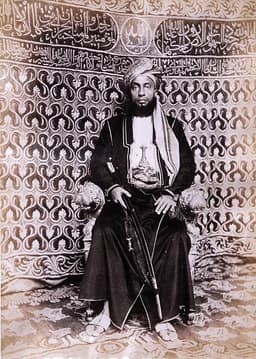
Ali bin Said
Emperor · Modern
39.6Total

Julius Caesar
General · Ancient
82.8Total
Basic Information
Born
1854
-100
Died
1893
-44
Era
Modern
Ancient
Nationality
Zanzibar
Roman Republic
Occupation
Emperor
General
Civilization
Other
Western
Score Comparison
Military (10%)
43.3
88.0
Political (20%)
26.4
78.0
Influence (20%)
46.3
85.0
Legacy (20%)
34.2
82.0
Leadership (15%)
38.1
80.0
Strategy (15%)
54.3
85.0
TOTAL
39.6
82.8
Ali bin Said — Complete Timeline
1890 AD
Accession to the ThronePolitical Action◆ Major
Ali bin Said became the fourth sultan of Zanzibar following the death of his brother Khalifa bin Said. His reign began during the height of European colonial competition in East Africa, with Zanzibar already under British influence.
SuccessionSultanateColonial Era
Signing of the Heligoland-Zanzibar TreatyPolitical Action
Ali bin Said's government accepted the Heligoland-Zanzibar Treaty between Britain and Germany. This treaty defined colonial spheres of influence, with Zanzibar becoming a British protectorate while Germany gained control over mainland Tanganyika.
Colonial TreatyBritish ProtectorateScramble for Africa
Impact: regional
Establishment of British ProtectoratePolitical Action◆ Major
Ali bin Said formally accepted British protectorate status over Zanzibar. This gave Britain control over Zanzibar's foreign affairs and defense while the sultan retained internal authority, effectively ending Zanzibar's sovereignty.
British ProtectorateLoss of SovereigntyColonial Rule
Impact: regional
Julius Caesar — Complete Timeline
58 BC
Gallic WarsWar◆ Major
Caesar, as proconsul of Gaul, launched a series of campaigns that conquered all of Gaul (modern France, Belgium, and parts of Switzerland). He fought numerous battles, including against the Helvetii, the Belgae, and the Gallic chieftain Vercingetorix. The wars brought immense wealth and a loyal army to Caesar.
Gallic WarsConquestRoman Expansion
Impact: regional
49 BC
Crossing the RubiconPolitical Action◆ Major
Caesar led Legio XIII across the Rubicon River into Italy, defying the Roman Senate's order to disband his army. This act triggered a civil war against Pompey and the Optimates, ultimately leading to Caesar's dictatorship and the end of the Roman Republic.
Roman Civil WarEnd of RepublicPower Struggle
Impact: global
48 BC
Battle of PharsalusWar◆ Major
Caesar's outnumbered army defeated the larger forces of Pompey the Great at Pharsalus in Greece. Caesar's tactical use of a reserve line to counter Pompey's cavalry charge proved decisive. Pompey fled to Egypt, where he was assassinated, leaving Caesar as the undisputed master of the Roman world.
Roman Civil WarBattleDecisive Victory
Impact: regional
44 BC
Appointment as Dictator for LifePolitical Action◆ Major
The Roman Senate appointed Caesar dictator perpetuo (dictator for life), granting him unprecedented personal power. This move concentrated military, legislative, and judicial authority in one person, effectively ending the Roman Republic's traditional system of checks and balances and alarming many senators.
DictatorshipEnd of RepublicPower Consolidation
Impact: regionaldestructive
Assassination on the Ides of MarchPolitical Action◆ Major
A group of Roman senators, led by Marcus Junius Brutus and Gaius Cassius Longinus, stabbed Caesar to death at a meeting of the Senate in the Theatre of Pompey. The assassination was intended to restore the Republic, but instead triggered another civil war that led to the rise of the Roman Empire.
AssassinationRoman PoliticsEnd of Republic
Impact: globaldestructive
Expert Analysis
ali-bin-said-vs-julius-caesar
# The Crossroads of Destiny: Caesar and the Sultan Who Lost an Empire
On a winter day in 49 BCE, a Roman general stood at the banks of a small river in northern Italy, the Rubicon, and made a choice that would echo through millennia. Less than two thousand years later, on the spice-scented island of Zanzibar, another ruler faced his own Rubicon—not a river of water, but a treaty of ink. One man crossed into legend. The other crossed into oblivion. What separates a figure who reshapes the world from one who merely watches it slip away?
Origins
Gaius Julius Caesar was born into the chaos of the late Roman Republic, a world of senatorial intrigue, civil wars, and a political system strained to its breaking point. His family, the Julian clan, claimed descent from the goddess Venus—a detail that Caesar himself never let anyone forget. He grew up in a Rome where ambition was not merely encouraged but essential for survival, and where a man's worth was measured by his ability to seize opportunity from the jaws of crisis.
Ali bin Said, by contrast, was born in 1854 on the island of Zanzibar, a sultanate that had grown wealthy controlling the spice and slave trades of the Indian Ocean. His world was one of inherited power, where the sultan's authority was absolute but fragile, sustained by a delicate balance of Arab merchant families, African subjects, and increasingly, European gunboats. Where Caesar breathed the air of a republic in its death throes, Ali inhaled the fumes of an empire in its twilight.
Rise to Power
Caesar's ascent was a masterpiece of calculated risk. He served as a military tribune, then quaestor in Spain, where he reportedly wept before a statue of Alexander the Great, lamenting that by his age, Alexander had conquered the world while he had done nothing. He forged alliances with the wealthy Crassus and the powerful Pompey, forming the First Triumvirate. His conquest of Gaul from 58 to 50 BCE was not merely a military campaign—it was a personal empire built on the backs of a million slain Gauls and the loyalty of legions who would follow him anywhere.
Ali bin Said's path was simpler and far more tragic. He became the fourth sultan of Zanzibar in 1890 upon the death of his brother Khalifa. He inherited a throne already trembling under the shadow of European imperialism. The Scramble for Africa was in full swing, and Zanzibar, once a powerful trading hub, had become a prize to be divided. Ali did not seize his moment; he was handed a moment already slipping through his fingers.
Leadership & Governance
Caesar ruled with a blend of military genius and political pragmatism that bordered on the supernatural. As dictator, he reformed the calendar, granted citizenship to provincials, initiated public works, and centralized authority in a way that made the old Republic obsolete. He was ruthless—his legions massacred, enslaved, and devastated—but he also understood that power required the consent of the governed, or at least their fear and admiration. His military campaigns, from the subjugation of Gaul to the civil war against Pompey, were exercises in strategic brilliance. At the Battle of Alesia in 52 BCE, he besieged a Gallic army while simultaneously defending against a relief force, a feat of logistics and nerve that still stuns military historians.
Ali bin Said's governance was a study in limitation. His reign lasted barely three years, and his most significant act was signing the Heligoland-Zanzibar Treaty in 1890, which ceded Zanzibar's status as an independent sultanate to become a British protectorate. He accepted foreign control over his country's foreign affairs and, effectively, its destiny. Where Caesar expanded Rome's borders, Ali watched his shrink. Where Caesar commanded legions, Ali commanded only a court of advisors who urged submission. His military score of 35.6 reflects not a lack of courage but a lack of opportunity—there was no army to lead, no battle to fight, only a pen to wield.
Triumph & Tragedy
Caesar's greatest moment was also his most terrifying: crossing the Rubicon. "The die is cast," he reportedly said, and with those words, he plunged Rome into a civil war that would end the Republic forever. His triumph was total—he defeated Pompey, pacified the Mediterranean, and returned to Rome as dictator for life. But his tragedy was the Ides of March, March 15, 44 BCE, when sixty senators, men he had pardoned and promoted, stabbed him to death in the Senate chamber. His last words, according to tradition, were "Et tu, Brute?"—a cry of betrayal that has haunted history.
Ali bin Said's triumph, if it can be called that, was survival. He maintained the sultanate's existence, albeit as a British puppet. His tragedy was that he presided over the end of Zanzibar's sovereignty. The Heligoland-Zanzibar Treaty, which traded Zanzibar for German claims in East Africa, was not his idea—it was a European arrangement to which he could only consent. He died in 1893, just three years after taking the throne, leaving behind a protectorate that would not gain true independence until 1963.
Character & Destiny
Caesar was a man of boundless ambition, sharp intellect, and a willingness to break every rule to achieve his vision. He was generous to his enemies, which some saw as wisdom and others as folly, and he understood that history is written by the victors. His personality—arrogant, charismatic, and ruthless—shaped his decisions. He believed he was destined for greatness, and he bent the world to that belief.
Ali bin Said was a man of his time, caught in a current too strong to resist. He was not a tyrant or a visionary; he was a traditional ruler facing forces beyond his comprehension. His decisions were not acts of will but acts of accommodation. He accepted British protection because the alternative—resistance—seemed impossible. Where Caesar forged his own destiny, Ali was forged by it.
Legacy
Caesar's legacy is the Roman Empire itself. His name became synonymous with imperial power—Kaiser, Tsar, Caesar. His writings, especially the *Commentaries on the Gallic War*, remain classics of military literature. He transformed the Republic into an empire, and that empire shaped Western civilization for fifteen hundred years. His assassination did not restore the Republic; it only accelerated the rise of Augustus and the imperial system.
Ali bin Said's legacy is far quieter. He is remembered, if at all, as the sultan who signed away Zanzibar. His name appears in history books as a footnote to the Heligoland-Zanzibar Treaty, a diplomatic arrangement that reshaped East Africa but left no monument to his rule. His legacy score of 44.4 reflects a ruler who governed during a transition, not a transformation.
Conclusion
Two men, two worlds, two fates. Caesar crossed the Rubicon and became immortal. Ali bin Said signed a treaty and became a memory. Yet both were products of their eras—Caesar of a Republic ripe for conquest, Ali of an empire ripe for partition. The difference lies not in their character alone but in the currents of history that swept them along. Caesar chose his path; Ali accepted his. In the end, it is not the river that matters, but whether you have the courage to cross it.
Rankings
🥇
Julius CaesarLeader
Mil: 88.0Pol: 78.0Inf: 85.0
82.8
🥈
Ali bin Said
Mil: 43.3Pol: 26.4Inf: 46.3
39.6
+43.2 behind
How This Comparison Works
Algorithm
Each figure is scored on 6 dimensions (0—100 scale) based on structured historical data: Military (10%), Political (20%), Influence (20%), Legacy (20%), Leadership (15%), Strategy (15%). The weighted total produces the final ranking.
Data Sources
Scores are computed from structured sub-indicators in the database. Scale factors adjust for era (Ancient ×0.85, Modern ×1.0) and civilization size (Eastern ×1.05, Other ×0.80) to account for differences in population and military scale.
Maximum 3 Figures
Comparisons are limited to 2—3 figures to ensure readability and statistical meaningfulness.
Error Margins
±5 points per dimension — Sub-scores are derived from historical records with inherent uncertainty. Two figures within 5 points on a dimension should be considered roughly equivalent in that area.
Total Score Accuracy
±3 points overall — The weighted combination of 6 dimensions produces a total score with approximately ±3 points of uncertainty. Differences of less than 3 points are not statistically significant— the figures are effectively tied.
Known Limitations
- Historical records are incomplete and uneven across civilizations
- Figures from oral-tradition societies may be underrepresented
- Occupation labels can misclassify multi-role figures
- Scores measure capability and impact, not moral character
- Quantitative scoring is a comparison tool, not absolute truth
Capability Radar
Military (10%) — Battles & Warfare
Battles
5
95
Win Rate
5
92
Expansion
5
97
Political (20%) — Governance & Reform
Reform
10
90
Diplomacy
20
85
Economy
15
82
Influence (20%) — Cultural & Global Reach
Cultural
10
88
Global
5
94
Legacy (20%) — Historical Impact
Historical
10
95
Longevity
5
96
Leadership (15%) — Power & Stability
Tenure
15
75
Stability
10
60
Strategy (15%) — Tactics & Innovation
Strategy
5
94
Tactics
5
96
Reform
5
88
Similar Comparisons
Comments & Discussion
No comments yet. Be the first to share your thoughts!