Loading...
Altan Khan vs Julius Caesar
Julius Caesar leads by 21.0 pts · 2 figures compared
…
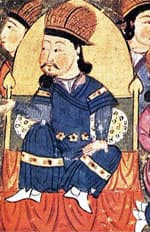
Altan Khan
Emperor · Modern
61.8Total

Julius Caesar
General · Ancient
82.8Total
Basic Information
Born
1507
-100
Died
1582
-44
Era
Modern
Ancient
Nationality
Mongolia
Roman Republic
Occupation
Emperor
General
Civilization
Eastern
Western
Score Comparison
Military (10%)
65.0
88.0
Political (20%)
55.0
78.0
Influence (20%)
68.0
85.0
Legacy (20%)
55.0
82.0
Leadership (15%)
72.0
80.0
Strategy (15%)
55.0
85.0
TOTAL
61.8
82.8
Altan Khan — Complete Timeline
1571 AD
Peace Treaty with Ming ChinaPolitical Action◆ Major
Altan Khan negotiated a peace treaty with the Ming dynasty, ending decades of conflict. The treaty established trade relations and recognized Altan Khan's authority, bringing stability to the border region.
Peace TreatyMing DynastyTrade
Impact: regionalconstructive
1578 AD
Establishment of Ties with the Dalai LamaCultural
Altan Khan met with Sonam Gyatso, the third Dalai Lama, and granted him the title 'Dalai Lama'. This meeting formalized the alliance between the Mongols and the Gelug school of Tibetan Buddhism, strengthening Buddhist influence in Mongolia.
Dalai LamaTibetan BuddhismAlliance
Impact: regionalconstructive
1580 AD
Foundation of HohhotCultural◆ Major
Altan Khan founded the city of Hohhot, which became a major center for trade and Buddhism in Inner Mongolia. The city served as his capital and facilitated economic and cultural exchange with the Ming dynasty.
City FoundationHohhotTrade
Impact: regionalconstructive
Julius Caesar — Complete Timeline
58 BC
Gallic WarsWar◆ Major
Caesar, as proconsul of Gaul, launched a series of campaigns that conquered all of Gaul (modern France, Belgium, and parts of Switzerland). He fought numerous battles, including against the Helvetii, the Belgae, and the Gallic chieftain Vercingetorix. The wars brought immense wealth and a loyal army to Caesar.
Gallic WarsConquestRoman Expansion
Impact: regional
49 BC
Crossing the RubiconPolitical Action◆ Major
Caesar led Legio XIII across the Rubicon River into Italy, defying the Roman Senate's order to disband his army. This act triggered a civil war against Pompey and the Optimates, ultimately leading to Caesar's dictatorship and the end of the Roman Republic.
Roman Civil WarEnd of RepublicPower Struggle
Impact: global
48 BC
Battle of PharsalusWar◆ Major
Caesar's outnumbered army defeated the larger forces of Pompey the Great at Pharsalus in Greece. Caesar's tactical use of a reserve line to counter Pompey's cavalry charge proved decisive. Pompey fled to Egypt, where he was assassinated, leaving Caesar as the undisputed master of the Roman world.
Roman Civil WarBattleDecisive Victory
Impact: regional
44 BC
Appointment as Dictator for LifePolitical Action◆ Major
The Roman Senate appointed Caesar dictator perpetuo (dictator for life), granting him unprecedented personal power. This move concentrated military, legislative, and judicial authority in one person, effectively ending the Roman Republic's traditional system of checks and balances and alarming many senators.
DictatorshipEnd of RepublicPower Consolidation
Impact: regionaldestructive
Assassination on the Ides of MarchPolitical Action◆ Major
A group of Roman senators, led by Marcus Junius Brutus and Gaius Cassius Longinus, stabbed Caesar to death at a meeting of the Senate in the Theatre of Pompey. The assassination was intended to restore the Republic, but instead triggered another civil war that led to the rise of the Roman Empire.
AssassinationRoman PoliticsEnd of Republic
Impact: globaldestructive
Expert Analysis
altan-khan-vs-julius-caesar
# The Crossing and the Covenant
On a winter day in 49 BCE, a Roman general stood at the edge of a small river in northern Italy. The Rubicon was little more than a stream, but crossing it with an army meant civil war—an act of treason that would shatter centuries of republican tradition. Julius Caesar hesitated only briefly before giving the order. Across the world and fifteen centuries later, another leader faced a different kind of threshold. Altan Khan, a Mongol chieftain who had spent decades raiding the Great Wall, chose not to cross into war but to extend his hand in peace. Two men, both born to power and shaped by violence, yet their paths diverged like the branches of the Ganges and the Tiber. Why did one die by the dagger of his friends, while the other built a city that still stands?
Origins
Caesar was born into the chaos of a dying republic. His family, the Julii, claimed descent from the goddess Venus, but their political influence had waned. Rome in the first century BCE was a world of iron discipline and ruthless ambition—senators bribed voters, generals butchered rivals, and the poor crowded into tenements that collapsed in the night. Caesar’s father died when he was sixteen, leaving him to navigate a system where a man’s worth was measured by his victories and his debts. He learned early that survival meant mastering both the sword and the scroll.
Altan Khan entered a world no less brutal. Mongolia in the early 1500s was fractured, its once-mighty empire reduced to squabbling tribes. He was born a grandson of Dayan Khan, the last Mongol ruler to unite the steppes, but that unity had dissolved into blood feuds. Altan grew up in a tent, learning to ride before he could walk, watching his uncles and cousins kill each other for the right to call themselves khan. The Ming Chinese to the south saw the Mongols as barbarians at the gate, to be bought off with silk or crushed with gunpowder. Altan’s inheritance was not a republic in decay but a dream in pieces.
Rise to Power
Caesar’s rise was a study in calculated risk. At thirty-seven, he secured the governorship of Gaul—a province that promised glory and plunder. Over eight years, he conquered a territory larger than Italy, crossing the Rhine and landing in Britain, writing his own dispatches that made him a legend in Rome. He understood that in a republic built on public image, words were as powerful as legions. When his enemies in the Senate ordered him to disband his army and return as a private citizen, he knew they meant to destroy him. The Rubicon was not a gamble; it was the only move left.
Altan Khan’s path was slower, more patient. He spent his twenties and thirties consolidating power among the Mongol tribes, not through grand conquests but through marriage alliances and careful diplomacy. His great triumph came not on a battlefield but at a negotiating table. In 1571, after decades of raids that bled both sides, Altan Khan signed a peace treaty with the Ming dynasty. The terms were simple: the Mongols would stop their attacks, and the Chinese would open border markets for trade. For Altan, this was not surrender but strategy. He understood something his ancestors had not—that the real power of the steppes lay not in looting but in commerce.
Leadership & Governance
Caesar governed as he fought: decisively, ruthlessly, and with a flair for the dramatic. As dictator of Rome, he reformed the calendar, granted citizenship to provincials, and launched massive public works. He centralized power in his own hands, packing the Senate with his supporters and issuing laws that bypassed traditional checks. His military genius was undeniable—at Alesia, he besieged 80,000 Gauls while simultaneously repelling a relief army of 250,000, a feat of logistics and nerve that still stuns historians. But his political wisdom was brittle. He pardoned his enemies, expecting gratitude; they repaid him with daggers.
Altan Khan ruled differently. He understood that in the steppes, authority came not from terror but from trust. His peace with the Ming opened trade routes that brought silver, tea, and grain to Mongolia, stabilizing a society that had lived on the edge of famine. His greatest achievement was cultural. In 1578, he met Sonam Gyatso, a Tibetan Buddhist lama, and gave him the title “Dalai Lama”—meaning “Ocean of Wisdom.” This single act transformed Mongolia. Altan Khan did not impose Buddhism by force; he wove it into the fabric of Mongol identity, building monasteries and sponsoring translations of sacred texts. The religion gave his people a unifying faith, replacing the old shamanic traditions with a system that emphasized peace over plunder.
Triumph & Tragedy
Caesar’s triumph was the conquest of Gaul, a campaign that made him the richest man in Rome and the master of a hundred thousand soldiers. His tragedy was the Ides of March. On March 15, 44 BCE, sixty senators surrounded him in the Theater of Pompey, stabbing him twenty-three times. He fell at the feet of a statue of his former rival, Pompey, bleeding out on the marble floor. The assassination was meant to save the Republic; instead, it triggered a civil war that ended with the rise of his adopted heir, Octavian, and the birth of the Empire Caesar had unwittingly created.
Altan Khan’s triumph was subtler. The peace treaty of 1571 held for decades, and the city he founded in 1580—Hohhot, meaning “Blue City” in Mongolian—became a center of trade and Buddhism that thrives to this day. His tragedy was that he did not live to see the full flowering of his vision. He died in 1582, just two years after Hohhot’s founding, and his successors could not maintain the unity he had built. The Mongols fractured again, and the Qing Empire eventually absorbed them. But Altan Khan’s legacy endured in the monasteries and the prayers, in the city that still stands where the steppe meets the wall.
Character & Destiny
Caesar was a man of immense charisma and fatal arrogance. He believed he could bend history to his will, and for a time, he was right. But he could not imagine that his enemies might prefer death to submission. His personality—bold, brilliant, and blind to the limits of power—drove him to the Senate house on that March morning, unarmed and unafraid, expecting loyalty and finding steel.
Altan Khan was more pragmatic, more patient. He had seen enough bloodshed to know that war was a tool, not a purpose. His character was shaped by the steppes, where survival depended on reading the seasons and the winds. He did not seek to conquer China; he sought to trade with it. He did not try to erase the old Mongol gods; he found a new one that could unite his people. Where Caesar gambled everything on a single crossing, Altan built bridges—literal and metaphorical—that lasted.
Legacy
Caesar’s name became synonymous with power itself. Every emperor from Augustus to Napoleon borrowed his title: Kaiser, Tsar, Caesar. His writings—the *Commentaries on the Gallic War*—are still read as models of clarity and propaganda. But his legacy is complicated. He destroyed the Republic he claimed to love, and his murder did not restore it. The Roman Empire that followed was his creation, for better and for worse.
Altan Khan’s legacy is quieter but no less profound. He is remembered in Mongolia as a unifier and a builder, the khan who brought Buddhism to the steppes and made peace with the dragon. Hohhot, now a city of three million, bears his imprint. The title “Dalai Lama,” which he bestowed, continues to shape the spiritual and political destiny of Tibet. In the long arc of history, Altan Khan did not change the world as Caesar did—but he changed his world, and it endured.
Conclusion
One man crossed a river and changed history in a single, violent stroke. The other signed a treaty and built a city, brick by patient brick. Caesar’s life was a tragedy of ambition, a story of a man who reached too high and was torn down by those he had defeated. Altan Khan’s life was a story of reconciliation, of a leader who understood that the greatest conquest is not of land but of hearts. Which path is wiser? The Rubicon still runs, and Hohhot still stands. Perhaps the answer depends on whether you measure legacy in centuries or in souls.
Rankings
🥇
Julius CaesarLeader
Mil: 88.0Pol: 78.0Inf: 85.0
82.8
🥈
Altan Khan
Mil: 65.0Pol: 55.0Inf: 68.0
61.8
+21.0 behind
How This Comparison Works
Algorithm
Each figure is scored on 6 dimensions (0—100 scale) based on structured historical data: Military (10%), Political (20%), Influence (20%), Legacy (20%), Leadership (15%), Strategy (15%). The weighted total produces the final ranking.
Data Sources
Scores are computed from structured sub-indicators in the database. Scale factors adjust for era (Ancient ×0.85, Modern ×1.0) and civilization size (Eastern ×1.05, Other ×0.80) to account for differences in population and military scale.
Maximum 3 Figures
Comparisons are limited to 2—3 figures to ensure readability and statistical meaningfulness.
Error Margins
±5 points per dimension — Sub-scores are derived from historical records with inherent uncertainty. Two figures within 5 points on a dimension should be considered roughly equivalent in that area.
Total Score Accuracy
±3 points overall — The weighted combination of 6 dimensions produces a total score with approximately ±3 points of uncertainty. Differences of less than 3 points are not statistically significant— the figures are effectively tied.
Known Limitations
- Historical records are incomplete and uneven across civilizations
- Figures from oral-tradition societies may be underrepresented
- Occupation labels can misclassify multi-role figures
- Scores measure capability and impact, not moral character
- Quantitative scoring is a comparison tool, not absolute truth
Capability Radar
Military (10%) — Battles & Warfare
Battles
65
95
Win Rate
60
92
Expansion
70
97
Political (20%) — Governance & Reform
Reform
55
90
Diplomacy
80
85
Economy
50
82
Influence (20%) — Cultural & Global Reach
Cultural
70
88
Global
65
94
Legacy (20%) — Historical Impact
Historical
75
95
Longevity
70
96
Leadership (15%) — Power & Stability
Tenure
65
75
Stability
45
60
Strategy (15%) — Tactics & Innovation
Strategy
60
94
Tactics
55
96
Reform
50
88
Similar Comparisons
Comments & Discussion
LEGIONARY_SKEPTIC6/17/2026
Caesar crossing the Rubicon? Please. That wasn't bold strategy, that was political suicide dressed up as genius. He gambled everything on a single illegal act, then spent years chasing Pompey across the Mediterranean. Altan Khan actually read the room—building a capital (Hohhot) in 1557 that's still standing today. Caesar got stabbed 23 times by his friends. I'd say the Mongol knew which threshold mattered more.
阿勒坦汗的粉丝6/17/2026
拿凯撒跟俺答汗比?完全是驴唇不对马嘴!凯撒跨鲁比孔河是为了个人野心,毁了罗马共和;俺答汗在1571年达成隆庆和议,结束了明蒙两百年的血仇。一个死在元老院地板上,一个活到70岁、建立了归化城。你告诉我,谁才是真正明智的领袖?
NUMISMATIST_NARRATIVE6/17/2026
Coin evidence tells the real story here. Caesar issued coins with his own portrait while still alive—a brazen king-like move in a republic. Altan Khan? No known coins with his face minted in his lifetime. He understood that Mongol khans projected power through tribute systems, not self-deification. Caesar's currency propaganda got him killed. Sometimes the loudest legacy isn't the strongest one.
征服者的逻辑6/17/2026
十五世纪的距离是个借口。凯撒是赌徒,俺答汗是建筑师。一个靠高卢战争的血债坐上权力巅峰,一个通过三次入边求贡把草原和明朝绑在一起。凯撒的遗产是内战和刺杀;俺答汗的遗产是呼和浩特和大召寺。你要我选?草原永远比大理石更耐腐蚀。