Loading...
This comparison has not been analyzed yet.
One-time AI generation (~1 minute). Scores and timeline are already available below.
Amadu Seku vs Ishwari Singh
Amadu Seku leads by 9.8 pts · 2 figures compared
…

Amadu Seku
Emperor · Modern
45.7Total
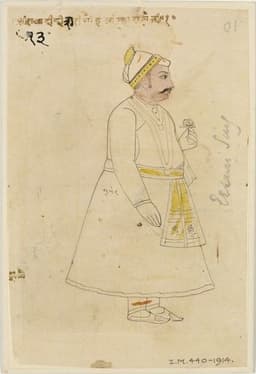
Ishwari Singh
Emperor · Modern
35.9Total
Basic Information
Born
1806
1721
Died
1853
1750
Era
Modern
Modern
Nationality
Macina Empire
India
Occupation
Emperor
Emperor
Civilization
Other
Indian
Score Comparison
Military (10%)
50.0
21.2
Political (20%)
40.8
26.4
Influence (20%)
49.4
46.3
Legacy (20%)
37.5
34.2
Leadership (15%)
65.7
38.1
Strategy (15%)
30.3
39.6
TOTAL
45.7
35.9
Amadu Seku — Complete Timeline
1845 AD
Succession as Caliph of MacinaPolitical Action◆ Major
Amadu Seku succeeded his father Seku Amadu as caliph of the Macina Caliphate upon the latter's death. He inherited a stable theocratic state and continued his father's policies of Islamic governance and territorial consolidation.
SuccessionCaliphateMacina
Impact: regional
1846 AD
Continued Islamic AdministrationReform
Amadu Seku continued the implementation of Islamic law and administration established by his father. He maintained the system of qadis (judges) and Islamic schools, ensuring the caliphate remained a center of religious learning and governance.
Islamic AdministrationEducationLaw
Impact: regionalconstructive
1850 AD
Maintenance of Macina StabilityPolitical Action◆ Major
Amadu Seku successfully maintained the internal stability and territorial integrity of the Macina Caliphate during his reign. He managed relations with neighboring states and prevented internal rebellions, preserving the state his father had founded.
StabilityGovernanceMacina
Impact: regionalconstructive
Ishwari Singh — Complete Timeline
1747 AD
Conflict with Madho SinghPolitical Action◆ Major
Ishwari Singh faced a succession dispute with his half-brother Madho Singh, who claimed the throne. The conflict led to civil war and Maratha intervention, weakening Jaipur.
Succession CrisisCivil WarJaipur
Impact: regionaldestructive
1748 AD
Battle of BagruWar◆ Major
Ishwari Singh fought the Maratha army under Malhar Rao Holkar at Bagru. He was defeated, leading to the loss of territory and increased Maratha influence in Jaipur.
Maratha InvasionBattleJaipur
Impact: regional
1750 AD
SuicidePolitical Action◆ Major
After losing the support of his nobles and facing defeat by the Marathas, Ishwari Singh committed suicide by consuming poison. His death ended the Kachwaha rule in Jaipur temporarily.
SuicideEnd of ReignJaipur
Impact: regionaltragic
This comparison has not been analyzed yet.
One-time AI generation (~1 minute). Scores and timeline are already available below.
Rankings
🥇
Amadu SekuLeader
Mil: 50.0Pol: 40.8Inf: 49.4
45.7
🥈
Ishwari Singh
Mil: 21.2Pol: 26.4Inf: 46.3
35.9
+9.8 behind
How This Comparison Works
Algorithm
Each figure is scored on 6 dimensions (0—100 scale) based on structured historical data: Military (10%), Political (20%), Influence (20%), Legacy (20%), Leadership (15%), Strategy (15%). The weighted total produces the final ranking.
Data Sources
Scores are computed from structured sub-indicators in the database. Scale factors adjust for era (Ancient ×0.85, Modern ×1.0) and civilization size (Eastern ×1.05, Other ×0.80) to account for differences in population and military scale.
Maximum 3 Figures
Comparisons are limited to 2—3 figures to ensure readability and statistical meaningfulness.
Error Margins
±5 points per dimension — Sub-scores are derived from historical records with inherent uncertainty. Two figures within 5 points on a dimension should be considered roughly equivalent in that area.
Total Score Accuracy
±3 points overall — The weighted combination of 6 dimensions produces a total score with approximately ±3 points of uncertainty. Differences of less than 3 points are not statistically significant— the figures are effectively tied.
Known Limitations
- Historical records are incomplete and uneven across civilizations
- Figures from oral-tradition societies may be underrepresented
- Occupation labels can misclassify multi-role figures
- Scores measure capability and impact, not moral character
- Quantitative scoring is a comparison tool, not absolute truth
Capability Radar
Military (10%) — Battles & Warfare
Battles
20
15
Win Rate
25
10
Expansion
15
5
Political (20%) — Governance & Reform
Reform
35
10
Diplomacy
30
10
Economy
30
10
Influence (20%) — Cultural & Global Reach
Cultural
25
10
Global
10
5
Legacy (20%) — Historical Impact
Historical
20
10
Longevity
15
5
Leadership (15%) — Power & Stability
Tenure
40
20
Stability
25
5
Strategy (15%) — Tactics & Innovation
Strategy
20
10
Tactics
20
10
Reform
15
5
Similar Comparisons
Comments & Discussion
No comments yet. Be the first to share your thoughts!