Loading...
Ishwari Singh vs Julius Caesar
Julius Caesar leads by 46.9 pts · 2 figures compared
…
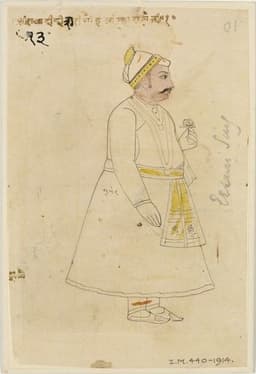
Ishwari Singh
Emperor · Modern
35.9Total

Julius Caesar
General · Ancient
82.8Total
Basic Information
Born
1721
-100
Died
1750
-44
Era
Modern
Ancient
Nationality
India
Roman Republic
Occupation
Emperor
General
Civilization
Indian
Western
Score Comparison
Military (10%)
21.2
88.0
Political (20%)
26.4
78.0
Influence (20%)
46.3
85.0
Legacy (20%)
34.2
82.0
Leadership (15%)
38.1
80.0
Strategy (15%)
39.6
85.0
TOTAL
35.9
82.8
Ishwari Singh — Complete Timeline
1747 AD
Conflict with Madho SinghPolitical Action◆ Major
Ishwari Singh faced a succession dispute with his half-brother Madho Singh, who claimed the throne. The conflict led to civil war and Maratha intervention, weakening Jaipur.
Succession CrisisCivil WarJaipur
Impact: regionaldestructive
1748 AD
Battle of BagruWar◆ Major
Ishwari Singh fought the Maratha army under Malhar Rao Holkar at Bagru. He was defeated, leading to the loss of territory and increased Maratha influence in Jaipur.
Maratha InvasionBattleJaipur
Impact: regional
1750 AD
SuicidePolitical Action◆ Major
After losing the support of his nobles and facing defeat by the Marathas, Ishwari Singh committed suicide by consuming poison. His death ended the Kachwaha rule in Jaipur temporarily.
SuicideEnd of ReignJaipur
Impact: regionaltragic
Julius Caesar — Complete Timeline
58 BC
Gallic WarsWar◆ Major
Caesar, as proconsul of Gaul, launched a series of campaigns that conquered all of Gaul (modern France, Belgium, and parts of Switzerland). He fought numerous battles, including against the Helvetii, the Belgae, and the Gallic chieftain Vercingetorix. The wars brought immense wealth and a loyal army to Caesar.
Gallic WarsConquestRoman Expansion
Impact: regional
49 BC
Crossing the RubiconPolitical Action◆ Major
Caesar led Legio XIII across the Rubicon River into Italy, defying the Roman Senate's order to disband his army. This act triggered a civil war against Pompey and the Optimates, ultimately leading to Caesar's dictatorship and the end of the Roman Republic.
Roman Civil WarEnd of RepublicPower Struggle
Impact: global
48 BC
Battle of PharsalusWar◆ Major
Caesar's outnumbered army defeated the larger forces of Pompey the Great at Pharsalus in Greece. Caesar's tactical use of a reserve line to counter Pompey's cavalry charge proved decisive. Pompey fled to Egypt, where he was assassinated, leaving Caesar as the undisputed master of the Roman world.
Roman Civil WarBattleDecisive Victory
Impact: regional
44 BC
Appointment as Dictator for LifePolitical Action◆ Major
The Roman Senate appointed Caesar dictator perpetuo (dictator for life), granting him unprecedented personal power. This move concentrated military, legislative, and judicial authority in one person, effectively ending the Roman Republic's traditional system of checks and balances and alarming many senators.
DictatorshipEnd of RepublicPower Consolidation
Impact: regionaldestructive
Assassination on the Ides of MarchPolitical Action◆ Major
A group of Roman senators, led by Marcus Junius Brutus and Gaius Cassius Longinus, stabbed Caesar to death at a meeting of the Senate in the Theatre of Pompey. The assassination was intended to restore the Republic, but instead triggered another civil war that led to the rise of the Roman Empire.
AssassinationRoman PoliticsEnd of Republic
Impact: globaldestructive
Expert Analysis
ishwari-singh-vs-julius-caesar
# The Ides of March and the Poison Cup: Two Rulers, Two Fates
On a crisp March morning in 44 BCE, Julius Caesar walked into the Senate chamber in Rome, brushing aside a soothsayer’s warning. Within minutes, sixty daggers ended his life and changed the course of Western history. Seventeen centuries later and thousands of miles away, in the pink-walled city of Jaipur, another ruler faced his end—not by an assassin’s blade, but by his own hand, swallowing poison after watching his kingdom crumble. One died at the height of his power, the other in the depths of despair. Why did Caesar’s ambition forge an empire, while Ishwari Singh’s struggle ended in oblivion?
Origins
Julius Caesar was born into the patrician Julian clan, one of Rome’s oldest families, but his youth was marked by political turmoil. The Roman Republic was tearing itself apart—civil wars, corruption, and the rise of military strongmen like Sulla and Marius. Caesar’s uncle by marriage, Marius, was a populist general; his enemy, Sulla, was a dictator who proscribed thousands. This violent, competitive world shaped Caesar into a survivor who understood that in Rome, power came from armies and alliances, not birthright alone.
Ishwari Singh emerged in a very different world—18th-century Rajasthan, where the Mughal Empire was fragmenting and Rajput kingdoms fought for survival. He was the eldest son of Maharaja Sawai Jai Singh II, the brilliant founder of Jaipur, a city of astronomy and diplomacy. But Jai Singh’s death in 1743 left a poisoned inheritance: Ishwari Singh’s half-brother, Madho Singh, backed by the Maratha confederacy, claimed the throne. Unlike Caesar, who grew up in a republic where talent could challenge tradition, Ishwari Singh was born into a feudal system where legitimacy was everything—and his legitimacy was contested from the start.
Rise to Power
Caesar’s path to power was a masterclass in patience and audacity. He climbed the Roman political ladder step by step—quaestor, aedile, pontifex maximus—but his real breakthrough came when he formed the First Triumvirate with Pompey and Crassus in 60 BCE. This alliance gave him command of Gaul, where he spent eight years conquering a vast territory, building a loyal army, and amassing enormous wealth. His Commentaries on the Gallic Wars were not just history but propaganda, crafting his image as Rome’s greatest general. When the Senate ordered him to disband his army, he crossed the Rubicon River in 49 BCE, plunging the Republic into civil war. By 45 BCE, he was dictator for life.
Ishwari Singh’s rise was forced and fragile. He inherited the throne of Jaipur in 1743, but his half-brother Madho Singh immediately challenged him, backed by the Maratha warlord Malhar Rao Holkar. Ishwari Singh tried to buy peace—he offered Madho Singh territories, but the Marathas wanted more. In 1747, the conflict escalated into open war. Unlike Caesar, who chose his battles and timed his moves, Ishwari Singh was reacting to forces he could not control. He had no Gaul to conquer, no loyal veterans forged in years of campaigns. His army was a coalition of reluctant nobles, his treasury drained by Maratha demands.
Leadership & Governance
Caesar governed with a blend of ruthlessness and reform. As dictator, he centralized power, reformed the calendar (creating the Julian calendar we still use in modified form), granted citizenship to provincials, and launched massive building projects. He pardoned many of his enemies, including Brutus and Cassius—a clemency that would prove fatal. His military genius lay in speed and logistics: he once marched his army 800 miles in three weeks. He led from the front, sharing hardships with his soldiers, who adored him.
Ishwari Singh ruled as a traditional Rajput king, but his position was always precarious. He tried diplomacy, paying tribute to the Marathas, but they kept demanding more. His nobles, seeing his weakness, began defecting to Madho Singh. In 1748, at the Battle of Bagru, Ishwari Singh faced the Maratha army under Holkar. He was decisively defeated, losing territory and prestige. Unlike Caesar, who turned defeats (like at Dyrrhachium) into eventual victories, Ishwari Singh had no second act. His leadership was defensive, reactive—he was trying to preserve a kingdom, not build an empire.
Triumph & Tragedy
Caesar’s greatest triumph was his conquest of Gaul—a feat that doubled Rome’s territory and made him a legend. His victory at the Battle of Alesia in 52 BCE, where he besieged the Gallic chieftain Vercingetorix, is still studied in military academies. But his tragedy was his own success: by destroying the Republic, he made himself a target. The Ides of March in 44 BCE was the culmination of a conspiracy by senators who feared his kingship. His death plunged Rome into another civil war, but his legacy—the Empire—survived.
Ishwari Singh’s triumph was fleeting: he managed to hold Jaipur for seven years against overwhelming odds. But his tragedy was total. After Bagru, the Marathas squeezed him further. His nobles abandoned him. By 1750, he was alone, his treasury empty, his half-brother marching on the capital. Rather than face capture or humiliation, he drank poison. He was 29 years old. The throne passed to Madho Singh, who ruled for 18 years—a reminder that in history, the winners write the story.
Character & Destiny
Caesar was audacious, calculating, and supremely confident. He once said, “It is easier to find men who will volunteer to die than to find those who are willing to endure pain with patience.” He believed in his own star, and his ambition was boundless. But his clemency was a double-edged sword: he spared enemies who later killed him. His personality drove him to take risks that paid off—until they didn’t.
Ishwari Singh was cautious, perhaps too cautious. He tried to negotiate with enemies who saw negotiation as weakness. His suicide was seen by Rajput tradition as an honorable exit—a king who would not live to see his kingdom fall. But it was also an admission of defeat. Where Caesar would have fought to the last legionary, Ishwari Singh chose a quiet, lonely end.
Legacy
Caesar’s legacy is monumental. His name became synonymous with imperial power—Caesar, Kaiser, Tsar. His writings survive, his calendar endures, and the Roman Empire he inadvertently created shaped Western civilization for 1,500 years. He is remembered as a genius, a tyrant, and a martyr.
Ishwari Singh is a footnote in Indian history, mentioned in chronicles of Jaipur as a tragic figure. His defeat and suicide are a cautionary tale about the dangers of internal division in the face of external threats. No cities bear his name, no empire remembers him. He was a victim of forces—Maratha expansion, Mughal decline, Rajput factionalism—that he could not master.
Conclusion
The difference between these two rulers is not simply one of talent or luck, but of world-historical context. Caesar lived in a Republic that was ripe for transformation; his ambition found a stage that could contain it. Ishwari Singh lived in a world of collapsing empires and predatory neighbors, where survival was the only victory. One man’s death was a political assassination that changed the world; the other’s was a personal tragedy that changed nothing. As the historian will note, the Ides of March brought down a dictator but gave birth to an empire. The poison cup in Jaipur ended a life but not a dynasty—and that, perhaps, is the cruelest difference of all.
Rankings
🥇
Julius CaesarLeader
Mil: 88.0Pol: 78.0Inf: 85.0
82.8
🥈
Ishwari Singh
Mil: 21.2Pol: 26.4Inf: 46.3
35.9
+46.9 behind
How This Comparison Works
Algorithm
Each figure is scored on 6 dimensions (0—100 scale) based on structured historical data: Military (10%), Political (20%), Influence (20%), Legacy (20%), Leadership (15%), Strategy (15%). The weighted total produces the final ranking.
Data Sources
Scores are computed from structured sub-indicators in the database. Scale factors adjust for era (Ancient ×0.85, Modern ×1.0) and civilization size (Eastern ×1.05, Other ×0.80) to account for differences in population and military scale.
Maximum 3 Figures
Comparisons are limited to 2—3 figures to ensure readability and statistical meaningfulness.
Error Margins
±5 points per dimension — Sub-scores are derived from historical records with inherent uncertainty. Two figures within 5 points on a dimension should be considered roughly equivalent in that area.
Total Score Accuracy
±3 points overall — The weighted combination of 6 dimensions produces a total score with approximately ±3 points of uncertainty. Differences of less than 3 points are not statistically significant— the figures are effectively tied.
Known Limitations
- Historical records are incomplete and uneven across civilizations
- Figures from oral-tradition societies may be underrepresented
- Occupation labels can misclassify multi-role figures
- Scores measure capability and impact, not moral character
- Quantitative scoring is a comparison tool, not absolute truth
Capability Radar
Military (10%) — Battles & Warfare
Battles
15
95
Win Rate
10
92
Expansion
5
97
Political (20%) — Governance & Reform
Reform
10
90
Diplomacy
10
85
Economy
10
82
Influence (20%) — Cultural & Global Reach
Cultural
10
88
Global
5
94
Legacy (20%) — Historical Impact
Historical
10
95
Longevity
5
96
Leadership (15%) — Power & Stability
Tenure
20
75
Stability
5
60
Strategy (15%) — Tactics & Innovation
Strategy
10
94
Tactics
10
96
Reform
5
88
Similar Comparisons
Comments & Discussion
CAESAR'S BLADE6/17/2026
"Caesar and Ishwari Singh aren't even in the same league. Caesar didn't just conquer—he engineered a political machine that outlasted him. The guy wrote his own war commentaries to shape public opinion. He cross-rubricated Gaul, reformed the calendar, and turned client kingdoms into assets. Ishwari Singh? He inherited a carefully balanced alliance system and let factional jealousy destroy it. One legacy built an empire; the other legacy is a footnote in guidebooks to Jaipur's forts."
数据派的沉默6/17/2026
"先别急着夸。比较前先看数据:凯撒行省任内税收增长约400%,打赢高卢战争后个人财富够发军饷养了整整8个军团。反观Ishwari Singh在位不到3年。你连完整财政记录都没有,凭什么说他是‘失败者’?历史上很多统治者死得快是因为遇到的敌人更强、资源更少。只比较结局就下判断,这叫偷懒的历史叙事,不是严肃的比较研究。"
REPUBLIC SCEPTIC6/17/2026
"I’ve seen this romanticization before—Ishwari Singh as tragic prince versus Caesar the tyrant-slayer. Bull. Caesar was a populist who broke the Senate’s aristocratic stranglehold and gave land to veterans and the poor. The Senate hated him because he threatened their power. Singh was a prince who couldn’t even hold his own court together. One died challenging an entrenched elite, the other because he couldn't manage family politics. Context matters, but so does outcome."
血色日落手札6/17/2026
"有人说Ishwari Singh懦弱自杀,但看看他的困境:他的弟弟Madho Singh有马拉塔人撑腰,Jaipur的贵族集体倒戈,连他父亲留下的重臣都背叛了他。他面临的不是内部纷争,是区域权力体系的重组。凯撒死时身边还有副手和忠臣帮他收尸、复仇。Ishwari Singh最后能做的,就是给妻妾和城堡里的人留一条生路。这是失败,但也是悲壮的清醒。"
CALENDAR REFORMER6/17/2026
"Forget the daggers and poison—the real comparison is how they handled systems. Caesar reorganised the Roman calendar, reformed debt laws, and started public works that lasted 400 years. He understood that power isn’t just armies; it's bureaucracy. Ishwari Singh inherited Jai Singh II's scientific city, his astronomical instruments, his diplomatic networks—and dismantled them. His reign is a case study in how to burn a legacy. One man expanded his world; the other shrank. That’s not tragedy, tha