Loading...
This comparison has not been analyzed yet.
One-time AI generation (~1 minute). Scores and timeline are already available below.
Andres Manuel Lopez Obrador vs Emeka Anyaoku
Emeka Anyaoku leads by 0.4 pts · 2 figures compared
…
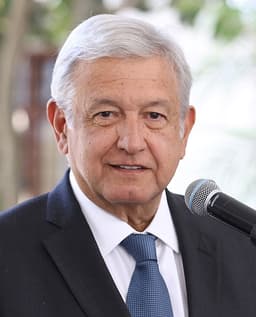
Andres Manuel Lopez Obrador
Politician · Modern
55.6Total

Emeka Anyaoku
Politician · Modern
56.0Total
Basic Information
Born
1953
1933
Died
—
—
Era
Modern
Modern
Nationality
Mexico
Nigeria
Occupation
Politician
Politician
Civilization
Western
Other
Score Comparison
Military (10%)
49.8
24.9
Political (20%)
68.0
72.0
Influence (20%)
56.4
55.0
Legacy (20%)
45.8
50.0
Leadership (15%)
72.0
79.8
Strategy (15%)
40.8
45.1
TOTAL
55.6
56.0
Andres Manuel Lopez Obrador — Complete Timeline
2018 AD
Elected President of MexicoPolitical Action◆ Major
López Obrador won the 2018 Mexican general election with 53% of the vote, representing the MORENA party. His victory ended decades of dominance by the PRI and PAN parties, marking a shift to leftist governance in Mexico.
ElectionPolitical Change
Impact: nationalconstructive
Cancelled the Mexico City Texcoco AirportPolitical Action◆ Major
After a public consultation, AMLO cancelled the partially built $13 billion Mexico City Texcoco airport project, citing corruption and cost overruns. He replaced it with the expansion of the Santa Luc
InfrastructureCorruption
Impact: nationaldestructive
2019 AD
Launched the 'Fourth Transformation' reformsReform◆ Major
AMLO initiated a series of constitutional and policy changes under the 'Fourth Transformation' agenda, including anti-corruption measures, austerity for high-level officials, and increased social spending. These reforms aimed to reduce inequality and state corruption.
ReformSocial Policy
Impact: nationalconstructive
Implemented the 'Sembrando Vida' reforestation programReform
AMLO launched Sembrando Vida, a large-scale reforestation and rural employment program providing payments to farmers for planting trees. The program aimed to combat deforestation and poverty in rural Mexico, covering over 1 million hectares.
EnvironmentSocial Program
Impact: nationalconstructive
2020 AD
Faced the COVID-19 pandemic responsePolitical Action◆ Major
AMLO's government implemented a limited lockdown and promoted the 'Healthy Distance' campaign. His administration faced criticism for downplaying the pandemic and for a high death toll, but also expanded hospital capacity and vaccination rollout.
PandemicPublic Health
Impact: national
2022 AD
Nationalized lithium reservesReform
AMLO signed a decree nationalizing lithium reserves in Mexico, declaring the mineral a strategic resource for the state. This move aimed to control the supply chain for electric vehicle batteries, but raised concerns among foreign investors about property rights.
NationalizationEnergy
Impact: nationalconstructive
Emeka Anyaoku — Complete Timeline
1990 AD
Elected Commonwealth Secretary-GeneralPolitical Action◆ Major
Emeka Anyaoku was elected as the third Commonwealth Secretary-General at the Commonwealth Heads of Government Meeting in Harare, Zimbabwe, in 1991. He took office on July 1, 1990, becoming the first African to hold the position.
CommonwealthDiplomacyNigeria
Impact: globalconstructive
1991 AD
Oversaw Commonwealth Response to ApartheidPolitical Action◆ Major
During his tenure, Anyaoku played a key role in coordinating Commonwealth policy on the dismantling of apartheid in South Africa. He supported the transition to majority rule and the readmission of South Africa to the Commonwealth in 1994 after the election of Nelson Mandela.
ApartheidSouth AfricaCommonwealth
Impact: globalconstructive
1995 AD
Suspended Nigeria from the CommonwealthPolitical Action◆ Major
Under Anyaoku's leadership, the Commonwealth suspended Nigeria's membership in 1995 following the execution of Ken Saro-Wiwa and eight other Ogoni activists by the military regime of Sani Abacha. This was a significant diplomatic sanction against his own country.
SanctionsNigeriaHuman Rights
Impact: global
This comparison has not been analyzed yet.
One-time AI generation (~1 minute). Scores and timeline are already available below.
Rankings
🥇
Emeka AnyaokuLeader
Mil: 24.9Pol: 72.0Inf: 55.0
56.0
🥈
Andres Manuel Lopez Obrador
Mil: 49.8Pol: 68.0Inf: 56.4
55.6
+0.4 behind
How This Comparison Works
Algorithm
Each figure is scored on 6 dimensions (0—100 scale) based on structured historical data: Military (10%), Political (20%), Influence (20%), Legacy (20%), Leadership (15%), Strategy (15%). The weighted total produces the final ranking.
Data Sources
Scores are computed from structured sub-indicators in the database. Scale factors adjust for era (Ancient ×0.85, Modern ×1.0) and civilization size (Eastern ×1.05, Other ×0.80) to account for differences in population and military scale.
Maximum 3 Figures
Comparisons are limited to 2—3 figures to ensure readability and statistical meaningfulness.
Error Margins
±5 points per dimension — Sub-scores are derived from historical records with inherent uncertainty. Two figures within 5 points on a dimension should be considered roughly equivalent in that area.
Total Score Accuracy
±3 points overall — The weighted combination of 6 dimensions produces a total score with approximately ±3 points of uncertainty. Differences of less than 3 points are not statistically significant— the figures are effectively tied.
Known Limitations
- Historical records are incomplete and uneven across civilizations
- Figures from oral-tradition societies may be underrepresented
- Occupation labels can misclassify multi-role figures
- Scores measure capability and impact, not moral character
- Quantitative scoring is a comparison tool, not absolute truth
Capability Radar
Military (10%) — Battles & Warfare
Battles
28
22
Win Rate
34
23
Expansion
33
25
Political (20%) — Governance & Reform
Reform
60
60
Diplomacy
55
75
Economy
50
55
Influence (20%) — Cultural & Global Reach
Cultural
40
50
Global
40
65
Legacy (20%) — Historical Impact
Historical
45
55
Longevity
30
50
Leadership (15%) — Power & Stability
Tenure
65
70
Stability
45
60
Strategy (15%) — Tactics & Innovation
Strategy
36
32
Tactics
38
33
Reform
43
34
Similar Comparisons
Comments & Discussion
No comments yet. Be the first to share your thoughts!