Loading...
Anerood Jugnauth vs Eric Zemmour
Anerood Jugnauth leads by 13.8 pts · 2 figures compared
…
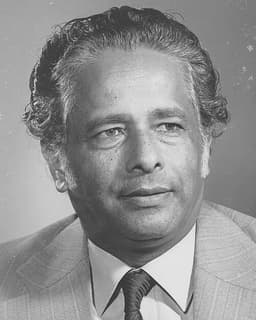
Anerood Jugnauth
Politician · Modern
59.0Total

Eric Zemmour
Politician · Modern
45.2Total
Basic Information
Born
1930
1958
Died
—
—
Era
Modern
Modern
Nationality
Mauritius
France
Occupation
Politician
Politician
Civilization
Other
Western
Score Comparison
Military (10%)
46.1
49.6
Political (20%)
70.3
30.7
Influence (20%)
59.0
51.0
Legacy (20%)
52.0
39.2
Leadership (15%)
78.0
58.8
Strategy (15%)
43.5
42.8
TOTAL
59.0
45.2
Anerood Jugnauth — Complete Timeline
1982 AD
Elected Prime Minister of MauritiusPolitical Action◆ Major
Jugnauth became Prime Minister after his Militant Socialist Movement (MSM) won the 1982 general election, defeating Seewoosagur Ramgoolam. He inherited an economy facing high unemployment and debt.
Electoral VictoryPower Transition
Impact: national
1983 AD
Established the Mauritius Export Processing ZoneReform
Jugnauth's government expanded the Export Processing Zone (EPZ) scheme, attracting foreign investment in textile manufacturing. This policy transformed Mauritius from a sugar-dependent economy to a diversified one, reducing unemployment.
Economic ReformIndustrialization
Impact: nationalconstructive
1987 AD
Re-elected Prime Minister (1987)Political Action◆ Major
Jugnauth won the 1987 general election, securing a second term. His government continued economic liberalization policies, leading to sustained growth and the emergence of Mauritius as a middle-income country.
Re-electionEconomic Growth
Impact: nationalconstructive
2003 AD
Became President of MauritiusPolitical Action
Jugnauth was elected President of Mauritius by the National Assembly, a largely ceremonial role. He served until 2012, providing a figurehead role after his long tenure as Prime Minister.
PresidencyCeremonial Role
Impact: national
2014 AD
Returned as Prime Minister (2014)Political Action◆ Major
Jugnauth returned as Prime Minister after his MSM-led alliance won the 2014 general election. At age 84, he became one of the world's oldest serving leaders, focusing on infrastructure projects.
Political ComebackInfrastructure
Impact: national
2017 AD
Resigned as Prime MinisterPolitical Action◆ Major
Jugnauth resigned as Prime Minister in January 2017, handing power to his son, Pravind Jugnauth. The succession was criticized as dynastic but was legal under the constitution.
ResignationDynastic Succession
Impact: national
Eric Zemmour — Complete Timeline
2014 AD
Published 'Le Suicide français'Cultural◆ Major
Zemmour published the book 'Le Suicide fran
PublicationPolitical Essay
Impact: nationaldestructive
2021 AD
Announced candidacy for 2022 presidential electionPolitical Action◆ Major
Zemmour declared his candidacy for the 2022 French presidential election, running as a far-right nationalist. His campaign focused on anti-immigration and anti-Islam rhetoric.
CandidacyFar-Right Politics
Impact: nationaldestructive
2022 AD
First-round presidential election result (2022)Political Action◆ Major
Zemmour received 7.07% of the vote in the first round of the 2022 presidential election, finishing fourth. He failed to qualify for the runoff.
ElectionFourth Place
Impact: national
Expert Analysis
Origins
**Anerood Jugnauth** was born on March 29, 1930, in Palma, Mauritius, into a Hindu family of modest means. He studied law in the United Kingdom, earning a degree from Lincoln's Inn, and returned to Mauritius to practice as a barrister. His early career was marked by involvement in labor unions and the independence movement, which gave him grassroots political experience.
**Eric Zemmour** was born on August 31, 1958, in Montreuil, France, to a Jewish family of Algerian origin. He studied at Sciences Po Paris and began a career in journalism, working for publications like *Le Figaro* and later as a television commentator on CNews. His formative years were shaped by his observations of French society and immigration, which later became central to his political rhetoric.
Rise to Power
Jugnauth rose through the ranks of the Labour Party and later founded the Militant Socialist Movement (MSM) in 1983. His turning point came in 1982 when his MSM-led alliance won the general election, defeating long-serving Prime Minister Seewoosagur Ramgoolam. Jugnauth became Prime Minister on June 12, 1982, inheriting an economy dependent on sugar and facing high unemployment.
Zemmour's rise was unconventional. He gained prominence as a polemicist through his books and media appearances. His 2014 book *Le Suicide français* became a bestseller, arguing that France's decline was due to immigration and multiculturalism. This catapulted him into the political spotlight. He announced his candidacy for the 2022 French presidential election on November 30, 2021, as a far-right nationalist, drawing support from disaffected conservatives.
Leadership & Governance
Jugnauth's leadership was pragmatic and economically focused. He expanded the Export Processing Zone (EPZ) scheme, attracting foreign investment in textile manufacturing. This transformed Mauritius from a low-income sugar-dependent economy to a middle-income diversified one, with GDP growth averaging 5-6% annually in the 1980s and 1990s. He also strengthened democratic institutions and maintained stability in a multi-ethnic society. His political score of 70.3 reflects his ability to build coalitions and win multiple elections.
Zemmour's leadership was ideological and confrontational. He advocated for drastic immigration restrictions, including the abolition of birthright citizenship, and promoted a return to traditional French values. His campaign was marked by controversial statements about Islam and immigrants. However, his political score of 30.7 indicates limited electoral success; he received only 7.07% in the first round of the 2022 presidential election, failing to reach the runoff. His influence score of 51.0 shows his ability to shift public discourse, but his leadership score of 58.8 reflects his inexperience in governance.
Triumph & Tragedy
Jugnauth's greatest triumph was the economic transformation of Mauritius. His EPZ policies created jobs and reduced unemployment from over 20% in the early 1980s to single digits by the 1990s. He also successfully managed the transition to a multi-party democracy. However, his legacy is marred by accusations of dynastic politics: in 2017, he resigned as Prime Minister and handed power to his son, Pravind Jugnauth, a move criticized as nepotistic. His strategy score of 43.5 suggests limited long-term planning beyond economic policy.
Zemmour's triumph was his ability to influence French political discourse, pushing the mainstream right to adopt tougher immigration stances. His book sales and media presence gave him a platform. However, his failure to win the presidency or even reach the runoff was a clear setback. He scored 39.2 in legacy, as his impact remains uncertain and largely rhetorical. His military score of 49.6 is irrelevant to his career.
Character & Destiny
Jugnauth was known for his calm demeanor and strategic patience. He often worked behind the scenes to build consensus, which helped him stay in power for decades. His character was shaped by his legal background and focus on stability. This allowed him to navigate ethnic tensions in Mauritius without major conflict. However, his decision to install his son as successor revealed a willingness to prioritize family over democratic norms.
Zemmour is confrontational and ideologically rigid. His background as a polemicist made him a polarizing figure, appealing to those who felt left behind by globalization but alienating moderates. His character drove him to take uncompromising stances, which limited his coalition-building ability. Historical assessments view him as a symptom of French political discontent rather than a transformative leader.
Legacy
Jugnauth's legacy is concrete: he modernized Mauritius's economy, setting it on a path to becoming one of Africa's most developed nations. The EPZ model has been studied as a successful development strategy. However, his dynastic move tarnished his democratic credentials. His total score of 59.0 reflects a mixed but impactful record.
Zemmour's legacy is less tangible. He shifted the Overton window on immigration in France, but his political failure means his ideas may not endure. He scored 45.2 overall, with low political and legacy scores. His influence on the far-right is notable but not transformative.
Conclusion
Anerood Jugnauth had a greater impact on his nation than Eric Zemmour. Jugnauth's concrete economic policies transformed Mauritius, while Zemmour's influence was primarily rhetorical. Jugnauth's total score of 59.0 versus Zemmour's 45.2 reflects this disparity. Jugnauth's leadership score of 78.0 and political score of 70.3 demonstrate his effectiveness as a statesman, whereas Zemmour's political score of 30.7 and legacy score of 39.2 show his limitations. While Zemmour may have influenced French discourse, Jugnauth's legacy is one of actual governance and development.
Rankings
🥇
Anerood JugnauthLeader
Mil: 46.1Pol: 70.3Inf: 59.0
59.0
🥈
Eric Zemmour
Mil: 49.6Pol: 30.7Inf: 51.0
45.2
+13.8 behind
How This Comparison Works
Algorithm
Each figure is scored on 6 dimensions (0—100 scale) based on structured historical data: Military (10%), Political (20%), Influence (20%), Legacy (20%), Leadership (15%), Strategy (15%). The weighted total produces the final ranking.
Data Sources
Scores are computed from structured sub-indicators in the database. Scale factors adjust for era (Ancient ×0.85, Modern ×1.0) and civilization size (Eastern ×1.05, Other ×0.80) to account for differences in population and military scale.
Maximum 3 Figures
Comparisons are limited to 2—3 figures to ensure readability and statistical meaningfulness.
Error Margins
±5 points per dimension — Sub-scores are derived from historical records with inherent uncertainty. Two figures within 5 points on a dimension should be considered roughly equivalent in that area.
Total Score Accuracy
±3 points overall — The weighted combination of 6 dimensions produces a total score with approximately ±3 points of uncertainty. Differences of less than 3 points are not statistically significant— the figures are effectively tied.
Known Limitations
- Historical records are incomplete and uneven across civilizations
- Figures from oral-tradition societies may be underrepresented
- Occupation labels can misclassify multi-role figures
- Scores measure capability and impact, not moral character
- Quantitative scoring is a comparison tool, not absolute truth
Capability Radar
Military (10%) — Battles & Warfare
Battles
24
28
Win Rate
23
30
Expansion
27
37
Political (20%) — Governance & Reform
Reform
70
10
Diplomacy
75
5
Economy
80
5
Influence (20%) — Cultural & Global Reach
Cultural
40
20
Global
45
15
Legacy (20%) — Historical Impact
Historical
50
15
Longevity
60
10
Leadership (15%) — Power & Stability
Tenure
85
0
Stability
75
5
Strategy (15%) — Tactics & Innovation
Strategy
31
39
Tactics
32
41
Reform
37
44
Similar Comparisons
Comments & Discussion
No comments yet. Be the first to share your thoughts!