Loading...
Ange-Felix Patasse vs Tony Blair
Tony Blair leads by 6.1 pts · 2 figures compared
…
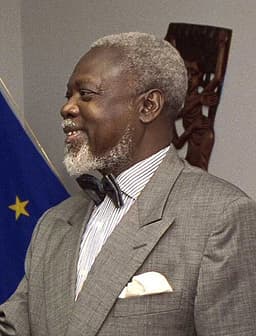
Ange-Felix Patasse
Politician · Modern
47.4Total

Tony Blair
Politician · Modern
53.5Total
Basic Information
Born
1937
1953
Died
—
—
Era
Modern
Modern
Nationality
Central African Republic
United Kingdom
Occupation
Politician
Politician
Civilization
Other
Western
Score Comparison
Military (10%)
50.0
27.7
Political (20%)
39.4
55.0
Influence (20%)
49.4
65.0
Legacy (20%)
40.0
54.0
Leadership (15%)
67.0
66.0
Strategy (15%)
40.8
28.0
TOTAL
47.4
53.5
Ange-Felix Patasse — Complete Timeline
1993 AD
Elected President of CARPolitical Action◆ Major
Ange-Félix Patassé won the presidential election with 52.5% of the vote in the second round, becoming the first democratically elected president of the Central African Republic. His victory ended a period of military rule.
Central African RepublicDemocracyElection
Impact: nationalconstructive
1996 AD
Survived Army MutiniesWar
Three army mutinies erupted against Patass
Central African RepublicMutinyFrench Intervention
Impact: nationaldestructive
2003 AD
Overthrown by François BozizéPolitical Action◆ Major
While Patass
Central African RepublicCoupBozizé
Impact: nationaltragic
Tony Blair — Complete Timeline
1997 AD
Election as Prime MinisterPolitical Action◆ Major
Blair led the Labour Party to a landslide victory in the general election, ending 18 years of Conservative rule. He became the youngest prime minister since 1812, promising modernization and a 'Third Way' in politics.
ElectionLabour PartyThird Way
Impact: nationalconstructive
1998 AD
Good Friday AgreementPolitical Action
Blair played a key role in negotiating the Good Friday Agreement, which brought an end to the Troubles in Northern Ireland. The agreement established a power-sharing government and was approved by referendums in both Northern Ireland and the Republic of Ireland.
Northern IrelandPeace ProcessGood Friday Agreement
Impact: regionalconstructive
2003 AD
Decision to Join the Iraq WarPolitical Action◆ Major
Blair committed British forces to the US-led invasion of Iraq, based on intelligence about weapons of mass destruction. The war was controversial, and the failure to find WMDs damaged Blair's credibility, leading to accusations of misleading Parliament.
Iraq WarWMDForeign Policy
Impact: globaldestructive
Expert Analysis
Origins
Ange-Félix Patassé was born on January 25, 1937, in Paoua, a remote village in what was then French Ubangi-Shari (now the Central African Republic). His father was a farmer and a local chief. Patassé studied agriculture in France and later worked as a civil servant in the colonial administration. He entered politics in the 1960s under President David Dacko, serving in various ministerial roles, including Minister of Agriculture and Minister of Transport.
Tony Blair was born on May 6, 1953, in Edinburgh, Scotland, into a middle-class family. His father was a lawyer and later a university lecturer. Blair attended the prestigious Fettes College and studied law at St John's College, Oxford. After qualifying as a barrister, he entered politics, joining the Labour Party. He was elected to Parliament in 1983 for the safe seat of Sedgefield.
Rise to Power
Patassé rose to prominence as a trusted ally of President David Dacko, but after Dacko was overthrown by Jean-Bédel Bokassa in 1966, Patassé went into exile. He returned in the 1980s and formed the Movement for the Liberation of the Central African People (MLPC). In 1993, after a period of political turmoil and under international pressure, CAR held multi-party elections. Patassé won the presidency in the second round with 52.5% of the vote, becoming the first democratically elected president of the Central African Republic. His victory marked a transition from authoritarian rule.
Tony Blair's rise was meteoric. He became Labour leader in 1994 after the sudden death of John Smith. He repositioned the party as 'New Labour', moving it to the center and embracing market reforms. In the 1997 general election, Blair led Labour to a landslide victory, ending 18 years of Conservative government. At 43, he became the youngest prime minister since 1812. His victory was built on a platform of modernization, economic competence, and social justice.
Leadership & Governance
Patassé's leadership style was characterized by attempts to consolidate power in a fragile state. He faced multiple army mutinies in 1996-1997 over unpaid salaries and poor conditions. French troops intervened to restore order, but the mutinies weakened his authority. Patassé relied heavily on ethnic and regional loyalties, particularly from his northern Sara ethnic group. His government struggled with corruption and inefficiency, and he failed to build strong institutions. On the positive side, he maintained a multi-party system and held elections, though they were flawed. His political score of 39.4 reflects his difficulties in governing effectively.
Blair was a highly centralizing leader, known for his 'sofa government' style and reliance on a small circle of advisers. He pursued a reform agenda: devolution to Scotland and Wales, the Human Rights Act, and significant investment in public services. His leadership score of 66.0 is close to Patassé's 67.0, but Blair's political score of 55.0 is higher. Blair's governance was marked by a focus on presentation and media management. He also played a key role in negotiating the Good Friday Agreement in 1998, which ended the Troubles in Northern Ireland—a triumph of diplomacy.
Triumph & Tragedy
Patassé's greatest success was being the first democratically elected president of CAR, a milestone for the country. He also survived multiple mutinies and maintained a semblance of democratic process. However, his greatest failure was his inability to stabilize the country. Corruption, ethnic tensions, and economic mismanagement plagued his tenure. In 2003, while Patassé was abroad, rebel forces led by François Bozizé captured Bangui and overthrew him. He went into exile in Togo, ending his rule in ignominy. His legacy score of 40.0 reflects this tragic end.
Blair's greatest triumph was the Good Friday Agreement, which brought peace to Northern Ireland. He also presided over a period of economic growth and public service improvements. However, his decision to join the US-led invasion of Iraq in 2003, based on flawed intelligence about weapons of mass destruction, became his defining tragedy. The war was deeply controversial, led to thousands of deaths, and damaged Blair's reputation. The subsequent inquiry (Chilcot Report) heavily criticized his judgment. His strategy score of 28.0 is abysmal, reflecting this catastrophic decision.
Character & Destiny
Patassé was a charismatic but insecure leader. He trusted few outside his ethnic circle and often made decisions based on personal loyalty rather than institutional strength. His character contributed to his downfall: he failed to address the root causes of instability—poverty, corruption, and ethnic division. His destiny was to be overthrown, a common fate for many African leaders of his era.
Blair was supremely confident and persuasive, but his conviction sometimes bordered on hubris. He believed in the moral force of his arguments, which led him to ignore dissenting voices over Iraq. His character—idealistic yet calculating—shaped his destiny: a historic peacemaker in Northern Ireland but a war leader who damaged his legacy. His total score of 53.5 is higher than Patassé's 47.4, but his strategy score is much lower.
Legacy
Patassé's legacy is mixed. He is remembered as the first democratically elected president, but his tenure is seen as a period of instability and missed opportunities. CAR's democratic progress was reversed after his overthrow, and the country remains one of the world's most fragile states. His influence score of 49.4 is modest.
Blair's legacy is deeply contested. He transformed the Labour Party and made it electable, but the Iraq War tarnished his reputation. The Good Friday Agreement endures as a model for conflict resolution. His influence score of 65.0 is high, reflecting his impact on British politics and international affairs. However, his legacy score of 54.0 is weighed down by Iraq.
Conclusion
While both leaders had significant impacts, Tony Blair had a greater overall influence on the world stage. His political score of 55.0 and influence score of 65.0 surpass Patassé's 39.4 and 49.4, respectively. Blair's role in the Good Friday Agreement alone is a lasting achievement, whereas Patassé's democratic legacy was undone by his own failures. The score gap of 6.1 points reflects this. However, Blair's low strategy score (28.0 vs Patassé's 40.8) shows that his judgment was flawed. Nonetheless, on balance, Blair's impact on global politics, for good and ill, was more profound. Patassé's story is a cautionary tale of the challenges of democratic consolidation in a fragile state.
Rankings
🥇
Tony BlairLeader
Mil: 27.7Pol: 55.0Inf: 65.0
53.5
🥈
Ange-Felix Patasse
Mil: 50.0Pol: 39.4Inf: 49.4
47.4
+6.1 behind
How This Comparison Works
Algorithm
Each figure is scored on 6 dimensions (0—100 scale) based on structured historical data: Military (10%), Political (20%), Influence (20%), Legacy (20%), Leadership (15%), Strategy (15%). The weighted total produces the final ranking.
Data Sources
Scores are computed from structured sub-indicators in the database. Scale factors adjust for era (Ancient ×0.85, Modern ×1.0) and civilization size (Eastern ×1.05, Other ×0.80) to account for differences in population and military scale.
Maximum 3 Figures
Comparisons are limited to 2—3 figures to ensure readability and statistical meaningfulness.
Error Margins
±5 points per dimension — Sub-scores are derived from historical records with inherent uncertainty. Two figures within 5 points on a dimension should be considered roughly equivalent in that area.
Total Score Accuracy
±3 points overall — The weighted combination of 6 dimensions produces a total score with approximately ±3 points of uncertainty. Differences of less than 3 points are not statistically significant— the figures are effectively tied.
Known Limitations
- Historical records are incomplete and uneven across civilizations
- Figures from oral-tradition societies may be underrepresented
- Occupation labels can misclassify multi-role figures
- Scores measure capability and impact, not moral character
- Quantitative scoring is a comparison tool, not absolute truth
Capability Radar
Military (10%) — Battles & Warfare
Battles
22
8
Win Rate
27
12
Expansion
29
15
Political (20%) — Governance & Reform
Reform
30
70
Diplomacy
40
60
Economy
20
55
Influence (20%) — Cultural & Global Reach
Cultural
20
55
Global
15
65
Legacy (20%) — Historical Impact
Historical
25
60
Longevity
15
45
Leadership (15%) — Power & Stability
Tenure
60
65
Stability
10
50
Strategy (15%) — Tactics & Innovation
Strategy
32
21
Tactics
32
23
Reform
39
24
Similar Comparisons
Comments & Discussion
No comments yet. Be the first to share your thoughts!