Loading...
Antoninus Pius vs Di Xin of Shang
Antoninus Pius leads by 8.8 pts · 2 figures compared
…
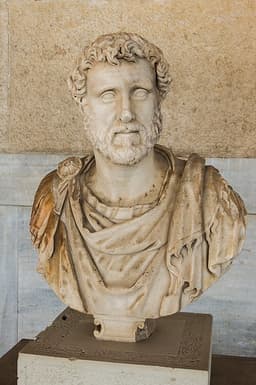
Antoninus Pius
Emperor · Ancient
53.5Total

Di Xin of Shang
Emperor · Ancient
44.7Total
Basic Information
Born
86
-1050
Died
161
-1046
Era
Ancient
Ancient
Nationality
Roman Empire
Shang China
Occupation
Emperor
Emperor
Civilization
Western
Eastern
Score Comparison
Military (10%)
21.2
45.0
Political (20%)
70.0
27.9
Influence (20%)
54.9
51.8
Legacy (20%)
47.5
52.0
Leadership (15%)
78.0
38.1
Strategy (15%)
35.7
43.7
TOTAL
53.5
44.7
Antoninus Pius — Complete Timeline
132 AD
Suppression of the Jewish RevoltWar
Antoninus Pius, as governor of Asia, was involved in suppressing the Bar Kokhba revolt in Judea. The revolt was crushed with heavy casualties, and Jews were expelled from Jerusalem. This event occurred before his accession to the throne.
Jewish RevoltSuppressionJudea
Impact: regionaldestructive
138 AD
Reign of Peace and ProsperityPolitical Action◆ Major
Antoninus Pius became Roman emperor upon the death of Hadrian. His reign was characterized by internal stability, legal reforms, and economic prosperity, with no major military campaigns. He maintained the borders through diplomacy and client kingdoms.
Pax RomanaStabilityGood Emperor
Impact: globalconstructive
Adoption of Marcus Aurelius and Lucius VerusPolitical Action◆ Major
Following Hadrian's death, Antoninus Pius adopted Marcus Aurelius and Lucius Verus as his sons and heirs, as required by Hadrian's will. This ensured a smooth succession and continued the system of adoptive emperors.
SuccessionAdoptionDynasty
Impact: globalconstructive
142 AD
Construction of the Antonine WallOther◆ Major
Antoninus Pius ordered the construction of a turf and stone fortification across the narrowest part of Scotland, north of Hadrian's Wall. The wall marked the northernmost boundary of the Roman Empire in Britain and was manned for about 20 years before being abandoned.
FrontierFortificationBritain
Impact: regional
Di Xin of Shang — Complete Timeline
1050 BC
Construction of the Wine Pool and Meat ForestCultural
Di Xin allegedly built a pool filled with wine and hung meat in trees, creating a 'wine pool and meat forest' for extravagant orgies. This story, recorded in later texts, exemplifies his reputation as a decadent tyrant.
DecadenceLegendTyranny
Impact: nationaldestructive
Imprisonment of King Wen of ZhouPolitical Action◆ Major
Di Xin imprisoned King Wen of Zhou at Youli, a Shang prison. During his captivity, King Wen is said to have studied the I Ching. Di Xin later released him after receiving tribute, a decision that allowed Zhou to continue its rise.
ImprisonmentZhou RisePolitical Mistake
Impact: regional
1046 BC
Battle of MuyeWar
Di Xin's Shang army was defeated by King Wu of Zhou at the Battle of Muye. The Shang forces, including slave soldiers who defected, were routed. This battle ended the Shang dynasty and established Zhou rule over China.
BattleDynastic ChangeShang Defeat
Impact: globaltragic
Self-immolation at Deer Terrace PavilionOther◆ Major
After the defeat at Muye, Di Xin retreated to the Deer Terrace Pavilion, adorned himself with jade, and set the building on fire, burning himself to death. This act became a symbol of his tyranny and the Shang dynasty's fall.
DeathTyrannyDynastic Fall
Impact: nationaltragic
Expert Analysis
Origins
Antoninus Pius was born in 86 AD near Lanuvium, Italy, into a wealthy senatorial family. His father, Titus Aurelius Fulvus, was a consul, and his mother was Arria Fadilla. He received a thorough education in rhetoric and law, which prepared him for a career in public service. His early career included serving as quaestor, praetor, and consul, and he gained a reputation for integrity and administrative competence.
Di Xin, also known as King Zhou, was born around 1105 BC as the last ruler of the Shang dynasty in China. He was the son of King Di Yi and inherited the throne at a young age. Traditional accounts describe him as intelligent and physically strong but arrogant and cruel. His upbringing in the royal palace exposed him to the excesses of the court.
Rise to Power
Antoninus Pius rose through the ranks of Roman administration, serving as governor of Asia and proconsul. His big break came when Emperor Hadrian adopted him as his successor in 138 AD, on condition that Antoninus adopt Marcus Aurelius and Lucius Verus. Upon Hadrian's death, Antoninus became emperor, ensuring a smooth transition. His reign began with the deification of Hadrian, which he pushed through the Senate despite opposition.
Di Xin became king after his father's death around 1075 BC. He inherited a stable Shang kingdom but faced increasing threats from neighboring tribes and the rising Zhou state. His rise was marked by consolidation of power, often through harsh measures. He appointed loyalists to key positions but alienated many nobles with his tyrannical behavior.
Leadership & Governance
Antoninus Pius is often called the "peaceful emperor" because his reign (138-161 AD) was marked by internal stability and few military conflicts. He governed with a light hand, respecting the Senate and maintaining existing laws. He focused on legal reforms, improving provincial administration, and public works. For example, he built the Antonine Wall in Scotland, but it was more a symbol of frontier control than aggressive expansion. His political score of 70.0 reflects his effective governance.
Di Xin's leadership was autocratic and self-indulgent. He centralized power, ignored traditional rituals, and imposed heavy taxes to fund his palaces and entertainments. His leadership score is 38.1, indicating poor governance. He allegedly created a "wine pool and meat forest" for orgies, alienating the nobility and commoners. He also imprisoned King Wen of Zhou, a popular leader, which fueled rebellion.
Triumph & Tragedy
Antoninus Pius's greatest triumph was maintaining peace and prosperity for 23 years. The Roman economy flourished, and he left the treasury with a surplus. His adoption of Marcus Aurelius and Lucius Verus ensured a stable succession. His tragedy was the lack of significant military glory, which later historians sometimes viewed as passive. However, his reign was a golden age for many Romans.
Di Xin's triumph was his early success in expanding Shang territory and suppressing rebellions. He had a military score of 45.0, showing some capability. But his tragedy was his downfall: the Battle of Muye in 1046 BC, where his army defected, leading to his suicide by self-immolation at Deer Terrace Pavilion. His tyranny caused the end of the Shang dynasty after 500 years.
Character & Destiny
Antoninus Pius was known for his calm, just, and diplomatic character. He avoided unnecessary conflicts and prioritized the welfare of the empire. His destiny was to be a caretaker ruler who stabilized Rome after Hadrian's reign. Historical assessments praise his mildness and foresight.
Di Xin's character, as portrayed by Zhou sources, was cruel, lustful, and arrogant. He ignored advice and indulged in excess. His destiny was to be overthrown and demonized. However, some modern scholars suggest that accounts of his tyranny may be exaggerated by the victorious Zhou to legitimize their rule.
Legacy
Antoninus Pius's legacy is as a model of peaceful, efficient governance. He is remembered as one of the "Five Good Emperors" and his reign set a standard for Roman leadership. The Antonine Wall remains a UNESCO World Heritage site. His political score of 70.0 and leadership score of 78.0 reflect his enduring impact.
Di Xin's legacy is as a cautionary tale of tyranny. He is often cited as a symbol of decadence and misrule in Chinese history. The Zhou dynasty used his example to justify their rebellion. His influence score of 51.8 shows that his story persisted, but his legacy is overwhelmingly negative. The Shang dynasty's fall led to the Zhou's feudal system.
Conclusion
Antoninus Pius had a greater impact on history with a total score of 53.5 versus Di Xin's 44.7. Pius maintained stability and prosperity for Rome, while Di Xin's misrule ended the Shang dynasty. Pius's governance ensured long-term peace, whereas Di Xin's reign led to chaos and regime change. Although Di Xin's story influenced Chinese political thought, Pius's practical achievements outweigh the legendary cautionary tale. The score gap of 8.8 points reflects the difference in effective leadership and lasting positive legacy.
Rankings
🥇
Antoninus PiusLeader
Mil: 21.2Pol: 70.0Inf: 54.9
53.5
🥈
Di Xin of Shang
Mil: 45.0Pol: 27.9Inf: 51.8
44.7
+8.8 behind
How This Comparison Works
Algorithm
Each figure is scored on 6 dimensions (0—100 scale) based on structured historical data: Military (10%), Political (20%), Influence (20%), Legacy (20%), Leadership (15%), Strategy (15%). The weighted total produces the final ranking.
Data Sources
Scores are computed from structured sub-indicators in the database. Scale factors adjust for era (Ancient ×0.85, Modern ×1.0) and civilization size (Eastern ×1.05, Other ×0.80) to account for differences in population and military scale.
Maximum 3 Figures
Comparisons are limited to 2—3 figures to ensure readability and statistical meaningfulness.
Error Margins
±5 points per dimension — Sub-scores are derived from historical records with inherent uncertainty. Two figures within 5 points on a dimension should be considered roughly equivalent in that area.
Total Score Accuracy
±3 points overall — The weighted combination of 6 dimensions produces a total score with approximately ±3 points of uncertainty. Differences of less than 3 points are not statistically significant— the figures are effectively tied.
Known Limitations
- Historical records are incomplete and uneven across civilizations
- Figures from oral-tradition societies may be underrepresented
- Occupation labels can misclassify multi-role figures
- Scores measure capability and impact, not moral character
- Quantitative scoring is a comparison tool, not absolute truth
Capability Radar
Military (10%) — Battles & Warfare
Battles
5
30
Win Rate
10
20
Expansion
5
15
Political (20%) — Governance & Reform
Reform
70
10
Diplomacy
85
15
Economy
80
20
Influence (20%) — Cultural & Global Reach
Cultural
50
40
Global
40
30
Legacy (20%) — Historical Impact
Historical
55
60
Longevity
50
70
Leadership (15%) — Power & Stability
Tenure
85
40
Stability
95
5
Strategy (15%) — Tactics & Innovation
Strategy
15
20
Tactics
10
25
Reform
20
10
Similar Comparisons
Comments & Discussion
No comments yet. Be the first to share your thoughts!