Loading...
Antoninus Pius vs Julius Caesar
Julius Caesar leads by 29.3 pts · 2 figures compared
…
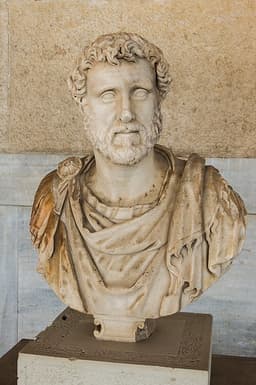
Antoninus Pius
Emperor · Ancient
53.5Total

Julius Caesar
General · Ancient
82.8Total
Basic Information
Born
86
-100
Died
161
-44
Era
Ancient
Ancient
Nationality
Roman Empire
Roman Republic
Occupation
Emperor
General
Civilization
Western
Western
Score Comparison
Military (10%)
21.2
88.0
Political (20%)
70.0
78.0
Influence (20%)
54.9
85.0
Legacy (20%)
47.5
82.0
Leadership (15%)
78.0
80.0
Strategy (15%)
35.7
85.0
TOTAL
53.5
82.8
Antoninus Pius — Complete Timeline
132 AD
Suppression of the Jewish RevoltWar
Antoninus Pius, as governor of Asia, was involved in suppressing the Bar Kokhba revolt in Judea. The revolt was crushed with heavy casualties, and Jews were expelled from Jerusalem. This event occurred before his accession to the throne.
Jewish RevoltSuppressionJudea
Impact: regionaldestructive
138 AD
Reign of Peace and ProsperityPolitical Action◆ Major
Antoninus Pius became Roman emperor upon the death of Hadrian. His reign was characterized by internal stability, legal reforms, and economic prosperity, with no major military campaigns. He maintained the borders through diplomacy and client kingdoms.
Pax RomanaStabilityGood Emperor
Impact: globalconstructive
Adoption of Marcus Aurelius and Lucius VerusPolitical Action◆ Major
Following Hadrian's death, Antoninus Pius adopted Marcus Aurelius and Lucius Verus as his sons and heirs, as required by Hadrian's will. This ensured a smooth succession and continued the system of adoptive emperors.
SuccessionAdoptionDynasty
Impact: globalconstructive
142 AD
Construction of the Antonine WallOther◆ Major
Antoninus Pius ordered the construction of a turf and stone fortification across the narrowest part of Scotland, north of Hadrian's Wall. The wall marked the northernmost boundary of the Roman Empire in Britain and was manned for about 20 years before being abandoned.
FrontierFortificationBritain
Impact: regional
Julius Caesar — Complete Timeline
58 BC
Gallic WarsWar◆ Major
Caesar, as proconsul of Gaul, launched a series of campaigns that conquered all of Gaul (modern France, Belgium, and parts of Switzerland). He fought numerous battles, including against the Helvetii, the Belgae, and the Gallic chieftain Vercingetorix. The wars brought immense wealth and a loyal army to Caesar.
Gallic WarsConquestRoman Expansion
Impact: regional
49 BC
Crossing the RubiconPolitical Action◆ Major
Caesar led Legio XIII across the Rubicon River into Italy, defying the Roman Senate's order to disband his army. This act triggered a civil war against Pompey and the Optimates, ultimately leading to Caesar's dictatorship and the end of the Roman Republic.
Roman Civil WarEnd of RepublicPower Struggle
Impact: global
48 BC
Battle of PharsalusWar◆ Major
Caesar's outnumbered army defeated the larger forces of Pompey the Great at Pharsalus in Greece. Caesar's tactical use of a reserve line to counter Pompey's cavalry charge proved decisive. Pompey fled to Egypt, where he was assassinated, leaving Caesar as the undisputed master of the Roman world.
Roman Civil WarBattleDecisive Victory
Impact: regional
44 BC
Appointment as Dictator for LifePolitical Action◆ Major
The Roman Senate appointed Caesar dictator perpetuo (dictator for life), granting him unprecedented personal power. This move concentrated military, legislative, and judicial authority in one person, effectively ending the Roman Republic's traditional system of checks and balances and alarming many senators.
DictatorshipEnd of RepublicPower Consolidation
Impact: regionaldestructive
Assassination on the Ides of MarchPolitical Action◆ Major
A group of Roman senators, led by Marcus Junius Brutus and Gaius Cassius Longinus, stabbed Caesar to death at a meeting of the Senate in the Theatre of Pompey. The assassination was intended to restore the Republic, but instead triggered another civil war that led to the rise of the Roman Empire.
AssassinationRoman PoliticsEnd of Republic
Impact: globaldestructive
Expert Analysis
antoninus-pius-vs-julius-caesar
# The Peaceful Emperor and the Conquering General: Antoninus Pius and Julius Caesar
On a March morning in 44 BCE, the most powerful man in the Roman world bled to death on the floor of the Senate chamber, stabbed sixty times by men he had once called friends. Julius Caesar, dictator for life, had conquered Gaul, defeated his rivals in civil war, and transformed the Republic into something that looked very much like a monarchy. His death would not restore the old order—it would drown Rome in more blood, until his adopted heir, Octavian, finally ended the chaos and became Augustus, the first emperor.
Nearly two centuries later, another Roman ruler died peacefully in his bed at his villa in Lorium, outside Rome. Antoninus Pius had reigned for twenty-three years, the longest uninterrupted rule since Augustus himself. He had never commanded an army in battle, never crossed a forbidden river, never faced a conspiracy of assassins. His reign was so tranquil that historians would struggle to find anything dramatic to say about it—and that, paradoxically, became his greatest achievement.
What explains the gulf between these two men, both rulers of Rome, yet so different in character and fate? The answer lies not in their era alone, but in the very nature of power itself.
Origins
Julius Caesar was born into the chaos of a dying republic. In 100 BCE, Rome was a city of violent political factions, where ambitious men could rise by military glory, bribery, or sheer audacity. Caesar’s family, the Julii, claimed descent from the goddess Venus, but they were not among the wealthiest patricians. His father died when Caesar was sixteen, leaving him to navigate a world where the old rules were crumbling. He learned early that in Rome, reputation was currency—and that nothing built reputation like conquest.
Antoninus Pius, born in 86 CE, entered a very different world. The empire was stable under Hadrian, the fifth of the so-called Five Good Emperors. His family came from the provincial nobility of Gaul, but they were senators, not soldiers. Antoninus never commanded a legion before becoming emperor. He was a governor, an administrator, a man of law and order. The Roman world no longer rewarded the conqueror; it rewarded the caretaker.
Rise to Power
Caesar’s path was forged in blood and ambition. As a young man, he was captured by pirates—and famously told them he would return to crucify them, which he did. He climbed the political ladder through the traditional offices, but his real breakthrough came when he secured command of Gaul in 58 BCE. Over eight years, he conquered a vast territory, built a loyal army, and amassed enough wealth to buy the loyalty of Rome itself. When the Senate ordered him to disband his army, he instead crossed the Rubicon River into Italy, triggering a civil war. By 45 BCE, he was master of Rome.
Antoninus Pius rose in a gentler manner. He served as governor of Asia, where he suppressed the Bar Kokhba revolt in Judea in 132 CE—a brutal campaign, but one he executed as a subordinate, not a commander. When Hadrian died in 138 CE, the emperor had already chosen Antoninus as his successor, on the condition that he adopt Marcus Aurelius and Lucius Verus as his heirs. Antoninus accepted. There was no civil war, no crossing of rivers, no Senate in terror. Power simply passed to him, as it was meant to.
Leadership & Governance
Caesar governed as a revolutionary. He reformed the calendar, granted citizenship to provincials, initiated public works, and centralized authority in his own hands. He was a military genius of the first order—his siege of Alesia, where he defeated a Gallic army three times the size of his own, remains a masterpiece of strategy. But his political wisdom was flawed. He pardoned his enemies, only to be murdered by them. He accepted the title of dictator for life, a flagrant violation of republican tradition, and seemed indifferent to the resentment it bred. His reforms were bold, but his arrogance was fatal.
Antoninus Pius governed as a conservator. He built the Antonine Wall across Scotland, but he did not seek to conquer the whole island. He reformed Roman law, improved provincial administration, and maintained peace through diplomacy rather than war. His leadership score of 81.0 reflects a ruler who understood that the empire’s greatest strength was not its legions but its stability. He did not need to be a military hero because the empire no longer demanded one. His strategy score of 45.6 suggests he was no great general—but he did not need to be. The empire was at peace, and he kept it that way.
Triumph & Tragedy
Caesar’s greatest triumph was the conquest of Gaul, which doubled Rome’s territory and filled its treasury. His greatest tragedy was his assassination on the Ides of March, 44 BCE, at the height of his power. He had achieved everything a Roman could dream of—and it cost him his life.
Antoninus Pius had no such dramatic triumphs. His reign was a long, quiet success. The tragedy, if it can be called that, is that he is largely forgotten. His influence score of 74.0 and legacy of 66.7 place him far below Caesar, yet he ruled longer and died naturally. History remembers the conqueror, not the caretaker.
Character & Destiny
Caesar was driven by an insatiable ambition. He believed in his own destiny, and he was right—but his belief made him reckless. He once said, “It is easier to find men who will volunteer to die than to find those who are willing to endure pain with patience.” He could endure pain, but not patience. His personality shaped his decisions, and his decisions shaped history. He chose glory over safety, and paid the price.
Antoninus Pius was a man of duty. He accepted the throne as a responsibility, not a prize. He was patient, prudent, and pious—hence his name. He understood that the empire needed a steady hand, not a brilliant one. His personality led him to preserve, not to conquer. And he died in bed.
Legacy
Caesar’s legacy is immeasurable. His military campaigns and political reforms paved the way for the Roman Empire. His name became synonymous with imperial power—kaiser, tsar, Caesar. His writings, especially the *Commentaries on the Gallic War*, remain classics of military literature. His total score of 83.3 reflects a figure who changed the world.
Antoninus Pius left a quieter legacy. He is remembered as one of the Five Good Emperors, a model of stable, lawful rule. His reign was a golden age for Rome, but golden ages are often invisible to those who live in them. His total score of 66.0 reflects a competent ruler, not a transformative one.
Conclusion
Standing on the Antonine Wall today, a few scattered stones in the Scottish grass, one might think of the emperor who ordered it built. It was a frontier, a limit, a statement that Rome would go no further. Antoninus Pius understood that sometimes the greatest victory is knowing when not to fight.
And standing at the foot of the Capitoline Hill in Rome, where Caesar’s blood once stained the Senate floor, one might think of the general who crossed the Rubicon. He understood that sometimes the only way to save a republic is to destroy it.
Two rulers, two destinies. One died by the sword. One died in his sleep. Both were Romans. The difference was not in their ambition, but in their world. Caesar lived in a time that demanded a conqueror. Antoninus lived in a time that demanded a caretaker. History gave each what he needed—and took from each what he was unwilling to give.
Rankings
🥇
Julius CaesarLeader
Mil: 88.0Pol: 78.0Inf: 85.0
82.8
🥈
Antoninus Pius
Mil: 21.2Pol: 70.0Inf: 54.9
53.5
+29.3 behind
How This Comparison Works
Algorithm
Each figure is scored on 6 dimensions (0—100 scale) based on structured historical data: Military (10%), Political (20%), Influence (20%), Legacy (20%), Leadership (15%), Strategy (15%). The weighted total produces the final ranking.
Data Sources
Scores are computed from structured sub-indicators in the database. Scale factors adjust for era (Ancient ×0.85, Modern ×1.0) and civilization size (Eastern ×1.05, Other ×0.80) to account for differences in population and military scale.
Maximum 3 Figures
Comparisons are limited to 2—3 figures to ensure readability and statistical meaningfulness.
Error Margins
±5 points per dimension — Sub-scores are derived from historical records with inherent uncertainty. Two figures within 5 points on a dimension should be considered roughly equivalent in that area.
Total Score Accuracy
±3 points overall — The weighted combination of 6 dimensions produces a total score with approximately ±3 points of uncertainty. Differences of less than 3 points are not statistically significant— the figures are effectively tied.
Known Limitations
- Historical records are incomplete and uneven across civilizations
- Figures from oral-tradition societies may be underrepresented
- Occupation labels can misclassify multi-role figures
- Scores measure capability and impact, not moral character
- Quantitative scoring is a comparison tool, not absolute truth
Capability Radar
Military (10%) — Battles & Warfare
Battles
5
95
Win Rate
10
92
Expansion
5
97
Political (20%) — Governance & Reform
Reform
70
90
Diplomacy
85
85
Economy
80
82
Influence (20%) — Cultural & Global Reach
Cultural
50
88
Global
40
94
Legacy (20%) — Historical Impact
Historical
55
95
Longevity
50
96
Leadership (15%) — Power & Stability
Tenure
85
75
Stability
95
60
Strategy (15%) — Tactics & Innovation
Strategy
15
94
Tactics
10
96
Reform
20
88
Similar Comparisons
Comments & Discussion
QUAESTOR-TURNED-CYNIC6/17/2026
Caesar's blood still stains the Senate floor because he fundamentally misunderstood Rome’s core institution. You can't "reform" a system by making yourself king in all but name while keeping the Senate around as window dressing. Antoninus understood that power is often best exercised when it's barely visible. His twenty-three years of peaceful rule proved that a boring emperor is a good emperor. Give me the quiet administrator who never needed a Rubicon over the brilliant general who made Rome h
战象饲养员6/17/2026
说实话,把安东尼努斯和平和凯撒放一起比就是纯粹的历史流量密码。凯撒一辈子打了多少仗?高卢战争杀了上百万人,征服了三百个部落。安东尼努斯呢?连敌人是谁都说不清楚。但问题在于:凯撒的征服给罗马带来了真正的财富和领土,安东尼努斯的和平只是在吃奥古斯都王朝的老本。没有凯撒的刀剑,哪来的安东尼努斯的岁月静好?|
THE-BREAD-CIRCUS-MAN6/17/2026
Let's be real: Antoninus Pius is the most overrated emperor in Roman history. His "peaceful reign" was just riding the coattails of Hadrian's defensive fortifications and Trajan's conquests. Meanwhile, the man literally never left Italy in twenty-three years. What kind of emperor doesn't visit his provinces? Caesar crossed the Rubicon, invaded Britain, fought in Gaul, Egypt, and Asia Minor. One man wrote history; the other just filled a seat in the palace.|
史海钩沉6/17/2026
数据不会骗人:凯撒统治不到五年,颁布了土地改革法、债务减免法,启动了日历改革,制定了新的殖民政策。安东尼努斯在位二十三年,除了修了几条路、建了几座庙,史书里几乎找不出什么实质性政绩。前者在短暂的权力巅峰期改变了罗马的基因,后者把二十三年活成了一天。比勤勉?比胆识?比变革的决心?我就不说谁赢了,你自己看着办。|
THE-SENATE'S-GHOST6/17/2026
Caesar's assassination was the predictable end of a man who thought his charisma and legions could overwrite a thousand years of constitutional precedent. Antoninus Pius, on the other hand, had the rare wisdom to treat the Senate as partners rather than punching bags. He consulted them on legislation, respected their privileges, and in return, they gave him stability. You want to know why one died in bed and the other on the floor? It's not about luck—it's about understanding that Rome's soul wa