Loading...
Arduin of Ivrea vs Mansa Uli
Mansa Uli leads by 8.4 pts · 2 figures compared
…
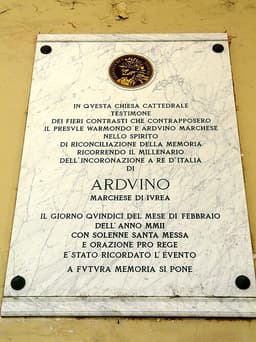
Arduin of Ivrea
Emperor · Medieval
41.9Total

Mansa Uli
Emperor · Medieval
50.3Total
Basic Information
Born
955
1250
Died
1015
1270
Era
Medieval
Medieval
Nationality
Italy
Mali Empire
Occupation
Emperor
Emperor
Civilization
Western
Other
Score Comparison
Military (10%)
50.0
40.0
Political (20%)
33.6
43.7
Influence (20%)
47.1
56.4
Legacy (20%)
35.8
45.0
Leadership (15%)
49.9
65.7
Strategy (15%)
36.8
45.0
TOTAL
41.9
50.3
Arduin of Ivrea — Complete Timeline
1002 AD
Proclaimed King of ItalyPolitical Action◆ Major
After the death of Emperor Otto III, Arduin of Ivrea was proclaimed King of Italy by the Lombard nobility in Pavia. This act challenged the authority of the German king Henry II, who claimed the Italian throne.
CoronationItalyRivalry
Impact: regional
1004 AD
Defeated by Henry II at the Battle of the Po RiverWar◆ Major
Arduin was defeated by Henry II's forces near the Po River. This military loss forced Arduin to retreat to his margraviate of Ivrea, effectively ending his claim to the Italian throne and allowing Henry II to be crowned King of Italy.
BattleHenry IIDefeat
Impact: regionaltragic
1014 AD
Excommunication by Pope Benedict VIIIPolitical Action
Arduin was excommunicated by Pope Benedict VIII for his continued resistance against Henry II. This ecclesiastical condemnation isolated Arduin politically and religiously, contributing to his eventual surrender and retirement.
ExcommunicationPapacyConflict
Impact: regionaldestructive
1015 AD
Retirement to a MonasteryOther
After years of failed resistance, Arduin retired to the Abbey of Fruttuaria, where he died as a monk. His retirement marked the end of the last major Italian challenge to German rule in the early 11th century.
RetirementItalyEnd of Resistance
Impact: regional
Mansa Uli — Complete Timeline
1255 AD
Expanded Mali Empire's territoryWar◆ Major
Mansa Uli continued the expansion of the Mali Empire begun by his father Sundiata Keita. He conquered additional territories in the Senegal River valley and the Gambia region, consolidating Mali's control over trans-Saharan trade routes.
ConquestEmpire building
Impact: regionalconstructive
Reign as Mansa of MaliPolitical Action◆ Major
Mansa Uli succeeded his father Sundiata Keita as the second mansa of the Mali Empire. His reign was marked by stability, economic growth, and the continuation of Sundiata's policies. He ruled for approximately 15 years until his death.
SuccessionRule
Impact: regionalconstructive
1260 AD
Performed the first Hajj by a Mali mansaCultural◆ Major
Mansa Uli (Wali) became the first Mali emperor to perform the Hajj pilgrimage to Mecca. His journey demonstrated Mali's wealth and Islamic piety, strengthening diplomatic and trade ties with North Africa and the Middle East.
PilgrimageIslamDiplomacy
Impact: regionalconstructive
Expert Analysis
Origins
Arduin of Ivrea was born around 955 into the powerful House of Ivrea in the Kingdom of Italy. His father, Dado, was count of Pombia, and his family had a history of opposing the Ottonian dynasty. Arduin inherited the March of Ivrea, a strategic territory in northwestern Italy, and was educated in the martial traditions of the Lombard nobility. His early life was shaped by the ongoing struggle between local Italian lords and the German emperors who claimed authority over Italy.
Mansa Uli (also known as Wali) was born in the early 13th century in the Mali Empire, the son of Sundiata Keita, the legendary founder of the empire. His exact birth year is uncertain, but he grew up in a period of rapid expansion and consolidation following Sundiata's victory at the Battle of Kirina (c. 1235). Uli was raised in the royal court, learning the arts of governance, warfare, and Islamic scholarship. His family's lineage traced back to the Keita dynasty, which claimed descent from the Prophet Muhammad's companion Bilal ibn Rabah.
Rise to Power
Arduin became Margrave of Ivrea in 990 upon his father's death. He quickly positioned himself as a leader of the Italian opposition to Emperor Otto III. After Otto III's death in 1002, the Lombard nobility, seeking to reassert Italian independence, proclaimed Arduin King of Italy in Pavia. This move challenged the German claim to the Italian throne and set the stage for conflict with Otto's successor, Henry II. Arduin's rise was swift but fragile, relying on the support of local lords who were wary of German dominance.
Mansa Uli succeeded his father Sundiata as mansa (emperor) of Mali around 1255. Sundiata had unified the Malinke people and conquered key trading cities like Ghana and Timbuktu. Uli inherited a stable, expanding empire and continued his father's policies. He consolidated control over the Senegal River valley and pushed the empire's borders westward. His rise was smooth due to the strong foundation laid by Sundiata and the loyalty of the imperial army.
Leadership & Governance
Arduin's leadership was characterized by defiance and localism. He relied on the support of Lombard nobles but failed to build a centralized administration. His governance was reactive, focusing on resisting Henry II rather than developing institutions. For example, after his defeat at the Battle of the Po River in 1004, he retreated to Ivrea and engaged in guerrilla warfare. He did not issue charters or reforms that endured. His political score of 33.6 reflects his inability to forge lasting alliances or govern effectively.
Mansa Uli's leadership was more strategic and institutional. He continued Sundiata's system of dividing the empire into provinces ruled by trusted generals and governors. He promoted Islam as a unifying force, building mosques and fostering trade with North Africa. His political score of 43.7 indicates a better grasp of statecraft. Uli's most notable act was performing the Hajj to Mecca, which demonstrated Mali's wealth and Islamic piety. This pilgrimage strengthened ties with the Muslim world and enhanced Mali's prestige. His leadership score of 65.7 highlights his ability to maintain stability and promote economic growth.
Triumph & Tragedy
Arduin's greatest triumph was being crowned King of Italy in 1002, a symbolic victory against German domination. However, his failure to secure his throne was his tragedy. He was defeated by Henry II in 1004 and excommunicated by Pope Benedict VIII in 1014. His retreat to the Abbey of Fruttuaria, where he died as a monk around 1015, marked the end of his ambitions. His military score of 50.0 and strategy score of 36.8 show he was a capable fighter but poor strategist.
Mansa Uli's greatest triumph was his Hajj, which established Mali as a major Islamic power. He also expanded the empire, securing trade routes and resources. His tragedy is that his reign is poorly documented, and his achievements are overshadowed by his father Sundiata and later Mansa Musa. Nonetheless, his legacy score of 45.0 reflects his role in consolidating the empire. His military score of 40.0 is lower, but his leadership score of 65.7 suggests he was an effective administrator.
Character & Destiny
Arduin was stubborn and proud, unwilling to compromise with Henry II. His character led him to resist even when defeat was inevitable. His excommunication isolated him politically, and his retreat to a monastery shows a man who accepted his fate after years of struggle. Historians view him as a last gasp of Italian independence before German dominance solidified.
Mansa Uli was pious and pragmatic. His Hajj demonstrates personal devotion, while his expansionist policies show a strategic mind. He was less warlike than his father but effective in maintaining control. His destiny was to be a transitional figure, bridging Sundiata's conquests and Musa's golden age. His character allowed him to build on success rather than fight against odds.
Legacy
Arduin's legacy is minimal. He is remembered as a failed king who could not withstand the German emperors. His revolt did not lead to lasting Italian independence, and his name is obscure outside specialist literature. His legacy score of 35.8 is the lowest among key figures of his era. He had no long-term impact on Italian politics.
Mansa Uli's legacy is more substantial. He solidified the Mali Empire's borders and set a precedent for Islamic piety among its rulers. His Hajj paved the way for Mansa Musa's famous pilgrimage. The empire's stability during his reign allowed for economic growth that benefited later rulers. His influence score of 56.4 is significantly higher than Arduin's 47.1. He is remembered as a capable mansa who continued his father's work.
Conclusion
Mansa Uli had greater impact than Arduin of Ivrea. Uli's total score of 50.3 exceeds Arduin's 41.9 by 8.4 points. While Arduin's resistance was notable, it failed to change the course of Italian history. Uli, by contrast, strengthened an empire that would dominate West Africa for centuries. His Hajj and administrative consolidation left a lasting legacy. Arduin's story is one of failure; Uli's is one of successful stewardship. Therefore, Mansa Uli is the more significant historical figure.
Rankings
🥇
Mansa UliLeader
Mil: 40.0Pol: 43.7Inf: 56.4
50.3
🥈
Arduin of Ivrea
Mil: 50.0Pol: 33.6Inf: 47.1
41.9
+8.4 behind
How This Comparison Works
Algorithm
Each figure is scored on 6 dimensions (0—100 scale) based on structured historical data: Military (10%), Political (20%), Influence (20%), Legacy (20%), Leadership (15%), Strategy (15%). The weighted total produces the final ranking.
Data Sources
Scores are computed from structured sub-indicators in the database. Scale factors adjust for era (Ancient ×0.85, Modern ×1.0) and civilization size (Eastern ×1.05, Other ×0.80) to account for differences in population and military scale.
Maximum 3 Figures
Comparisons are limited to 2—3 figures to ensure readability and statistical meaningfulness.
Error Margins
±5 points per dimension — Sub-scores are derived from historical records with inherent uncertainty. Two figures within 5 points on a dimension should be considered roughly equivalent in that area.
Total Score Accuracy
±3 points overall — The weighted combination of 6 dimensions produces a total score with approximately ±3 points of uncertainty. Differences of less than 3 points are not statistically significant— the figures are effectively tied.
Known Limitations
- Historical records are incomplete and uneven across civilizations
- Figures from oral-tradition societies may be underrepresented
- Occupation labels can misclassify multi-role figures
- Scores measure capability and impact, not moral character
- Quantitative scoring is a comparison tool, not absolute truth
Capability Radar
Military (10%) — Battles & Warfare
Battles
15
30
Win Rate
20
40
Expansion
10
40
Political (20%) — Governance & Reform
Reform
5
30
Diplomacy
15
50
Economy
5
40
Influence (20%) — Cultural & Global Reach
Cultural
5
45
Global
5
35
Legacy (20%) — Historical Impact
Historical
10
40
Longevity
5
30
Leadership (15%) — Power & Stability
Tenure
10
40
Stability
5
45
Strategy (15%) — Tactics & Innovation
Strategy
10
35
Tactics
15
30
Reform
5
20
Similar Comparisons
Comments & Discussion
No comments yet. Be the first to share your thoughts!