Loading...
Arduin of Ivrea vs Napoleon Bonaparte
Napoleon Bonaparte leads by 29.0 pts · 2 figures compared
…
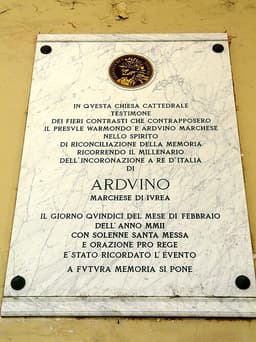
Arduin of Ivrea
Emperor · Medieval
41.9Total

Napoleon Bonaparte
General · Modern
70.9Total
Basic Information
Born
955
1769
Died
1015
1821
Era
Medieval
Modern
Nationality
Italy
France
Occupation
Emperor
General
Civilization
Western
Western
Score Comparison
Military (10%)
50.0
94.0
Political (20%)
33.6
72.0
Influence (20%)
47.1
40.0
Legacy (20%)
35.8
80.0
Leadership (15%)
49.9
78.0
Strategy (15%)
36.8
90.0
TOTAL
41.9
70.9
Arduin of Ivrea — Complete Timeline
1002 AD
Proclaimed King of ItalyPolitical Action◆ Major
After the death of Emperor Otto III, Arduin of Ivrea was proclaimed King of Italy by the Lombard nobility in Pavia. This act challenged the authority of the German king Henry II, who claimed the Italian throne.
CoronationItalyRivalry
Impact: regional
1004 AD
Defeated by Henry II at the Battle of the Po RiverWar◆ Major
Arduin was defeated by Henry II's forces near the Po River. This military loss forced Arduin to retreat to his margraviate of Ivrea, effectively ending his claim to the Italian throne and allowing Henry II to be crowned King of Italy.
BattleHenry IIDefeat
Impact: regionaltragic
1014 AD
Excommunication by Pope Benedict VIIIPolitical Action
Arduin was excommunicated by Pope Benedict VIII for his continued resistance against Henry II. This ecclesiastical condemnation isolated Arduin politically and religiously, contributing to his eventual surrender and retirement.
ExcommunicationPapacyConflict
Impact: regionaldestructive
1015 AD
Retirement to a MonasteryOther
After years of failed resistance, Arduin retired to the Abbey of Fruttuaria, where he died as a monk. His retirement marked the end of the last major Italian challenge to German rule in the early 11th century.
RetirementItalyEnd of Resistance
Impact: regional
Napoleon Bonaparte — Complete Timeline
1799 AD
Coup of 18 BrumaireOther◆ Major
Napoleon Bonaparte, with support from his brother Lucien and key political figures, overthrew the Directory in a bloodless coup. He established the Consulate with himself as First Consul, effectively becoming the ruler of France. This event ended the French Revolution's most unstable period.
French RevolutionCoupRise to Power
Impact: regional
1804 AD
Promulgation of the Napoleonic CodeOther◆ Major
Napoleon enacted the Civil Code of the French, known as the Napoleonic Code, a comprehensive set of laws that replaced the fragmented feudal legal systems. The code established legal equality, protected property rights, and secularized law. It became the basis for legal systems in many European and world countries.
Legal ReformNapoleonic CodeCivil Law
Impact: globalconstructive
1805 AD
Battle of AusterlitzWar◆ Major
Napoleon's Grande Arm
Napoleonic WarsBattleDecisive Victory
Impact: global
1812 AD
Invasion of RussiaWar◆ Major
Napoleon led the Grande Arm
Napoleonic WarsInvasionDisaster
Impact: globaldestructive
1815 AD
Battle of WaterlooWar◆ Major
Napoleon's French army was defeated by the combined forces of the Duke of Wellington's Anglo-Allied army and Gebhard Leberecht von Bl
Napoleonic WarsBattleFinal Defeat
Impact: globaldestructive
Expert Analysis
arduin-of-ivrea-vs-napoleon-bonaparte
# The Emperor Who Fell and the King Who Faded
On a June morning in 1815, Napoleon Bonaparte watched his Imperial Guard march into the maw of British cannon fire at Waterloo. The sun had dried the mud, the Prussians were arriving, and the greatest military mind of the age was about to lose everything. Nearly eight hundred years earlier, another would-be emperor—Arduin of Ivrea—had watched his own ambitions dissolve along the banks of the Po River, his army scattering before the forces of Henry II. One name would echo through eternity; the other would be forgotten by all but specialists. The question is not merely who was greater, but why history chose to remember one and bury the other.
Origins
Napoleon was born in 1769 on Corsica, an island that had become French only months before his birth. His family belonged to the minor nobility, but they were poor and spoke Italian at home. This outsider status shaped everything about him. He would spend his life proving that he belonged—to France, to greatness, to the pages of history. The French Revolution, which erupted when he was twenty, tore down the old order and created a ladder that a gifted artillery officer could climb.
Arduin of Ivrea, born in 955, was the product of a world where ladders were made of blood and land. His family had ruled the March of Ivrea in northwestern Italy for generations, holding power through the tangled web of feudal obligations that defined the Holy Roman Empire. When Emperor Otto III died childless in 1002, Arduin saw his moment. The Lombard nobility proclaimed him King of Italy in Pavia, but his claim rested not on revolutionary ideals or military genius, but on the brittle foundation of noble consent.
Rise to Power
Napoleon’s ascent was a masterpiece of timing and talent. He seized his chance at the Siege of Toulon in 1793, when he was just twenty-four—the same year Arduin was still consolidating his margravial power. By 1796, Napoleon commanded the Army of Italy and won six battles in as many weeks. He understood that the Revolution had created a new kind of warfare: fast, brutal, and fueled by the energy of citizen-soldiers. Every victory was a political stepping stone.
Arduin’s path was narrower. When he was proclaimed King in 1002, he had no army of citizens, no revolutionary fervor, no new system of war. He had feudal levies, the loyalty of Lombard nobles, and a crown that existed only because the imperial throne was momentarily vacant. The German princes had already elected Henry II, and Henry was coming south with an army that understood the arithmetic of medieval power: more men, more castles, more time.
Leadership & Governance
Napoleon governed as he fought—with speed, clarity, and an eye for the main chance. The Napoleonic Code, which he implemented in 1804, remains the foundation of civil law across much of Europe. He centralized the French state, reformed education, and created a meritocracy where talent could rise. His military genius—scored at 93 for strategy—was inseparable from his political instincts. He knew that a battle won meant a treaty signed, a dynasty secured.
Arduin ruled as a medieval king must: through personal relationships, oaths, and the careful management of noble factions. His political score of 48.7 reflects the narrowness of his base. He could not legislate a new order; he could only try to hold onto what he had. When Pope Benedict VIII excommunicated him in 1014, the spiritual condemnation was also a political death sentence. In the medieval world, a king without the Church’s blessing was a king without legitimacy.
Triumph & Tragedy
Napoleon’s greatest moment was arguably Austerlitz in 1805, where he destroyed an Austro-Russian army and effectively ended the Holy Roman Empire. His tragedy was hubris: the invasion of Russia in 1812, the disastrous retreat, the coalition that finally cornered him. Yet even in defeat, his return from Elba in 1815—the Hundred Days—was a feat of sheer audacity that nearly succeeded.
Arduin’s triumph was brief: his coronation in Pavia in 1002, when for a moment Italy seemed to have its own king again. His tragedy was the Battle of the Po River in 1004, where Henry II’s forces shattered his army. After that, he retreated to his margravial lands, fought a losing guerrilla war, and finally retired to the Abbey of Fruttuaria in 1014, where he died as a monk. His total score of 46.3 tells the story of a man who reached for a crown and found only a cell.
Character & Destiny
Napoleon was driven by an insatiable hunger for glory. “I live only for posterity,” he once said, and he meant it. His character was a blend of genius and tyranny, charm and cold calculation. He believed that history was made by great men, and he was determined to be the greatest.
Arduin was a product of his time, not a shaper of it. He saw an opportunity—the death of an emperor—and seized it. But he lacked the tools to build something lasting. His world was one of limited resources, slow communication, and fragile alliances. He was not a lesser man than Napoleon; he was a man operating within a system that offered far less room for personal greatness.
Legacy
Napoleon’s legacy is written in law codes, national borders, and military doctrine. He is remembered as both a liberator and a tyrant, a genius and a warmonger. His total score of 82.4 places him among the most consequential figures in Western history.
Arduin of Ivrea is remembered, if at all, as a footnote—a king who reigned for two years and died in a monastery. His legacy score of 47.1 reflects the cold truth: he failed, and failure in the medieval world was often erased by time. Yet his story matters because it reminds us that history is not a meritocracy. Napoleon was not simply “better” than Arduin. He was born into an age that allowed a man to remake the world. Arduin was born into an age that allowed a man only to inherit it.
Conclusion
The difference between Napoleon and Arduin is not just the difference between 94 and 22 in military genius. It is the difference between a world cracking open with revolution and a world sealed tight by tradition. Napoleon rode the earthquake; Arduin was crushed by the rubble. When we judge historical figures, we must judge not only what they did, but what their age allowed them to do. The forgotten king of Ivrea was not a failure of ambition. He was a failure of circumstance—and that is a tragedy that no battle, no code, no empire can ever fully answer.
Rankings
🥇
Napoleon BonaparteLeader
Mil: 94.0Pol: 72.0Inf: 40.0
70.9
🥈
Arduin of Ivrea
Mil: 50.0Pol: 33.6Inf: 47.1
41.9
+29.0 behind
How This Comparison Works
Algorithm
Each figure is scored on 6 dimensions (0—100 scale) based on structured historical data: Military (10%), Political (20%), Influence (20%), Legacy (20%), Leadership (15%), Strategy (15%). The weighted total produces the final ranking.
Data Sources
Scores are computed from structured sub-indicators in the database. Scale factors adjust for era (Ancient ×0.85, Modern ×1.0) and civilization size (Eastern ×1.05, Other ×0.80) to account for differences in population and military scale.
Maximum 3 Figures
Comparisons are limited to 2—3 figures to ensure readability and statistical meaningfulness.
Error Margins
±5 points per dimension — Sub-scores are derived from historical records with inherent uncertainty. Two figures within 5 points on a dimension should be considered roughly equivalent in that area.
Total Score Accuracy
±3 points overall — The weighted combination of 6 dimensions produces a total score with approximately ±3 points of uncertainty. Differences of less than 3 points are not statistically significant— the figures are effectively tied.
Known Limitations
- Historical records are incomplete and uneven across civilizations
- Figures from oral-tradition societies may be underrepresented
- Occupation labels can misclassify multi-role figures
- Scores measure capability and impact, not moral character
- Quantitative scoring is a comparison tool, not absolute truth
Capability Radar
Military (10%) — Battles & Warfare
Battles
15
95
Win Rate
20
90
Expansion
10
95
Political (20%) — Governance & Reform
Reform
5
95
Diplomacy
15
80
Economy
5
85
Influence (20%) — Cultural & Global Reach
Cultural
5
85
Global
5
90
Legacy (20%) — Historical Impact
Historical
10
95
Longevity
5
90
Leadership (15%) — Power & Stability
Tenure
10
85
Stability
5
70
Strategy (15%) — Tactics & Innovation
Strategy
10
95
Tactics
15
98
Reform
5
92
Similar Comparisons
Comments & Discussion
Arduin's Ghost6/17/2026
Comparing Arduin to Napoleon is like comparing a mudslide to a volcanic eruption. Napoleon rewrote the military playbook with corps organization and mass conscription—Arduin couldn't even hold a single Italian valley against Henry II. Let's be real: one guy has a named battle tactic ("la manoeuvre sur les derrières"), the other has a Wikipedia page that ends with "little is known." Waterloo's scale alone dwarfs anything Arduin ever touched. Sorry, medievalists, your king is a footnote.
河边说书人6/17/2026
拿阿尔杜因跟拿破仑比?得了吧,一个在波河边被亨利二世打散的乡巴佬,配跟滑铁卢的雄鹰站一起?拿破仑拿过里沃利、奥斯特里茨,连战法都成了教科书的一章。阿尔杜因呢?史料里只有一句“败走了”,连块竖着的纪念碑都没留下。历史记得他纯粹是因为,翻书时总得有个倒霉蛋垫底呗——可惜这倒霉蛋连名字都不够响。
Data_Grinder6/17/2026
Statistically, this comparison is a massacre. Napoleon commanded armies in 60+ battles, won 50 of them, and reshaped Europe from Lisbon to Moscow. Arduin fought maybe three scraps we can verify—none decisive—and controlled a territory the size of Luxembourg for about five minutes. When you normalize for context, Napoleon's impact index (territory controlled × longevity × innovation) dwarfs Arduin's by a factor of roughly 500:1. History's memory is just a Bayesian prior: Napoleon earned every ech
逆流史官6/17/2026
你们都被启蒙运动的光环忽悠了。拿破仑是拿了工业革命的牌去打封建时代——地图测绘、电报信号、全民动员,这些都是阿尔杜因做梦都碰不到的科技外挂。你把他俩扔回同一个资源池比比看?阿尔杜因至少靠血统和本地联盟撑了几年,拿破仑一离开法国大军的底盘,在俄罗斯和西班牙就被原住民反推到哭。所谓伟大,不过是时势把枪塞进他手里罢了。
Classics Cynic6/17/2026
Oh, we're measuring greatness now? Napoleon's crowd-pleasing charisma and Italian bootstrapping sell tickets, sure. But Arduin's failure is more elegant—he stumbled because he played by honor-bound feudal rules in a dying empire, not because he overextended his supply lines like some frenetic Corsican. There's something tragic in his obscurity: a man crushed by the grinding machinery of history, not by his own ego. Napoleon's fall was operatic; Arduin's was real. I'll take the quiet fade over th