Loading...
Ashok Gehlot vs Julius Caesar
Julius Caesar leads by 33.7 pts · 2 figures compared
…
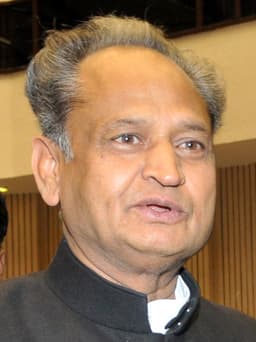
Ashok Gehlot
Politician · Modern
49.1Total

Julius Caesar
General · Ancient
82.8Total
Basic Information
Born
1951
-100
Died
—
-44
Era
Modern
Ancient
Nationality
India
Roman Republic
Occupation
Politician
General
Civilization
Indian
Western
Score Comparison
Military (10%)
43.3
88.0
Political (20%)
68.0
78.0
Influence (20%)
49.4
85.0
Legacy (20%)
40.8
82.0
Leadership (15%)
40.0
80.0
Strategy (15%)
60.0
85.0
TOTAL
49.1
82.8
Ashok Gehlot — Complete Timeline
1998 AD
Became Chief Minister of Rajasthan for the first timePolitical Action◆ Major
Ashok Gehlot was sworn in as the Chief Minister of Rajasthan after leading the Indian National Congress to victory in the state assembly elections. This marked the beginning of his tenure as a three-time CM, overseeing various development and welfare schemes.
Chief MinisterRajasthanCongress
Impact: regionalconstructive
2004 AD
Appointed as Union Minister of TextilesPolitical Action
Gehlot served as the Union Minister of Textiles in the Manmohan Singh government. He oversaw the implementation of the National Textile Policy and initiatives to boost the textile sector, though his tenure was relatively low-profile.
Union MinisterTextilesUPA
Impact: nationalconstructive
2008 AD
Second term as Chief Minister of RajasthanPolitical Action◆ Major
Gehlot returned as Chief Minister after the Congress party won the 2008 Rajasthan assembly elections. His second term focused on education, health, and infrastructure, but also faced challenges like the 2008 financial crisis and drought.
Chief MinisterRajasthanCongress
Impact: regionalconstructive
2018 AD
Third term as Chief Minister of RajasthanPolitical Action◆ Major
Gehlot became Chief Minister for a third time after the Congress won the 2018 Rajasthan elections. His tenure included implementation of welfare schemes like the Chiranjeevi Health Insurance Scheme and faced political challenges from within the party.
Chief MinisterRajasthanCongress
Impact: regionalconstructive
Julius Caesar — Complete Timeline
58 BC
Gallic WarsWar◆ Major
Caesar, as proconsul of Gaul, launched a series of campaigns that conquered all of Gaul (modern France, Belgium, and parts of Switzerland). He fought numerous battles, including against the Helvetii, the Belgae, and the Gallic chieftain Vercingetorix. The wars brought immense wealth and a loyal army to Caesar.
Gallic WarsConquestRoman Expansion
Impact: regional
49 BC
Crossing the RubiconPolitical Action◆ Major
Caesar led Legio XIII across the Rubicon River into Italy, defying the Roman Senate's order to disband his army. This act triggered a civil war against Pompey and the Optimates, ultimately leading to Caesar's dictatorship and the end of the Roman Republic.
Roman Civil WarEnd of RepublicPower Struggle
Impact: global
48 BC
Battle of PharsalusWar◆ Major
Caesar's outnumbered army defeated the larger forces of Pompey the Great at Pharsalus in Greece. Caesar's tactical use of a reserve line to counter Pompey's cavalry charge proved decisive. Pompey fled to Egypt, where he was assassinated, leaving Caesar as the undisputed master of the Roman world.
Roman Civil WarBattleDecisive Victory
Impact: regional
44 BC
Appointment as Dictator for LifePolitical Action◆ Major
The Roman Senate appointed Caesar dictator perpetuo (dictator for life), granting him unprecedented personal power. This move concentrated military, legislative, and judicial authority in one person, effectively ending the Roman Republic's traditional system of checks and balances and alarming many senators.
DictatorshipEnd of RepublicPower Consolidation
Impact: regionaldestructive
Assassination on the Ides of MarchPolitical Action◆ Major
A group of Roman senators, led by Marcus Junius Brutus and Gaius Cassius Longinus, stabbed Caesar to death at a meeting of the Senate in the Theatre of Pompey. The assassination was intended to restore the Republic, but instead triggered another civil war that led to the rise of the Roman Empire.
AssassinationRoman PoliticsEnd of Republic
Impact: globaldestructive
Expert Analysis
ashok-gehlot-vs-julius-caesar
# The Rubicon and the Polling Booth
On a cold January morning in 49 BCE, Julius Caesar stood at the banks of the Rubicon River, a tiny stream separating his province of Gaul from Italy proper. To cross with his legions was treason, a declaration of civil war. He hesitated, then uttered the famous words, *"Alea iacta est"* — the die is cast. More than two millennia later, in the winter of 2018, Ashok Gehlot stood before a microphone in Jaipur, having just secured his third term as Chief Minister of Rajasthan. No river, no legions, no treason — only a victory speech. The contrast between these two men, one a titan of ancient history, the other a seasoned politician of modern democracy, is not merely one of scale but of the very nature of power itself. What drove Caesar to gamble an empire, and Gehlot to navigate a bureaucracy? The answer lies in the worlds they inhabited and the ambitions they harbored.
Origins
Julius Caesar was born into the patrician Julian clan, a family with ancient lineage but modest political clout in the late Roman Republic. His uncle was the great reformer Gaius Marius, and his aunt was married to Marius, placing Caesar in a volatile world of senatorial intrigue and civil strife. He grew up amidst the Social War and the dictatorship of Sulla, who nearly had him killed for refusing to divorce his wife. The Republic was a blood sport, and Caesar learned early that survival required ruthlessness, charm, and an unquenchable thirst for glory.
Ashok Gehlot, born in 1951 in Jodhpur, Rajasthan, emerged from a different crucible. India was four years independent, a fledgling democracy grappling with poverty, caste, and the legacy of colonialism. Gehlot's father was a government employee; his family was not wealthy but politically connected. He studied law and joined the Indian National Congress, the party that had led India's freedom struggle. His world was one of committees, rallies, and grassroots organizing — a slow, patient climb through party ranks. Where Caesar inherited a sword, Gehlot inherited a party card.
Rise to Power
Caesar's ascent was a masterclass in audacity. He borrowed enormous sums to fund public spectacles, bought influence, and forged alliances with the wealthiest men in Rome — Crassus and Pompey. His military command in Gaul from 58 to 50 BCE was not merely a conquest but a personal empire-building project. He slaughtered, enslaved, and pacified hundreds of tribes, amassing a fortune and a loyal army. When the Senate ordered him to disband his forces, he instead crossed the Rubicon in 49 BCE, igniting a civil war that ended with him as dictator for life by 44 BCE. His rise was a high-stakes gamble, each move a potential death sentence.
Gehlot's path was more measured. He became Chief Minister of Rajasthan for the first time in 1998, a victory won through patient coalition-building and a reputation for administrative competence. His second term in 2008 came after the Congress party's national resurgence, and his third in 2018 after a fierce campaign against a popular incumbent. Unlike Caesar, Gehlot never challenged the system — he worked within it, using the levers of a democratic welfare state: subsidies, welfare schemes, and party loyalty. His key turning point was not a river but an election result.
Leadership & Governance
Caesar governed like a revolutionary. He reformed the calendar, granted citizenship to provincials, initiated public works, and centralized power in his own hands. His military genius was unparalleled — at Alesia in 52 BCE, he besieged a Gallic fortress while simultaneously fighting a relief army, a feat of logistics and tactics that still stuns historians. Yet his political wisdom was flawed: he pardoned his enemies, believing they would accept his authority, but they instead plotted his death. He was a brilliant strategist but a poor judge of personal loyalty.
Gehlot's leadership is the polar opposite. He is known as a consensus builder, a master of the backroom deal. His governance focused on social welfare: free healthcare, subsidized food, and education schemes for Rajasthan's poor. His political wisdom lies in balancing caste equations and appeasing factional rivals within the Congress party. But his military score of 52.2 is not a failure — it is irrelevant. In a democracy, the battlefield is the ballot box, and Gehlot's strategy of 58.7 reflects a cautious, incremental approach. He does not conquer Gaul; he negotiates budgets.
Triumph & Tragedy
Caesar's greatest moment was his triumph in Rome after defeating his rival Pompey at Pharsalus in 48 BCE. He paraded captives, displayed the wealth of the world, and was hailed as a living god. His tragedy came on the Ides of March, 44 BCE, when senators stabbed him twenty-three times. He died not on a battlefield but in a chamber of government, betrayed by men he had spared.
Gehlot's greatest triumph was winning his third term in 2018, defying anti-incumbency and a fierce Modi wave. His tragedy is more subtle: he has been accused of corruption scandals, factional infighting, and a failure to modernize Rajasthan's economy. He has never been assassinated, only criticized. His fall, if it comes, would be at the ballot box, not the Senate floor.
Character & Destiny
Caesar was driven by *ambitio* — a Roman concept of relentless pursuit of honor and glory. He was arrogant, charismatic, and reckless. "I came, I saw, I conquered," he wrote of a minor victory, and he meant it. His personality shaped his destiny: his refusal to compromise led to his death, but his refusal to be ordinary made him eternal.
Gehlot is a survivor. He is pragmatic, patient, and unglamorous. His personality is shaped by the constraints of democratic politics: he cannot cross a Rubicon because there is no Rubicon to cross. His destiny is to be a footnote in India's history, not a chapter. Where Caesar rewrote the narrative of the West, Gehlot merely administered a state.
Legacy
Caesar's legacy is the Roman Empire itself. His adopted heir Octavian became Augustus, and the Republic died with Caesar's blood. His name became a title — Kaiser, Tsar — and his writings, like *Commentarii de Bello Gallico*, are still read. He scored an 82.0 in legacy and 85.0 in influence, and rightly so.
Gehlot's legacy is more modest. He is remembered as a competent chief minister, a loyal Congressman, and a symbol of the party's waning power in northern India. His legacy score of 54.7 reflects the reality of democratic politics: few leaders outside the national pantheon are remembered beyond a generation. He will not have a month named after him.
Conclusion
Standing at the Rubicon, Caesar knew that crossing meant either immortality or annihilation. He chose the gamble. Standing at the podium in Jaipur, Gehlot knew that victory meant another term, another budget, another round of welfare schemes. He chose the routine. The difference between these two men is not merely one of talent or ambition; it is the difference between a world where power was seized at the point of a sword and a world where power is earned at the ballot box. Caesar remade the world because he could; Gehlot managed a state because he must. And that, perhaps, is the deepest measure of how far history has traveled — from the gamble of a single man to the patient arithmetic of millions.
Rankings
🥇
Julius CaesarLeader
Mil: 88.0Pol: 78.0Inf: 85.0
82.8
🥈
Ashok Gehlot
Mil: 43.3Pol: 68.0Inf: 49.4
49.1
+33.7 behind
How This Comparison Works
Algorithm
Each figure is scored on 6 dimensions (0—100 scale) based on structured historical data: Military (10%), Political (20%), Influence (20%), Legacy (20%), Leadership (15%), Strategy (15%). The weighted total produces the final ranking.
Data Sources
Scores are computed from structured sub-indicators in the database. Scale factors adjust for era (Ancient ×0.85, Modern ×1.0) and civilization size (Eastern ×1.05, Other ×0.80) to account for differences in population and military scale.
Maximum 3 Figures
Comparisons are limited to 2—3 figures to ensure readability and statistical meaningfulness.
Error Margins
±5 points per dimension — Sub-scores are derived from historical records with inherent uncertainty. Two figures within 5 points on a dimension should be considered roughly equivalent in that area.
Total Score Accuracy
±3 points overall — The weighted combination of 6 dimensions produces a total score with approximately ±3 points of uncertainty. Differences of less than 3 points are not statistically significant— the figures are effectively tied.
Known Limitations
- Historical records are incomplete and uneven across civilizations
- Figures from oral-tradition societies may be underrepresented
- Occupation labels can misclassify multi-role figures
- Scores measure capability and impact, not moral character
- Quantitative scoring is a comparison tool, not absolute truth
Capability Radar
Military (10%) — Battles & Warfare
Battles
41
95
Win Rate
47
92
Expansion
51
97
Political (20%) — Governance & Reform
Reform
40
90
Diplomacy
50
85
Economy
45
82
Influence (20%) — Cultural & Global Reach
Cultural
20
88
Global
15
94
Legacy (20%) — Historical Impact
Historical
25
95
Longevity
20
96
Leadership (15%) — Power & Stability
Tenure
45
75
Stability
50
60
Strategy (15%) — Tactics & Innovation
Strategy
51
94
Tactics
57
96
Reform
59
88
Similar Comparisons
Comments & Discussion
BrickThrowerClassicist6/17/2026
Comparing Gehlot to Caesar is like comparing a municipal canal inspector to Michelangelo. Caesar rewrote the calendar, conquered Gaul, and crossed the Rubicon knowing death or dictatorship awaited. Gehlot managed Rajasthan's bureaucracy and gave speeches. One man's actions echo through millennia; the other is a footnote in India's regional politics. The only thing they share is ambition—but Caesar's was for immortality, Gehlot's for a third term. Let's not pretend these are equivalent figures.
数据利刃6/17/2026
这个对比根本站不住脚。凯撒的“骰子已掷”是在叛国与内战边缘的豪赌,而格洛特的胜选演讲不过是在既定民主框架内的例行公事。一个是打破制度,一个是利用制度。你把一场可能改变西方文明轨迹的危机与一个省长的连任并置,这就像比较核弹发射与村委会选举——层次完全不同。历史类比不是随便什么东西都能往上套的。
GaulSplitter6/17/2026
Here's what the comparison misses: Caesar's crossing was an immediate, irreversible act that shattered a republic. Gehlot's third term was the result of years of coalition-building, welfare schemes, and caste arithmetic. Caesar gambled everything in a single night; Gehlot played the slow game of patronage and loyalty. One is a tragedy, the other is a bureaucracy. If you want a modern Caesar comparison, look at someone who actually overthrew a system—not a Congress party loyalist managing a state
历史量化师6/17/2026
我注意到这个分析完全忽略了军事维度。凯撒不仅是政客,更是人类历史上最杰出的军事指挥官之一,在高卢战役中消灭了约一百万敌人。格洛特呢?他的政绩包括发放自行车和智能手机给学生。这种比较就像说乒乓球桌和罗马广场一样——共享了“桌子”这个词,但本质完全不同。硬拉在一起只会稀释凯撒的历史分量,也没什么意义。
PraetorianGaze6/17/2026
The comparison tries to find drama in bureaucracy, but Gehlot's power was inherited from a party machine, not seized by personal audacity. Caesar built his own army from Gallic conquests, paid his soldiers from war booty, and defied the Senate with legions at his back. Gehlot rose through the Congress party's hierarchy, never commanding a single soldier or defying a single institutional ultimatum. One created his own power; the other was appointed to it. That's the difference between a founder a