Loading...
This comparison has not been analyzed yet.
One-time AI generation (~1 minute). Scores and timeline are already available below.
Ashok Gehlot vs Sakai Tadakiyo
Ashok Gehlot leads by 1.4 pts · 2 figures compared
…
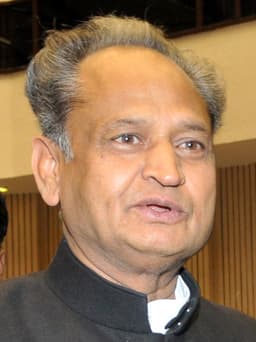
Ashok Gehlot
Politician · Modern
49.1Total

Sakai Tadakiyo
Politician · Modern
47.7Total
Basic Information
Born
1951
1624
Died
—
1681
Era
Modern
Modern
Nationality
India
Japan
Occupation
Politician
Politician
Civilization
Indian
Eastern
Score Comparison
Military (10%)
43.3
15.1
Political (20%)
68.0
68.0
Influence (20%)
49.4
48.6
Legacy (20%)
40.8
41.7
Leadership (15%)
40.0
72.0
Strategy (15%)
60.0
26.3
TOTAL
49.1
47.7
Ashok Gehlot — Complete Timeline
1998 AD
Became Chief Minister of Rajasthan for the first timePolitical Action◆ Major
Ashok Gehlot was sworn in as the Chief Minister of Rajasthan after leading the Indian National Congress to victory in the state assembly elections. This marked the beginning of his tenure as a three-time CM, overseeing various development and welfare schemes.
Chief MinisterRajasthanCongress
Impact: regionalconstructive
2004 AD
Appointed as Union Minister of TextilesPolitical Action
Gehlot served as the Union Minister of Textiles in the Manmohan Singh government. He oversaw the implementation of the National Textile Policy and initiatives to boost the textile sector, though his tenure was relatively low-profile.
Union MinisterTextilesUPA
Impact: nationalconstructive
2008 AD
Second term as Chief Minister of RajasthanPolitical Action◆ Major
Gehlot returned as Chief Minister after the Congress party won the 2008 Rajasthan assembly elections. His second term focused on education, health, and infrastructure, but also faced challenges like the 2008 financial crisis and drought.
Chief MinisterRajasthanCongress
Impact: regionalconstructive
2018 AD
Third term as Chief Minister of RajasthanPolitical Action◆ Major
Gehlot became Chief Minister for a third time after the Congress won the 2018 Rajasthan elections. His tenure included implementation of welfare schemes like the Chiranjeevi Health Insurance Scheme and faced political challenges from within the party.
Chief MinisterRajasthanCongress
Impact: regionalconstructive
Sakai Tadakiyo — Complete Timeline
1657 AD
Management of the Great Fire of Meireki AftermathPolitical Action◆ Major
Following the catastrophic Great Fire of Meireki that destroyed much of Edo, Tadakiyo oversaw reconstruction efforts including urban planning reforms. The fire led to the redesign of Edo with wider streets and firebreaks, shaping the city's modern layout.
Urban planningDisaster responseEdo
Impact: nationalconstructive
1666 AD
Appointment as TairoPolitical Action◆ Major
Sakai Tadakiyo was appointed as tairo (great elder), the highest advisory position in the Tokugawa shogunate under Shogun Tokugawa Ietsuna. This made him the de facto ruler of Japan during Ietsuna's minority and weak rule.
AppointmentTairoTokugawa Ietsuna
Impact: nationalconstructive
Domination of the Shogunate AdministrationPolitical Action◆ Major
As tairo, Tadakiyo centralized power in his own hands, controlling appointments, foreign policy, and domestic affairs. He sidelined other senior councilors and ruled through a network of loyal officials, maintaining stability but concentrating authority.
Power consolidationTokugawa shogunateAdministration
Impact: national
1680 AD
Loss of Power after Ietsuna's DeathPolitical Action◆ Major
Upon Shogun Ietsuna's death, Tadakiyo attempted to install a candidate from the imperial family as the next shogun but was outmaneuvered by rivals who supported Tokugawa Tsunayoshi. He was forced to retire, ending his dominance.
Power struggleRetirementTokugawa Tsunayoshi
Impact: nationaltragic
This comparison has not been analyzed yet.
One-time AI generation (~1 minute). Scores and timeline are already available below.
Rankings
🥇
Ashok GehlotLeader
Mil: 43.3Pol: 68.0Inf: 49.4
49.1
🥈
Sakai Tadakiyo
Mil: 15.1Pol: 68.0Inf: 48.6
47.7
+1.4 behind
How This Comparison Works
Algorithm
Each figure is scored on 6 dimensions (0—100 scale) based on structured historical data: Military (10%), Political (20%), Influence (20%), Legacy (20%), Leadership (15%), Strategy (15%). The weighted total produces the final ranking.
Data Sources
Scores are computed from structured sub-indicators in the database. Scale factors adjust for era (Ancient ×0.85, Modern ×1.0) and civilization size (Eastern ×1.05, Other ×0.80) to account for differences in population and military scale.
Maximum 3 Figures
Comparisons are limited to 2—3 figures to ensure readability and statistical meaningfulness.
Error Margins
±5 points per dimension — Sub-scores are derived from historical records with inherent uncertainty. Two figures within 5 points on a dimension should be considered roughly equivalent in that area.
Total Score Accuracy
±3 points overall — The weighted combination of 6 dimensions produces a total score with approximately ±3 points of uncertainty. Differences of less than 3 points are not statistically significant— the figures are effectively tied.
Known Limitations
- Historical records are incomplete and uneven across civilizations
- Figures from oral-tradition societies may be underrepresented
- Occupation labels can misclassify multi-role figures
- Scores measure capability and impact, not moral character
- Quantitative scoring is a comparison tool, not absolute truth
Capability Radar
Military (10%) — Battles & Warfare
Battles
41
11
Win Rate
47
16
Expansion
51
23
Political (20%) — Governance & Reform
Reform
40
55
Diplomacy
50
60
Economy
45
50
Influence (20%) — Cultural & Global Reach
Cultural
20
20
Global
15
10
Legacy (20%) — Historical Impact
Historical
25
30
Longevity
20
20
Leadership (15%) — Power & Stability
Tenure
45
65
Stability
50
55
Strategy (15%) — Tactics & Innovation
Strategy
51
26
Tactics
57
24
Reform
59
30
Similar Comparisons
Comments & Discussion
No comments yet. Be the first to share your thoughts!