Loading...
Asif Ali Zardari vs Minoo Masani
Minoo Masani leads by 4.9 pts · 2 figures compared
…
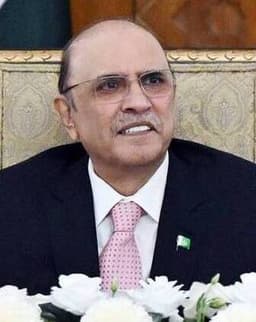
Asif Ali Zardari
Politician · Modern
49.2Total

Minoo Masani
Politician · Modern
54.1Total
Basic Information
Born
1955
1905
Died
—
1998
Era
Modern
Modern
Nationality
Pakistan
India
Occupation
Politician
Politician
Civilization
Indian
Indian
Score Comparison
Military (10%)
47.5
39.1
Political (20%)
37.9
55.0
Influence (20%)
51.0
54.9
Legacy (20%)
41.7
45.8
Leadership (15%)
64.0
72.0
Strategy (15%)
60.0
60.0
TOTAL
49.2
54.1
Asif Ali Zardari — Complete Timeline
1987 AD
Married Benazir BhuttoPolitical Action
Asif Ali Zardari married Benazir Bhutto, the former Prime Minister of Pakistan. The marriage was politically significant, uniting two influential political families.
MarriageBenazir BhuttoPolitical Alliance
Impact: nationalconstructive
1996 AD
Imprisoned on Corruption ChargesPolitical Action◆ Major
Zardari was arrested and imprisoned on corruption charges following the dismissal of Benazir Bhutto's government. He spent over eight years in prison, earning the nickname 'Mr. 10 Percent' for alleged kickbacks.
ImprisonmentCorruptionPolitical Persecution
Impact: nationaldestructive
2007 AD
Assassination of Benazir BhuttoPolitical Action
Benazir Bhutto was assassinated in a suicide attack after a political rally in Rawalpindi. Zardari became the co-chairman of the Pakistan Peoples Party (PPP) following her death.
AssassinationBenazir BhuttoPPP
Impact: nationaltragic
2008 AD
Elected President of PakistanPolitical Action◆ Major
Zardari was elected as the 11th President of Pakistan by the electoral college. He served from 2008 to 2013, during a period of political instability and conflict with the judiciary.
PresidencyPPPHead of State
Impact: nationalconstructive
2010 AD
Repealed the 17th Constitutional AmendmentReform
Zardari signed the 18th Constitutional Amendment, which repealed the 17th Amendment and devolved powers from the presidency to the prime minister and provinces. This restored parliamentary democracy.
Constitutional AmendmentDevolutionParliamentary Democracy
Impact: nationalconstructive
2013 AD
End of Presidential TermPolitical Action
Zardari's presidential term ended, and he was succeeded by Mamnoon Hussain. He returned to a role in the PPP leadership, focusing on party politics.
Presidential TermSuccessionPPP
Impact: national
Minoo Masani — Complete Timeline
1943 AD
Served as Mayor of BombayPolitical Action
Masani was elected Mayor of Bombay (now Mumbai) during World War II. He focused on municipal administration and civic issues, though his tenure was brief and overshadowed by the war and independence movement.
Municipal GovernmentMayor
1955 AD
Authored 'Socialism Reconsidered'Cultural
Masani published the book 'Socialism Reconsidered', arguing against state-controlled socialism and for a mixed economy with strong private sector. The book influenced Indian economic debates and helped shape the Swatantra Party's ideology.
BookEconomic PolicyIdeology
Impact: nationalconstructive
1957 AD
Served as Member of Parliament (Lok Sabha)Political Action
Masani was elected to the Lok Sabha from the Rajkot constituency. He served as a prominent opposition voice, criticizing the Congress government's economic policies and advocating for private enterprise.
ParliamentOppositionPolitics
Impact: national
1959 AD
Co-founded the Swatantra PartyPolitical Action◆ Major
Minoo Masani, along with C. Rajagopalachari and others, founded the Swatantra Party in Bombay. The party advocated for free-market economics, limited government, and individual liberties, opposing the socialist policies of the Congress Party.
Free MarketPolitical PartyLiberalism
Impact: nationalconstructive
Expert Analysis
Origins
Asif Ali Zardari was born on July 26, 1955, in Karachi, Pakistan, into a landowning family from Sindh. His father, Hakim Ali Zardari, was a businessman and politician. Zardari studied at the Cadet College Petaro but did not complete a university degree. He entered politics through his marriage to Benazir Bhutto in 1987, which united the Bhutto political dynasty with the Zardari family's influence.
Minoo Masani was born on November 20, 1905, in Bombay, India, into a Parsi family. His father, Sir Rustom Masani, was a civil servant. Masani studied at the London School of Economics, where he was influenced by socialist ideas, later shifting to classical liberalism. He was a member of the Indian National Congress before diverging from its socialist path.
Rise to Power
Zardari's rise was tied to Benazir Bhutto. After their marriage, he served as a federal minister during her first term (1988-1990) but was dismissed amid corruption allegations. He was imprisoned for over eight years, gaining notoriety as 'Mr. 10%'. Following Bhutto's assassination in 2007, Zardari became co-chairman of the Pakistan Peoples Party (PPP). In 2008, he was elected President of Pakistan by the electoral college, a role he held until 2013.
Masani rose through local politics. He was elected Mayor of Bombay in 1943 during World War II. He served in the Constituent Assembly of India but opposed the Congress party's economic policies. In 1959, he co-founded the Swatantra Party with C. Rajagopalachari, advocating free markets and limited government. He was elected to the Lok Sabha in 1962 from Rajkot, becoming a leading opposition voice.
Leadership & Governance
Zardari's leadership score of 64.0 reflects his pragmatic, deal-making style. As president, he signed the 18th Constitutional Amendment in 2010, devolving powers from the presidency to the prime minister and provinces, a move that reduced his own authority. He faced criticism for corruption and weak governance, with Pakistan's democracy score declining during his tenure. His strategy score of 60.0 indicates his ability to navigate political alliances, but his military score of 47.5 suggests limited influence over security policy.
Masani scored 72.0 in leadership, driven by his ideological consistency. As a parliamentarian, he championed free-market reforms, criticizing Nehru's socialist model. He authored 'Socialism Reconsidered' and argued for a mixed economy. However, his political influence remained limited; his Swatantra Party never won more than 44 seats in the Lok Sabha. His military score of 39.1 reflects his focus on civilian governance.
Triumph & Tragedy
Zardari's greatest success was the 18th Amendment, which strengthened democracy by limiting presidential powers. He also oversaw a peaceful transition of power in 2013, a rarity in Pakistan. His tragedy was his corruption-tainted reputation; he spent years in prison and was widely seen as a symbol of cronyism. His total score of 49.2 reflects these mixed outcomes.
Masani's triumph was his intellectual contribution to liberal economics in India. He co-founded the Swatantra Party, which influenced later economic reforms. His tragedy was the party's electoral failure; it dissolved by 1974. His total score of 54.1 edges out Zardari, but his impact was limited to ideas rather than governance.
Character & Destiny
Zardari was a survivor, adept at forming coalitions. His pragmatism helped him weather crises, but his lack of ideological grounding made him vulnerable to charges of opportunism. Masani was a principled liberal, but his rigid ideology limited his political appeal. Both men were shaped by their contexts: Zardari in a fragile democracy, Masani in a dominant-party system.
Legacy
Zardari's legacy is mixed: the 18th Amendment endures, but his corruption allegations tarnish the PPP. Masani's legacy is as a pioneer of Indian libertarianism, influencing later pro-market policies. In terms of concrete governance, Zardari had more direct impact; in terms of ideas, Masani's influence is longer-lasting.
Conclusion
Minoo Masani scores higher overall (54.1 vs 49.2) and in leadership (72.0 vs 64.0). While Zardari enacted constitutional reforms, his governance was marred by corruption. Masani's principled advocacy for free markets planted seeds that later bore fruit in India's 1991 reforms. Despite his limited electoral success, Masani's intellectual legacy has had a more profound and lasting impact on economic policy. Therefore, Minoo Masani had greater historical impact.
Rankings
🥇
Minoo MasaniLeader
Mil: 39.1Pol: 55.0Inf: 54.9
54.1
🥈
Asif Ali Zardari
Mil: 47.5Pol: 37.9Inf: 51.0
49.2
+4.9 behind
How This Comparison Works
Algorithm
Each figure is scored on 6 dimensions (0—100 scale) based on structured historical data: Military (10%), Political (20%), Influence (20%), Legacy (20%), Leadership (15%), Strategy (15%). The weighted total produces the final ranking.
Data Sources
Scores are computed from structured sub-indicators in the database. Scale factors adjust for era (Ancient ×0.85, Modern ×1.0) and civilization size (Eastern ×1.05, Other ×0.80) to account for differences in population and military scale.
Maximum 3 Figures
Comparisons are limited to 2—3 figures to ensure readability and statistical meaningfulness.
Error Margins
±5 points per dimension — Sub-scores are derived from historical records with inherent uncertainty. Two figures within 5 points on a dimension should be considered roughly equivalent in that area.
Total Score Accuracy
±3 points overall — The weighted combination of 6 dimensions produces a total score with approximately ±3 points of uncertainty. Differences of less than 3 points are not statistically significant— the figures are effectively tied.
Known Limitations
- Historical records are incomplete and uneven across civilizations
- Figures from oral-tradition societies may be underrepresented
- Occupation labels can misclassify multi-role figures
- Scores measure capability and impact, not moral character
- Quantitative scoring is a comparison tool, not absolute truth
Capability Radar
Military (10%) — Battles & Warfare
Battles
42
41
Win Rate
45
48
Expansion
51
51
Political (20%) — Governance & Reform
Reform
25
70
Diplomacy
40
55
Economy
20
75
Influence (20%) — Cultural & Global Reach
Cultural
20
30
Global
25
30
Legacy (20%) — Historical Impact
Historical
30
40
Longevity
20
35
Leadership (15%) — Power & Stability
Tenure
60
60
Stability
15
50
Strategy (15%) — Tactics & Innovation
Strategy
54
51
Tactics
57
57
Reform
61
59
Similar Comparisons
Comments & Discussion
No comments yet. Be the first to share your thoughts!