Loading...
This comparison has not been analyzed yet.
One-time AI generation (~1 minute). Scores and timeline are already available below.
Aslan Maskhadov vs Bharrat Jagdeo
Bharrat Jagdeo leads by 6.8 pts · 2 figures compared
…
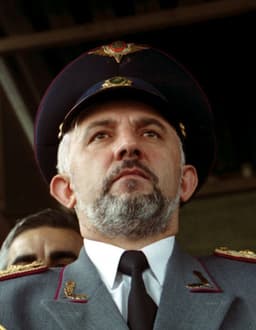
Aslan Maskhadov
Politician · Modern
47.3Total

Bharrat Jagdeo
Politician · Modern
54.1Total
Basic Information
Born
1951
1964
Died
—
—
Era
Modern
Modern
Nationality
Chechnya
Guyana
Occupation
Politician
Politician
Civilization
Western
Western
Score Comparison
Military (10%)
50.0
50.0
Political (20%)
36.5
72.0
Influence (20%)
54.1
51.8
Legacy (20%)
44.2
40.8
Leadership (15%)
51.9
72.0
Strategy (15%)
45.0
43.5
TOTAL
47.3
54.1
Aslan Maskhadov — Complete Timeline
1997 AD
Elected President of IchkeriaPolitical Action◆ Major
Aslan Maskhadov was elected as the second president of the Chechen Republic of Ichkeria after Dudayev's death. He won a democratic election but faced challenges from radical factions within Chechnya.
ChechnyaElectionIchkeria
Impact: regionalconstructive
1999 AD
Second Chechen War BeginsWar
Russian forces launched a second invasion of Chechnya after the apartment bombings in Russia. Maskhadov led the Chechen resistance but was unable to prevent Russian forces from capturing Grozny and establishing control.
Chechen WarRussiaInvasion
Impact: regionaltragic
2005 AD
Killed by Russian ForcesWar◆ Major
Maskhadov was killed by Russian special forces during a raid in the village of Tolstoy-Yurt. His death was a major victory for Russia in the Second Chechen War. He was succeeded by radical leaders.
AssassinationChechnyaRussia
Impact: regionaltragic
Bharrat Jagdeo — Complete Timeline
1999 AD
Became President of GuyanaPolitical Action◆ Major
Jagdeo became President of Guyana in August 1999, succeeding Janet Jagan who resigned due to health reasons. He was the youngest head of state in the Americas at the time.
PresidencySuccession
Impact: national
2001 AD
Re-elected PresidentPolitical Action◆ Major
Jagdeo won the 2001 presidential election, securing a full five-year term. The election was marred by allegations of fraud and post-election violence.
ElectionRe-election
Impact: national
2006 AD
Re-elected for a Second Full TermPolitical Action◆ Major
Jagdeo was re-elected in 2006 with a reduced majority. His second term focused on economic diversification, infrastructure development, and attracting foreign investment.
ElectionRe-election
Impact: national
2015 AD
Oversaw the Discovery of Offshore OilOther
During Jagdeo's tenure, ExxonMobil discovered significant offshore oil reserves in 2015. This discovery transformed Guyana's economic prospects, though it also raised concerns about governance and environmental impact.
Oil DiscoveryEconomic Transformation
Impact: nationalconstructive
2020 AD
Became Vice President of GuyanaPolitical Action◆ Major
After the PPP won the 2020 elections, Jagdeo became Vice President under President Irfaan Ali. He also retained his role as leader of the PPP, making him a key figure in the government.
Vice PresidencyPolitical Role
Impact: national
This comparison has not been analyzed yet.
One-time AI generation (~1 minute). Scores and timeline are already available below.
Rankings
🥇
Bharrat JagdeoLeader
Mil: 50.0Pol: 72.0Inf: 51.8
54.1
🥈
Aslan Maskhadov
Mil: 50.0Pol: 36.5Inf: 54.1
47.3
+6.8 behind
How This Comparison Works
Algorithm
Each figure is scored on 6 dimensions (0—100 scale) based on structured historical data: Military (10%), Political (20%), Influence (20%), Legacy (20%), Leadership (15%), Strategy (15%). The weighted total produces the final ranking.
Data Sources
Scores are computed from structured sub-indicators in the database. Scale factors adjust for era (Ancient ×0.85, Modern ×1.0) and civilization size (Eastern ×1.05, Other ×0.80) to account for differences in population and military scale.
Maximum 3 Figures
Comparisons are limited to 2—3 figures to ensure readability and statistical meaningfulness.
Error Margins
±5 points per dimension — Sub-scores are derived from historical records with inherent uncertainty. Two figures within 5 points on a dimension should be considered roughly equivalent in that area.
Total Score Accuracy
±3 points overall — The weighted combination of 6 dimensions produces a total score with approximately ±3 points of uncertainty. Differences of less than 3 points are not statistically significant— the figures are effectively tied.
Known Limitations
- Historical records are incomplete and uneven across civilizations
- Figures from oral-tradition societies may be underrepresented
- Occupation labels can misclassify multi-role figures
- Scores measure capability and impact, not moral character
- Quantitative scoring is a comparison tool, not absolute truth
Capability Radar
Military (10%) — Battles & Warfare
Battles
45
27
Win Rate
40
29
Expansion
10
37
Political (20%) — Governance & Reform
Reform
25
55
Diplomacy
40
65
Economy
15
70
Influence (20%) — Cultural & Global Reach
Cultural
30
20
Global
25
30
Legacy (20%) — Historical Impact
Historical
35
25
Longevity
20
20
Leadership (15%) — Power & Stability
Tenure
35
60
Stability
10
50
Strategy (15%) — Tactics & Innovation
Strategy
50
39
Tactics
55
42
Reform
30
44
Similar Comparisons
Comments & Discussion
No comments yet. Be the first to share your thoughts!